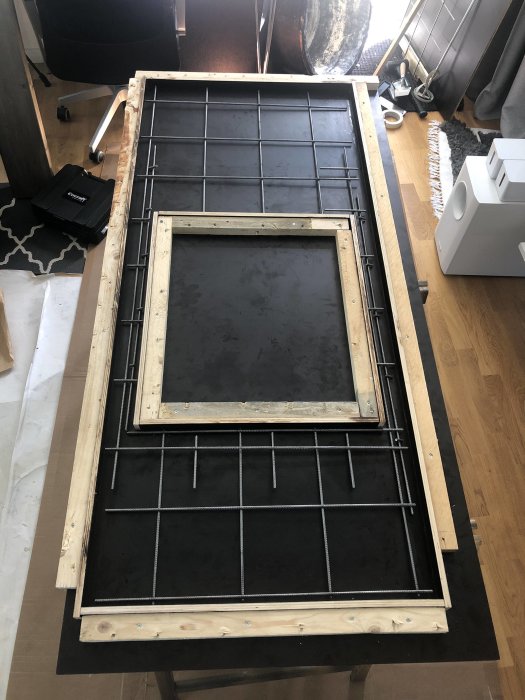
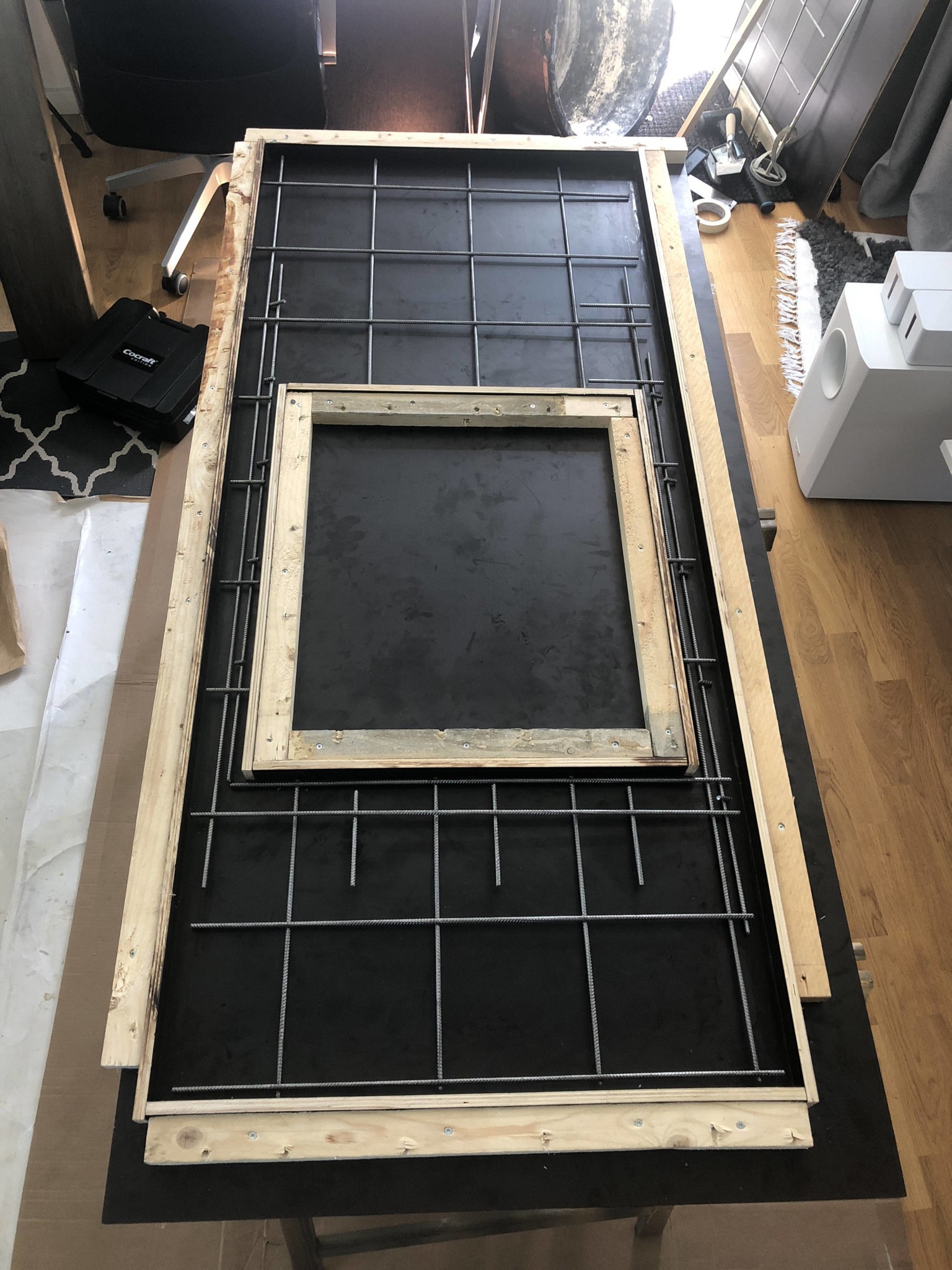
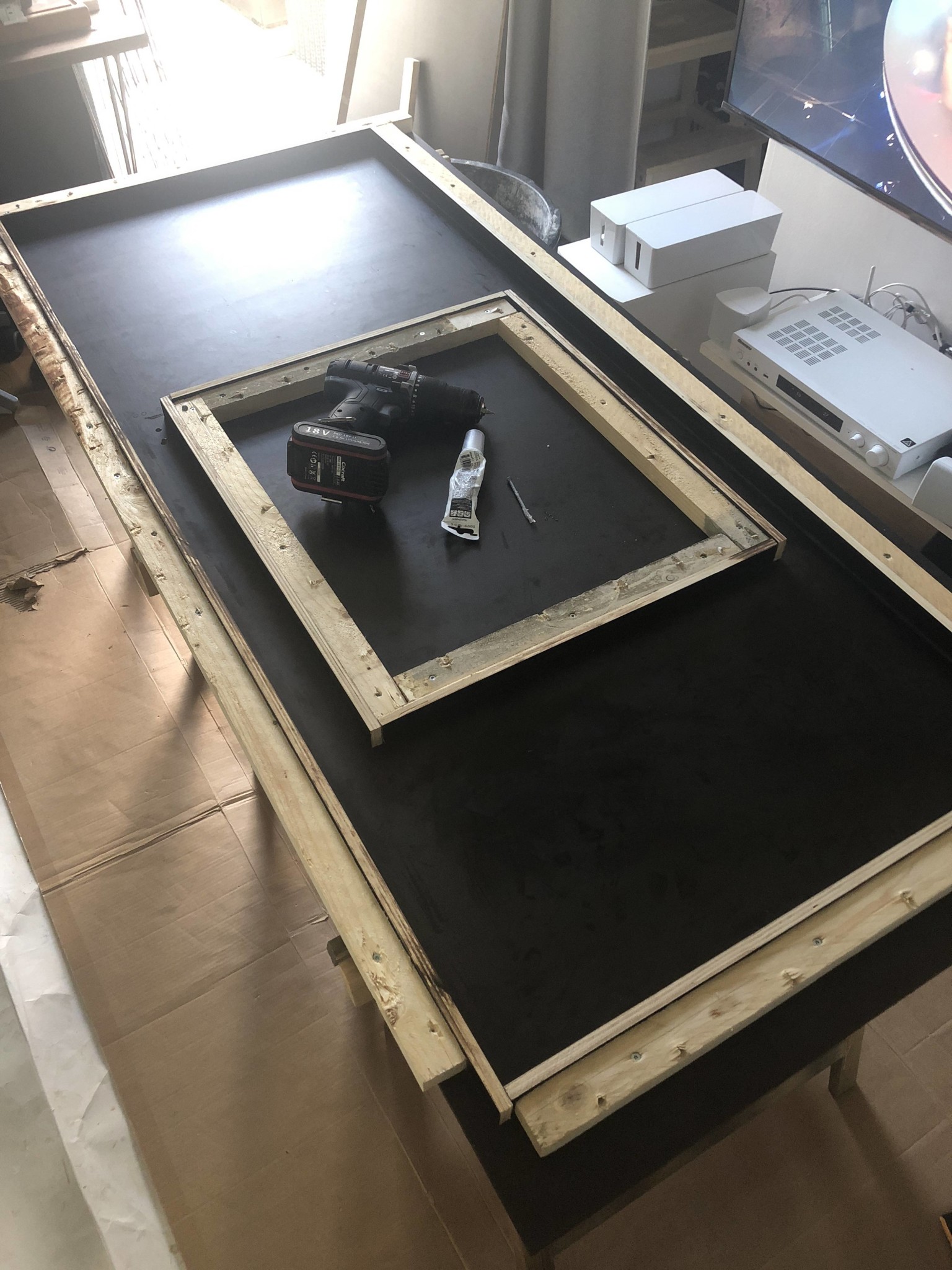
It's good to have metal along the edges, preferably bent so that they go around the corners. Normally, form oil is used for casting, but regular paraffin oil works fine for greasing the mold. You should rock or vibrate the concrete in the first layer and do the same after the reinforcement is placed. I see another issue; if you have such sharp edges, it will look odd and sharp. Perhaps place a thin triangular piece in the corners for rounding, but it can never be completely round without grinding. Vibrating can be done with a hammer drill on the underside, which allows the concrete to flow to the edges nicely.
There is silicone on what will become the front edge, creating a slight rounding. A larger rounding wouldn't look good on a bench that is only 3 cm high.
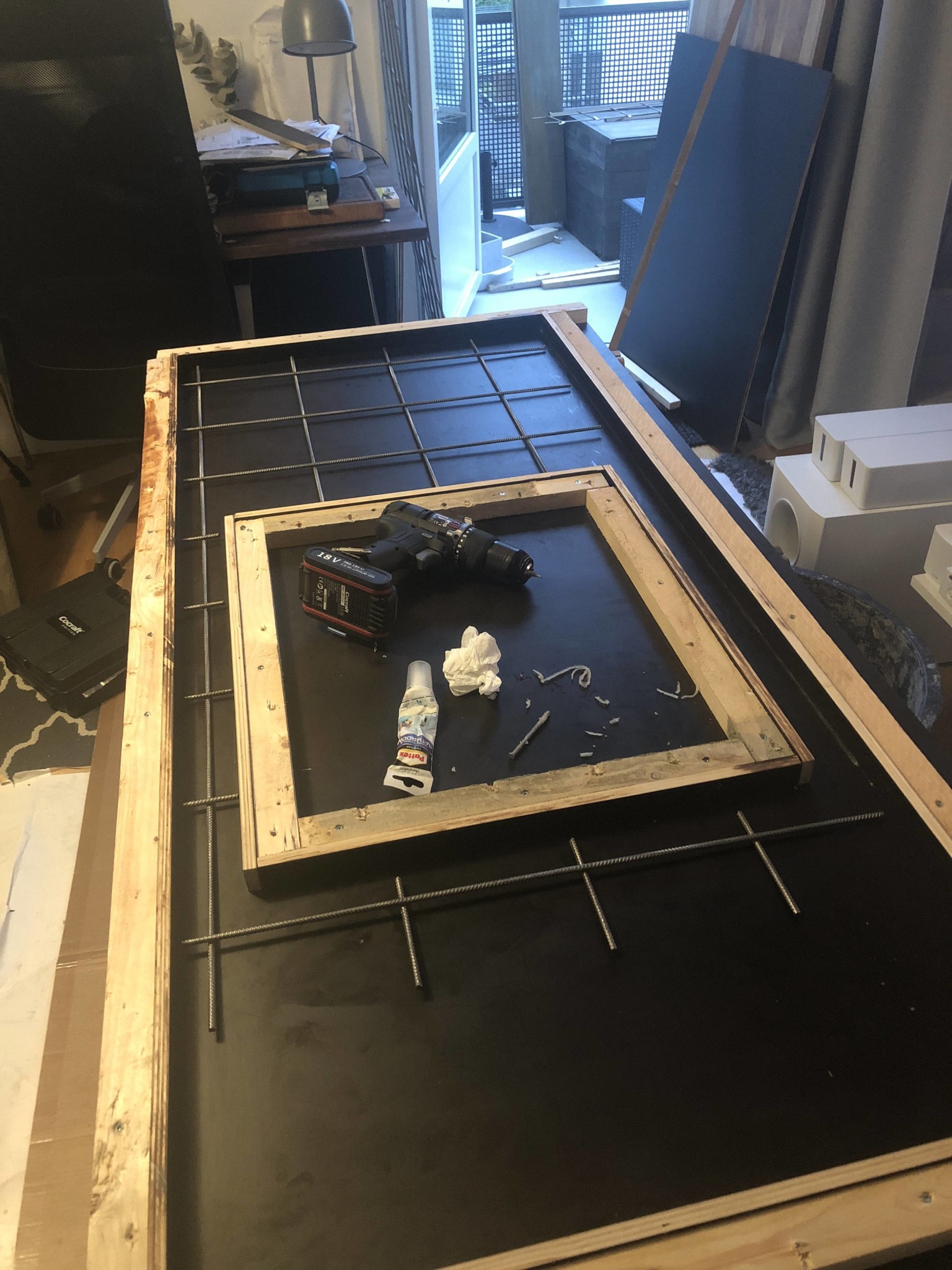
Need to get "iron" then, not sure if I can "bend" it myself (?). Is it enough to have iron just around all the outer corners, or should it be around the entire cut-out as well?
Not around the hole; it's the narrow piece that needs to be stiffened, otherwise it can break there. It's heavy stuff that needs to be moved, and it's easy for it to be lifted unevenly in some way. Bending 10 gauge iron is easy. If you have an aluminum ladder, insert the iron into the ladder hole and bend. If you hold the iron close to the ladder, the bend will be quite tight, or use a steel pipe that's fixed.
The question is then whether I might still be able to use the reinforcement I bought, which I was planning to throw away because it didn't cover the entire way. If it's enough to just place some loose pieces where it's missing.
Now it's starting to look like something, you have a cross in the corner and that's enough, feel free to put an extra iron on top in the narrow part, it doesn't need to be a 10, a 6 is enough, or you clip down the mat with some wings left and turn it upside down so it falls between, just builds a little more.
Edit saw that there was a piece left over but the same kind, not wrong.
I'm really afraid that this reinforcement is too thick and will leave visible marks in the concrete. I know that I should pour 75% and then shake the table with the rotary hammer. Then place the mesh. But after that, it becomes difficult. I shouldn't shake much after placing the mesh as it might leave marks, but it's still important to shake so everything settles properly?? What should I really do after I've placed the reinforcement and filled the concrete to the top?
I have used slightly thinner reinforcement from Biltema (4mm). It has worked great and has not left any marks, although I have cast at about 4cm thick.
I'm really afraid that this reinforcement is too thick and will leave visible marks in the concrete. I know that I should pour at 75% and then shake the table with the hammer drill. Then lay in the mesh. But after that, it becomes difficult. Ideally, I'm not supposed to shake more after laying the mesh as it can leave marks, but it's still important to shake so everything settles properly?? How should I actually do it after I've laid in the reinforcement and filled with concrete to the top?
I think you should be more afraid of cracking the slab at the narrow spots around the cutout. It's very flimsy there. Is there no way to cast a small beam (like a spring) innermost against the cutout?
I think the color difference you don't want is due to no aggregate getting between the form and the reinforcement. It will probably be more even if you use concrete with, say, 4mm stone but also if you increase the total thickness by a cm.
You should vibrate it until you're sure you have a smooth concrete against the mold, i.e., your visible top side and the edges all around. It's your corners that will be the most troublesome, both the outer corners and the cutout.
You can attach the reinforcement with stainless steel wire by adjusting the height before and hanging them on loose pins resting on the frame. This way, there's no risk of the reinforcement falling through, and you're sure it's at the right height.
I'm not entirely sure, but I would probably add half a cap of slip as long as the mold is sealed and completely level during casting.
If this were to succeed. Dare one? A lot of reinforcement on a countertop that's only 3cm thick. And nothing should "show" through the concrete on the visible sides. What are the odds, haha… dare I take a chance??
Pour the concrete really high so the reinforcement is as close to the bottom as possible without being exposed to air and risking rust…
Vibrate with a hammer drill before placing the reinforcement. And just lightly tap with a rubber mallet after the reinforcement is in? Or?
If this would succeed. Dare to try? A lot of reinforcement on just a 3cm thin countertop. And nothing should "shine" through the concrete on the visible sides. What are the odds, like, haha... dare to take a chance??
Pour the concrete really high up so the reinforcement is as far towards the bottom as possible without being exposed to air and risking rust...
Vibrate with a rotary hammer before placing the reinforcement. And just tap lightly with a rubber mallet after the reinforcement is in? Or?
[image]
You will never be able to lift that slab without it breaking with so little reinforcement. Not a chance. But try, the mold can be used again and it's not many liters of concrete.
You will never be able to lift that slab without it cracking with so little reinforcement. Not a chance. But try, the form can be used again and it's not many liters of concrete.
LITTLE reinforcement?
If there needs to be more reinforcement, I almost have to buy a denser mesh. Then it has to be a thinner mesh with that kind of floor reinforcement.

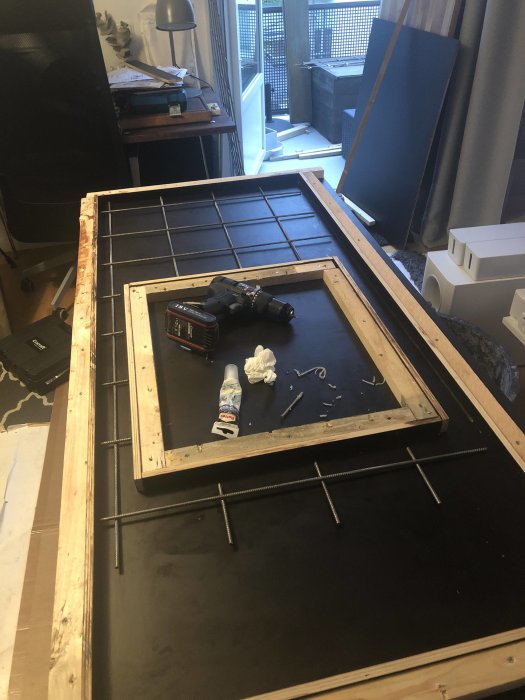

peterwesterlund said:
I'm really afraid that this reinforcement is too thick and will leave visible marks in the concrete. I know that I should pour at 75% and then shake the table with the hammer drill. Then lay in the mesh. But after that, it becomes difficult. Ideally, I'm not supposed to shake more after laying the mesh as it can leave marks, but it's still important to shake so everything settles properly?? How should I actually do it after I've laid in the reinforcement and filled with concrete to the top?