
9,146 views ·
13 replies
9k views
13 replies
How to attach braces in the best way (carport)
My stick-built carport wasn't as stable sideways as I had hoped. It stands steady but can "rock" somewhat sideways if you tug on the posts...
The solution will be braces at the 4 posts on each side of the 6 m long carport (attached to a shed at the back end).
Since the roof trusses and posts are not in the same place, I will attach a beam under the roof trusses so the brace can be fastened at the height of each post. But how do I attach the brace in the best way to the post, which is 90x90 glulam??
The solution will be braces at the 4 posts on each side of the 6 m long carport (attached to a shed at the back end).
Since the roof trusses and posts are not in the same place, I will attach a beam under the roof trusses so the brace can be fastened at the height of each post. But how do I attach the brace in the best way to the post, which is 90x90 glulam??
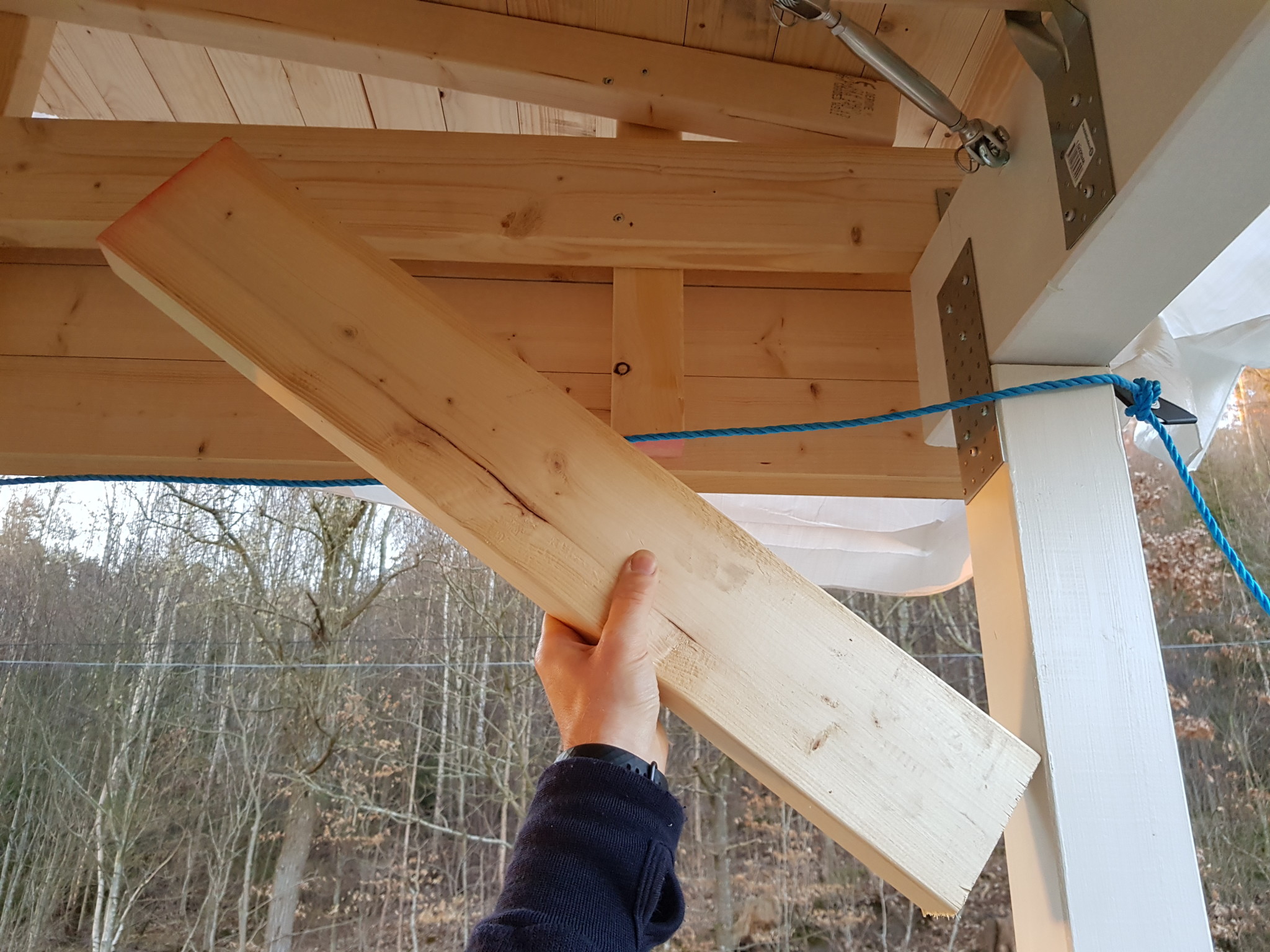
Joist hanger or a custom-made wrought iron bracket, depending on which fits better aesthetically.
Is it possible to place it on the other side?
Is it possible to place it on the other side?
What do you mean by the other side?Andreas_kalmar said:
Joist hangers and anchor screws are stable but perhaps not the most aesthetic. I'm not exactly a skilled blacksmith

It looks like the back of the post aligns with the roof truss with a 45 in between.
Ahh yes, that one probably does, but that's not how it looks on the other posts/roof trusses.
Edit, now that I see the picture I posted myself, it's not a roof truss you're seeing but just timber to attach the facade boards...
I would have cut at an angle in the right direction and then just screwed with long, strong wood screws, one from the lower edge of the brace and one from the upper edge. (No idea if that's how it's "supposed" to be done.)
I've also considered that solution, but I'm not sure it will have the right strength.Magnus E K said:
Exactly so. I would have taken the longest and thickest screw that can fit, maybe somewhere in the size 8x200, at the top edge, and two smaller ones at the bottom edge, maybe 6x100.
It's important to ensure that the grain of the brace runs more or less from flat side to flat side to minimize the risk of the brace cracking from the screws.
Since I am from the old school, I would also pre-drill the screw holes to minimize the risk of cracking.

I agree with the previous post. The loads probably won't be greater than what strong screws can handle. One could also consider strong (mostly for appearance's sake) angle irons at 135 degrees screwed from underneath, or alternatively flat irons from the sides. I would focus on the corner between the glulam beam and post and consider another solution for the gable wall. Which one, I cannot fully assess based on the picture.
Through-bolted carriage bolt M10 - 12 is usually very sturdy and those bolts hold well. Here, I would likely use twelves since you say you can move the construction by hand and since you're going through the thick glulam beam. If you find wide and thick square washers, it's good as they distribute the force from the bolt over a larger area and don't penetrate the wood as much when you tighten. Otherwise, use a nail plate and anchor nails.Buford said:
My stick-built carport wasn't as laterally stable as I had hoped. It's stable but can be "swung" slightly sideways if you pull on the posts...
The solution will be braces at the 4 posts on either side of the 6 m long carport (attached to a shed at the back end).
Since the rafters and posts aren't in the same place, I will attach a beam to the underside of the rafters so the brace can be attached in line with each post. But how do I best attach the brace to the post, which is 90x90 glulam?
I have never had the pleasure of trying to move a carport before, so I have nothing to compare it to. But now with the braces, it definitely feels stable, even if it's not completely rigid, which is explained by what you wrote. So I'll have to be satisfied with thatOldboy said:
Absolutely.
I have a "tractor shed" myself, which is now part of an outdoor box for our horses. The same type of construction with a roof on poles. Since it's a small building, LxWxH about 4x2.5x2 m, the stresses from weather and wind are relatively small. It's attached to the barn at the back. However, it now withstands massive sideways stresses as the horses scratch against the poles, especially in spring and fall when they shed their coats and grow a new one suited for the season. Imagine over 400 kg with four-wheel drive that pushes the rump at just over a meter high, pressing and moving... Lots of creaking happens... Yet it has held for 19 years now. Timber is tough!
So it should be fine even if it isn't rock-stable.
I have a "tractor shed" myself, which is now part of an outdoor box for our horses. The same type of construction with a roof on poles. Since it's a small building, LxWxH about 4x2.5x2 m, the stresses from weather and wind are relatively small. It's attached to the barn at the back. However, it now withstands massive sideways stresses as the horses scratch against the poles, especially in spring and fall when they shed their coats and grow a new one suited for the season. Imagine over 400 kg with four-wheel drive that pushes the rump at just over a meter high, pressing and moving... Lots of creaking happens... Yet it has held for 19 years now. Timber is tough!
So it should be fine even if it isn't rock-stable.
Click here to reply