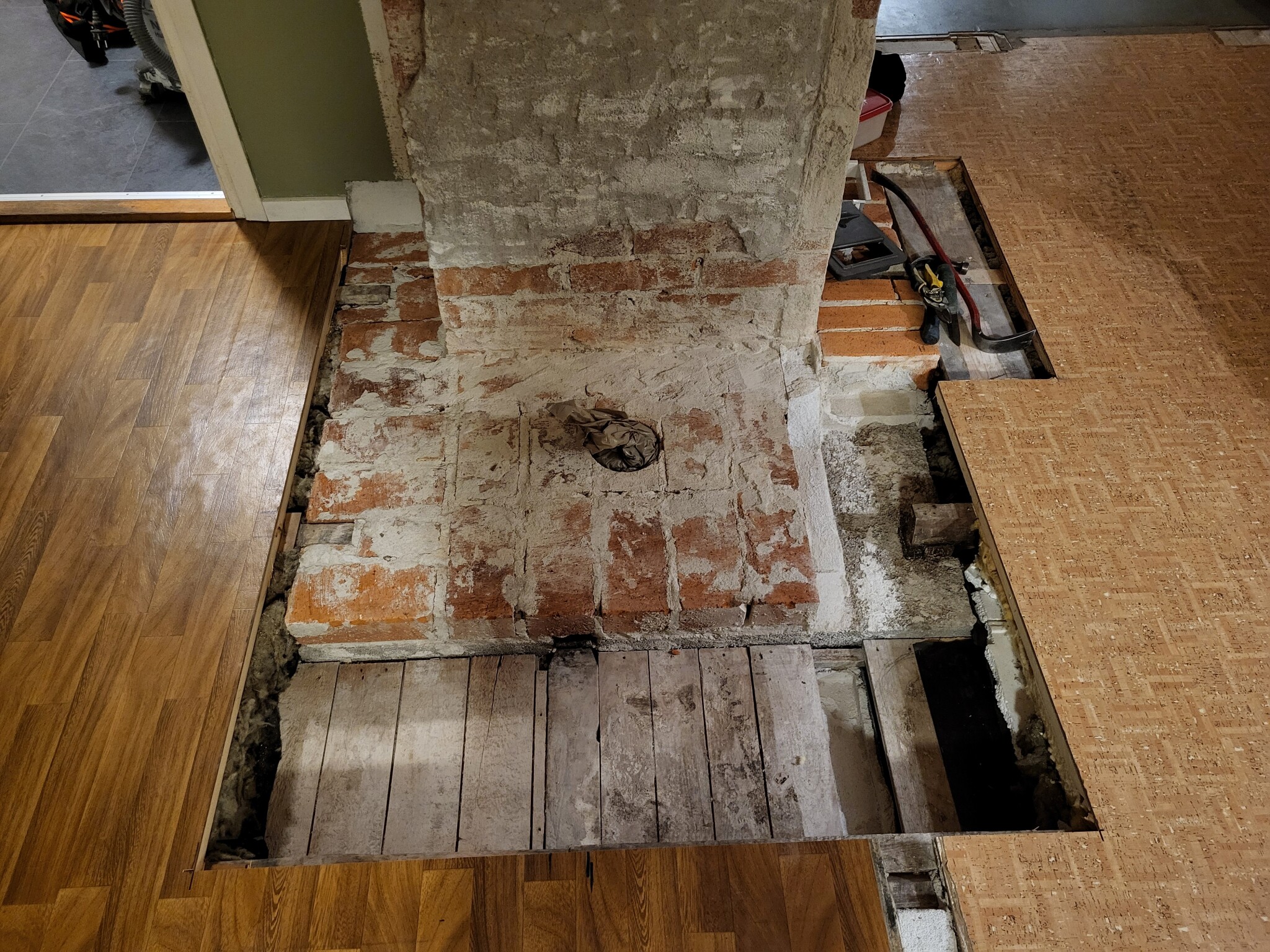
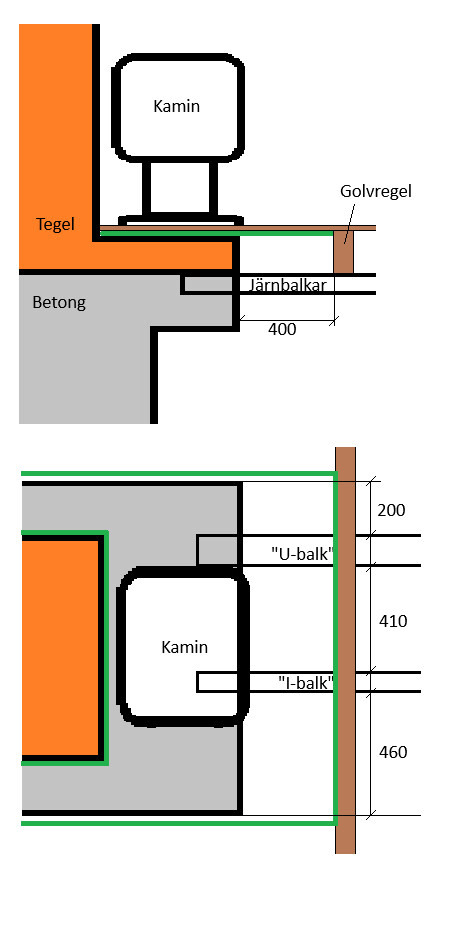
I would like to lay tiles in front of and under my stove in the "green area" below. The stove stands steadily on a part of the chimney stack, and the floor joists also partially rest on it.
Previously, the stove stood on a 15cm high plinth, and the spark guard consisted of a sheet lying on the vinyl floor, not super stylish in my opinion. Now the idea is for it to stand directly on the larger "tiled floor," and the vinyl outside will be replaced with parquet.
Without breaking off more bricks, I can make a slab that is about 3cm thick, which I assume is a bit weak to stand and walk on? I'm not quite confident that the wooden beam flexes zero and really don't want a crack in the tiles.
How would you proceed in my place?
Break off the entire layer of bricks and cast a slab about 10cm thick that is doweled into the chimney stack?
Break off every other brick to avoid casting so much?
Any other smart ideas?
I would like to lay tiles in front of and under my stove in the "green area" below.
The stove is firmly placed on a part of the chimney stack, and floor joists also partly rest on it.
Previously, the stove stood on a 15cm raised plinth, and the spark guard consisted of a metal plate on the plastic mat, not very stylish in my opinion.
Now the idea is for it to stand directly on the larger "tiled floor," and the plastic mat outside will be replaced with parquet.
Without removing more bricks, I can make a slab that is about 3cm thick. I assume it might be a bit weak to stand and walk on? I don't really trust the wooden beam not to flex and really don't want a crack in the tiles.
How would you proceed in my place?
Remove the entire brick layer and cast a slab about 10cm thick that is doweled into the chimney stack?
Remove every other brick to avoid casting too much?
Any other smart ideas?
Grateful for answers!
Would it be possible to screw in a construction plywood, do you think??
Would it be possible to screw on a construction plywood, perhaps??
Yes, it probably would, or...it probably depends on where you were thinking of screwing it on. Are you thinking that it would be sturdy enough to lay tiles on, or what do you mean?
Yes, it probably does, or...it probably depends on where you intended to screw it on? Do you mean it would be sturdy enough to lay tiles on, or how do you mean?
Yes if you get the board under the stove and place supports under and tile on top??
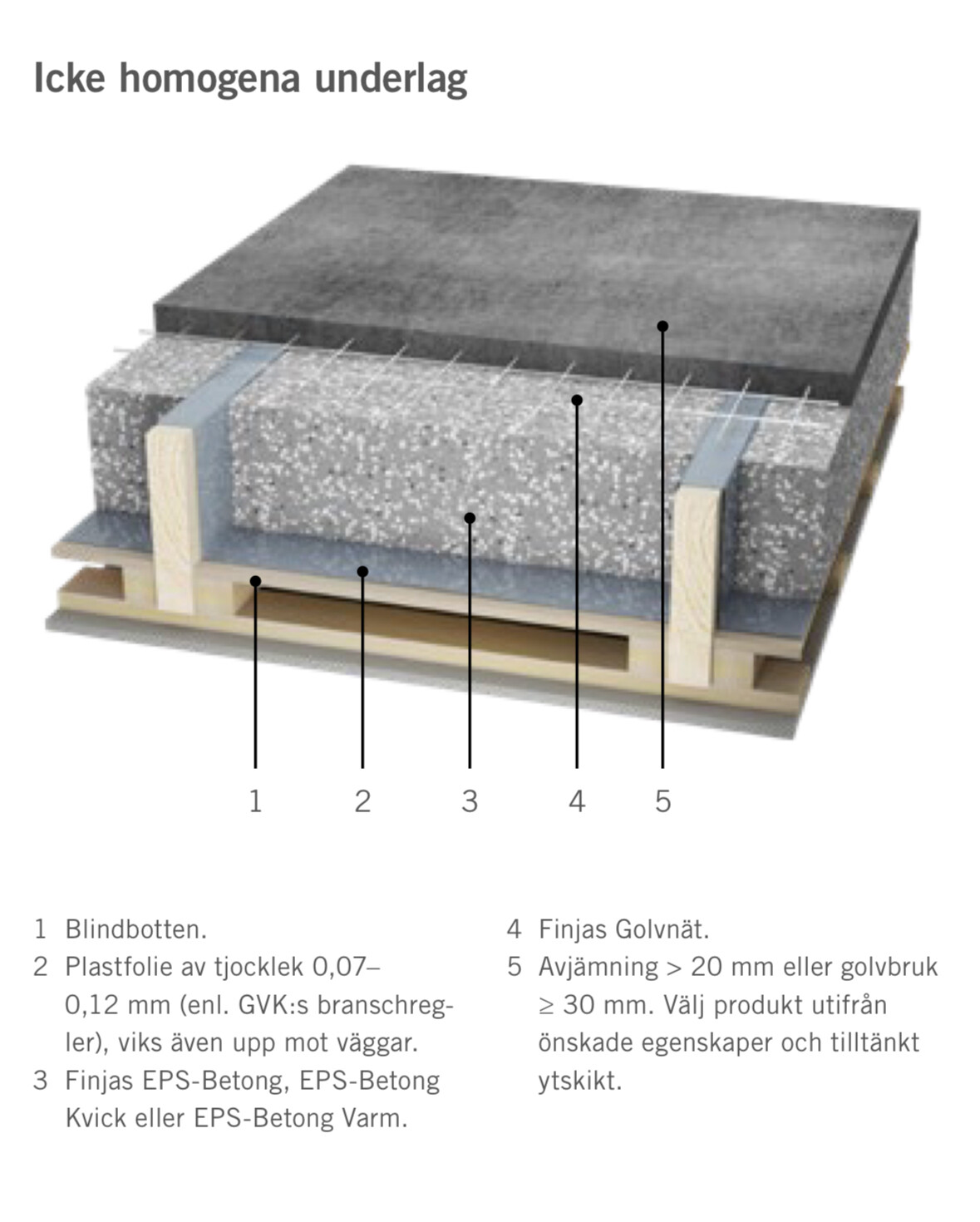
Pour with EPS concrete in the floor structure and then self-level 20-30mm:
Do you mean that would be enough?
That sounds really convenient, I'm a bit unsure about the thickness of the floor structure, I haven't quite removed the floor yet. I wonder how thick the EPS board would need to be? I would preferably have it as thin as possible.
Yes, if you slide the board under the stove and support it with blocks below and tile on top??
Yes, the stove isn't there yet, so that's not a problem.
What I'm a little unsure about is whether it will really be stable enough to tile on?
From what I understand, the surface needs to be quite rigid?
How thick would it need to be?
Do you think that would be enough?
It sounds really convenient, I'm a bit unsure about how thick the joist layer is, haven't really cut away the floor yet. I wonder how thick the EPS plate would need to be? I would prefer it to be as thin as possible.
Yes, this is designed for bathrooms in timber joist structures.
You make it as deep as you can, but you will need to create a subfloor, which you probably don't have today.
This will hold...
Yes, this is designed for bathrooms with wooden beams.
You make it as deep as you can, but you need to make a false floor that you probably don't have today.
This will hold..
Indeed, false floor exists, I just didn't include it in my excellent paint drawing.
Since it's not in the picture in your first post, I assume no reinforcement is needed to connect the EPS with the self-leveling compound slab? Do you prime, or is it okay without?
No reinforcement needed in the EPS?
I'll do some reading myself, but I got a bit eager when it suddenly seems so easy!😅
Yes, the blind bottom exists, I just didn't include it in my excellent paint drawing. Since it's not in the picture in your first post, I assume no reinforcement is needed to connect the EPS with the self-leveling compound slab? Do you need to prime, or is it okay anyway? No reinforcement needed in the EPS? I'll read up a bit myself, but I got a bit eager when it suddenly seems so simple!😅
No reinforcement in the EPS, it is a filler, and you want to get a rigid floor.
No reinforcement in the EPS, it's for filling and to get a rigid floor..
Okay, yes, it's this rigid floor issue that I'm a bit worried about. The floor beam I've drawn in flexes a little when you step on it, while the chimney and its "shelf" are rigid. If the EPS concrete acts as "support/bracing" against the chimney and that's enough, then I'm at ease. However, if it also relies on the EPS block supporting the wooden beam, then I become a bit uncertain. Those steel studs I've drawn aren't particularly thick, this was built as a summer cabin in the 60s. But maybe I'm just worrying too much? 😅 A 30mm self-leveling screed board is quite sturdy as well.
Alright!
Let's get started slowly!
I cut away the remaining floor and removed the insulation.
If no one stops me, I'll buy EPS concrete on my way home from work today and get going.
I'm quite tempted to spend half an hour breaking away the outermost row of bricks to get a thicker layer of EPS in the transition to the trossbotten, is it just unnecessary?
If nothing else, it will be better insulated?
Reinforcement in the EPS?
Dad thought I should place a 3-5 cm XPS board at the bottom against the trossbotten, is that a bad idea?
There, tonight I got help from my dad to take one step closer!
It feels good that it has transitioned from tearing down to building up!
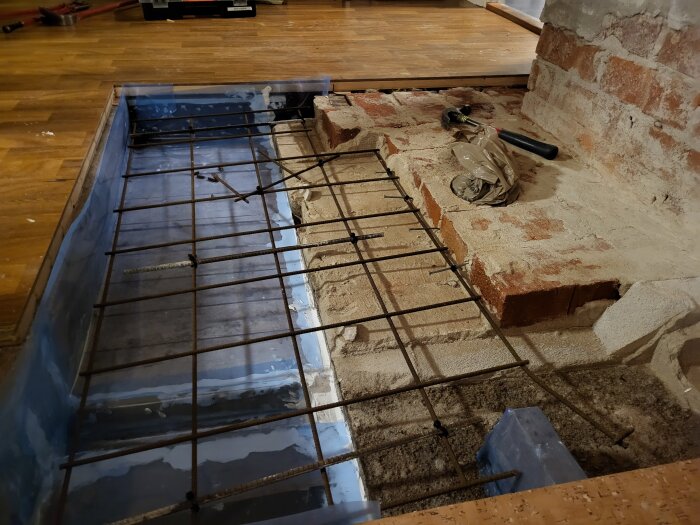
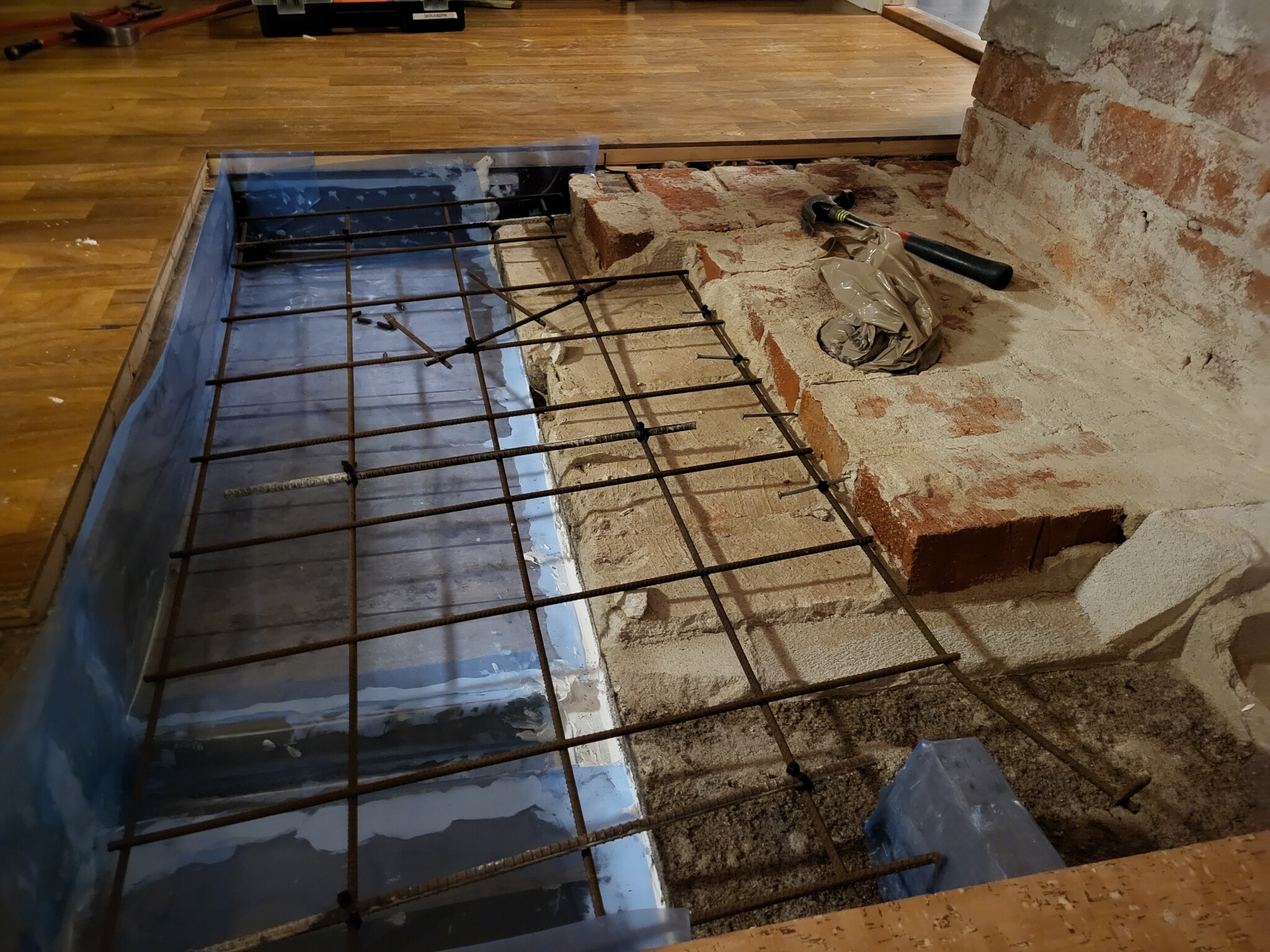
I got a feeling and removed the row of bricks closest to the joint, and threw in some rebar I had lying around:
I don't know if it makes any difference at all, but it can hardly hurt, I think.
So now it's just a matter of waiting, hopefully pouring leveling compound on Saturday morning.
The area outside the row of bricks on the right side of the chimney won't get tiles, there will just be parquet, filled in an old hole after a ledge where the kitchen stove stood, mostly because there was a bit of leftover EPS.
Vi vill skicka notiser för ämnen du bevakar och händelser som berör dig.

Lostmoose said:
I would like to lay tiles in front of and under my stove in the "green area" below.