

Hello!
It's soon time to start putting up walls in my little basement project. I'm going to build bedrooms for the kids and need some advice since I find different recommendations everywhere.
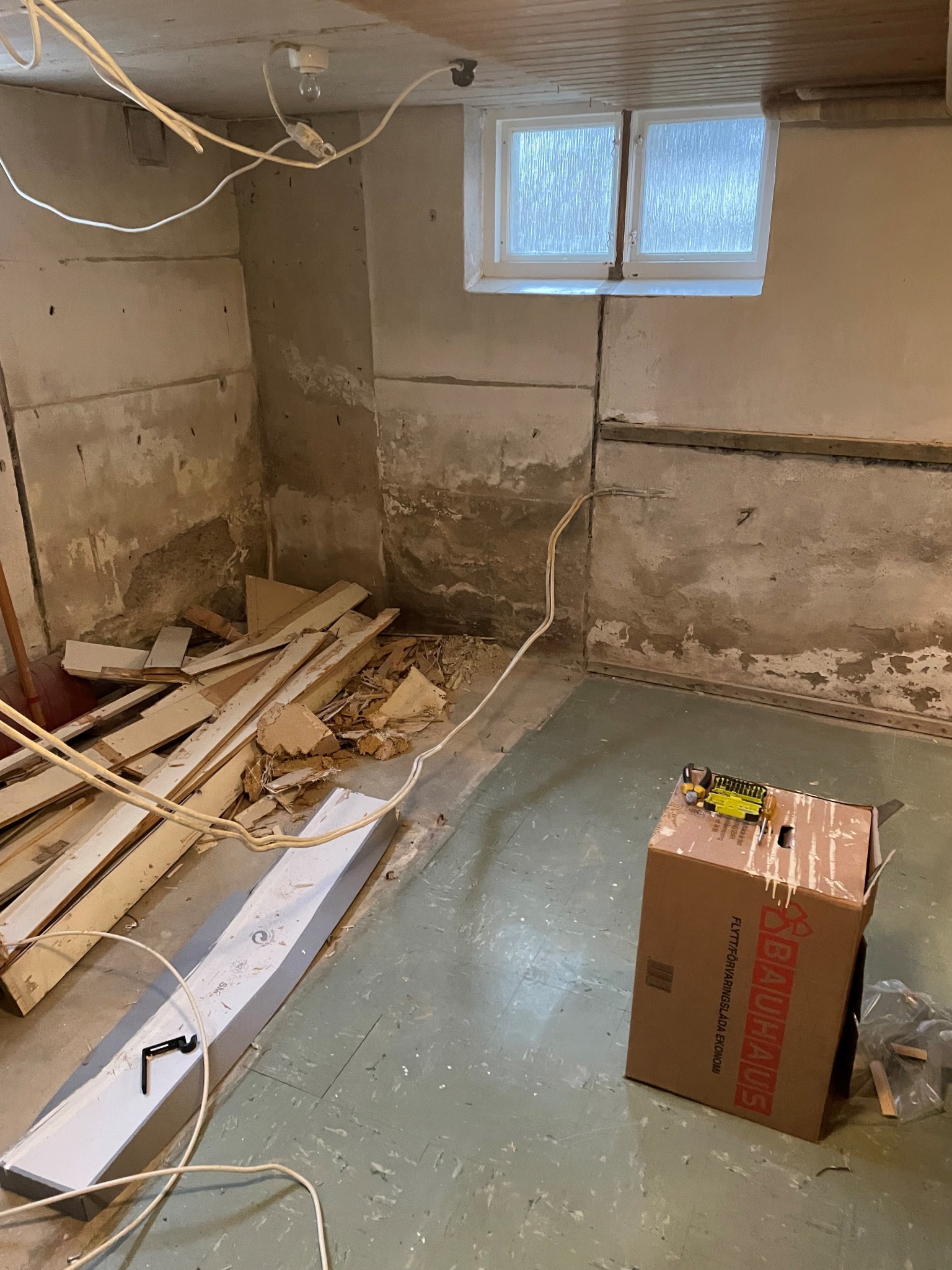
The lady we bought the house from used this room as a bedroom without any issues, but I tore everything down because it was old and shabby.
Drainage was done around 2014, so it's dry and nice.
When I tore everything down, the setup was as follows, from outside to inside: Concrete wall, plastic cover, horizontal wooden studs nailed into the concrete, vertical wooden studs nailed onto these, insulation, drywall, wallpaper.
The basement is partly above/below ground and the boundary is approximately at the height of the cord going through the wall/stud just above.
My first thought was to place metal studs a few centimeters away from the outer wall, insert insulation boards into the U-shape of the studs, put up drywall and then another layer of drywall or a different board material. This is where I get uncertain, as on some sites it is recommended to use a vapor barrier/plastic, and on some sites, it's not. Also, some places suggest inserting insulation between the studs and the wall in addition to the layer that should sit "inside the studs."
How would you have done it? The pictures are before and after the demolition.
It's soon time to start putting up walls in my little basement project. I'm going to build bedrooms for the kids and need some advice since I find different recommendations everywhere.
The lady we bought the house from used this room as a bedroom without any issues, but I tore everything down because it was old and shabby.
Drainage was done around 2014, so it's dry and nice.
When I tore everything down, the setup was as follows, from outside to inside: Concrete wall, plastic cover, horizontal wooden studs nailed into the concrete, vertical wooden studs nailed onto these, insulation, drywall, wallpaper.
The basement is partly above/below ground and the boundary is approximately at the height of the cord going through the wall/stud just above.
My first thought was to place metal studs a few centimeters away from the outer wall, insert insulation boards into the U-shape of the studs, put up drywall and then another layer of drywall or a different board material. This is where I get uncertain, as on some sites it is recommended to use a vapor barrier/plastic, and on some sites, it's not. Also, some places suggest inserting insulation between the studs and the wall in addition to the layer that should sit "inside the studs."
How would you have done it? The pictures are before and after the demolition.

Hello
I am currently finishing a bedroom for my daughter in the basement. I hired a company that plastered the walls, and then I painted with a vapor-open paint. It turned out very nice, and it avoids the future risks of moisture that framed walls entail.
I am currently finishing a bedroom for my daughter in the basement. I hired a company that plastered the walls, and then I painted with a vapor-open paint. It turned out very nice, and it avoids the future risks of moisture that framed walls entail.

What did the studs you dismantled look like? The wall seems to have been quite damp previously.
How it functioned before can give a clue as to what might work now - if you have drained and also INSULATED the wall externally, you have moved the dew point outward in the construction, which is good. However, any form of internal insulation is a risk, there's no getting around it.
If you still want to stud internally, then it should be metal studs with some insulation in between, and you should have an air gap to the wall. This space must also be ventilated. I have just done this on an outer wall, 3m wide, and then placed vents high up by the ceiling and by the floor - there seems to be a good airflow there right now, but I have still prepared to use a fan.
If children are going to live there, it might also be a good idea to conduct a radon measurement, and you might want to seal a bit extra between the slab and the wall as a first measure if you have radon. If it's significant, of course, other measures are needed as well.
How it functioned before can give a clue as to what might work now - if you have drained and also INSULATED the wall externally, you have moved the dew point outward in the construction, which is good. However, any form of internal insulation is a risk, there's no getting around it.
If you still want to stud internally, then it should be metal studs with some insulation in between, and you should have an air gap to the wall. This space must also be ventilated. I have just done this on an outer wall, 3m wide, and then placed vents high up by the ceiling and by the floor - there seems to be a good airflow there right now, but I have still prepared to use a fan.
If children are going to live there, it might also be a good idea to conduct a radon measurement, and you might want to seal a bit extra between the slab and the wall as a first measure if you have radon. If it's significant, of course, other measures are needed as well.
Yes, I considered that too, but since I want to be able to easily attach things to the walls, I prefer sheet material for what will be the bedroom. Another adjacent room will be plasteredJ Jarnis8000 said:

Yes, I will have vented flooring with strips and also in the ceiling. Radon has been measured and isn't present, and moisture was measured in only one spot in the whole basement and it was about a value of 18/19% (in September). Everything was dry and fine when I tore it out, both the wooden sill, studs, and insulation. Even the plastic that was there was fine and the wall behind was dusty as heck, and I assume it wouldn't have been like that if there had been moisture, right? Dust = dry?MathiasS said:
What did the studs you dismantled look like? The wall seems to have been quite damp before.
How it worked previously can give an indication of what might work now - if you have drained and also INSULATED the wall externally, you have moved the dew point outward in the structure, which is good, but any form of internal insulation is a risk, there's no getting around it.
If you are going to frame internally anyway, then metal studs with some insulation in between are the way to go, and you should have an air gap to the wall. This space must also be ventilated. I have just done this on an external wall, 3m wide, and positioned vents high up by the ceiling as well as by the floor - there seems to be a good airflow there now, but I have still prepared to use a fan.
If children will live there, it might also be time for a radon measurement, and you might want to seal a bit extra between the slab and the wall as a first measure if you have radon. If it's a lot, other measures are needed too.
So you think no plastic and double layers of insulation are needed then?


Here in the forum, the general opinion is that you shouldn't have plastic in the basement, but rather it should be made so that incoming moisture can evaporate. Obviously, the walls have been exposed to moisture, and not just temporarily.
Go with your first thought with the metal studs, and if you want to hang things on the wall, first screw in OSB board (with a 10mm gap to the floor and ceiling) and then gypsum as the surface layer.
You should probably knock off loose plaster as well as repair the plaster and roll the walls with Biltema's masonry & plaster primer before that too.
Skip the plastic.
You should probably knock off loose plaster as well as repair the plaster and roll the walls with Biltema's masonry & plaster primer before that too.
Skip the plastic.
Roga1337 said:
Go with your first thought with the metal studs, and if you want to hang things on the wall, first screw in an OSB board (with a 10mm gap to the floor and ceiling) and then plasterboard as the surface layer.
You should probably knock off any loose plaster and patch it up, then roll the walls with Biltema's masonry and plaster primer first as well.
Skip the plastic.
Thanks! What is the reason for having to plaster the wall? I've brushed away the worst loose debris so there's no risk of it "collapsing" behind the wall.
Click here to reply