
50,244 views ·
7 replies
50k views
7 replies
How do you know if a wall is load-bearing?
Hello,
I'm planning to remove some walls in our house. The house is a split-level house built in 1938 and the walls on the upper floor are made with standing two-inch planks. On the lower floor, the walls are made of some form of stone material.
The house has a hipped roof and the roof trusses extend down to the exterior walls, with "support posts" a meter or so in from the exterior walls, but only on the long sides of the house. (Oddly explained, but partially shown to the right in the first image). On the ends of the house, the roof trusses only go down to the exterior walls.
On the upper floor, we want to take down (completely or partially) the walls surrounding the staircase between the kitchen and the living room. I believe the floor joists run perpendicular to the walls we want to take down. The floorboards are laid parallel to these walls.
How do you know if these walls are load-bearing? What additional information is needed to determine this?
Thanks in advance,
Samuel
I'm planning to remove some walls in our house. The house is a split-level house built in 1938 and the walls on the upper floor are made with standing two-inch planks. On the lower floor, the walls are made of some form of stone material.
The house has a hipped roof and the roof trusses extend down to the exterior walls, with "support posts" a meter or so in from the exterior walls, but only on the long sides of the house. (Oddly explained, but partially shown to the right in the first image). On the ends of the house, the roof trusses only go down to the exterior walls.
On the upper floor, we want to take down (completely or partially) the walls surrounding the staircase between the kitchen and the living room. I believe the floor joists run perpendicular to the walls we want to take down. The floorboards are laid parallel to these walls.
How do you know if these walls are load-bearing? What additional information is needed to determine this?
Thanks in advance,
Samuel
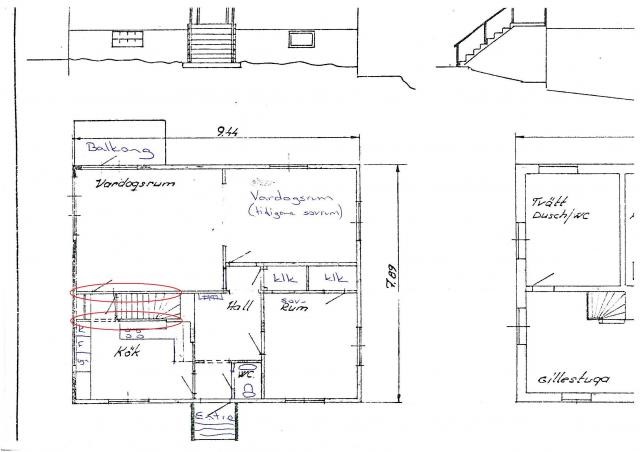
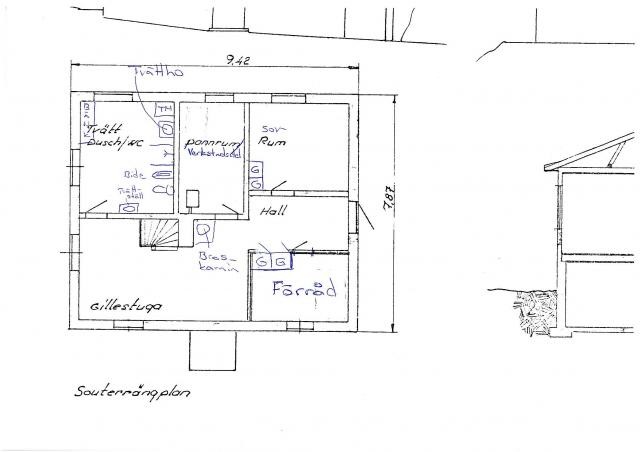
Last edited:
Usually, the wall you want to remove is a so-called load-bearing wall. (Which runs in the middle of the house). In your case, it may be possible to remove it. It is not certain that it is load-bearing. You don't have an upper floor above this, and the decisive factor is entirely how your roof trusses are constructed. The little that can be seen in the sketch is not enough to make a statement about this. A roof truss manufacturer can answer this question. I have myself had a split-level house where a wall similar to the one you want to remove was taken down without problems. There, the roof trusses were self-supporting.
Hello again,
Thanks for the responses so far. I climbed up to the attic and took a picture of the roof trusses, in case it might be of help. The picture is taken along the house, so that the trusses on the left in the picture are the long side of the house (the wall at the top of the drawings in the previous post). Can the picture provide additional information on whether the wall is load-bearing?
Where else can one find a constructor or the like who can come and take a look at it?
Does anyone know if the lower of the two marked walls in the picture in the first post might be load-bearing?
Thanks again,
Samuel
Thanks for the responses so far. I climbed up to the attic and took a picture of the roof trusses, in case it might be of help. The picture is taken along the house, so that the trusses on the left in the picture are the long side of the house (the wall at the top of the drawings in the previous post). Can the picture provide additional information on whether the wall is load-bearing?
Where else can one find a constructor or the like who can come and take a look at it?
Does anyone know if the lower of the two marked walls in the picture in the first post might be load-bearing?
Thanks again,
Samuel
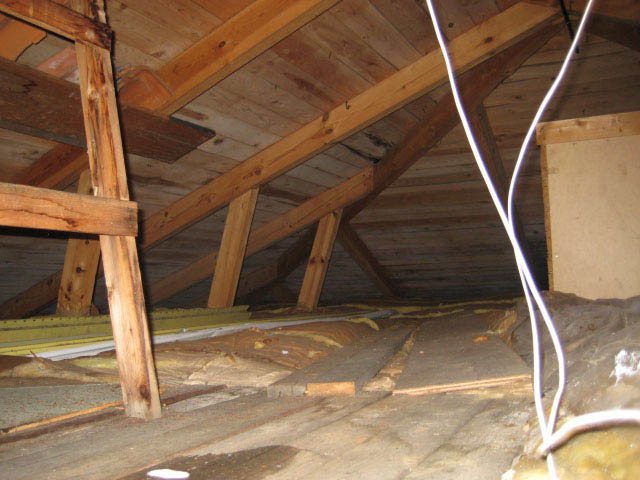
My thought when I see it is that the upper of the two walls probably has a load-bearing capacity but maybe not so extreme if there isn't much above it, yet.
Then I wonder if you plan to have a stair railing or if it's supposed to be a flat floor and then the staircase comes as a hole in the floor :blushing:
because if you're going to have a railing, it doesn't make much difference if you put up one or two pillars, maybe 4x4'', which you can also attach the stair railing to, making it sturdier than if you just attach it to the floor there.
Then I wonder if you plan to have a stair railing or if it's supposed to be a flat floor and then the staircase comes as a hole in the floor :blushing:
because if you're going to have a railing, it doesn't make much difference if you put up one or two pillars, maybe 4x4'', which you can also attach the stair railing to, making it sturdier than if you just attach it to the floor there.
Sure, there should be a railing by the stairs. The initial idea has been to install a glulam beam against the ceiling where the existing wall is, and then there will also be pillars supporting the beam. What I want to avoid is having to make a building notification with everything that entails.
Still no input on the lower wall?
Where should I turn?
Best regards,
Samuel
Still no input on the lower wall?
Where should I turn?
Best regards,
Samuel
It doesn't seem to have any support in the basement and is somewhat close to both an outer wall and the upper wall, while the beams in the rafters lie across them if I'm interpreting the drawing correctly, so it seems unlikely that the lower one would be load-bearing.Sam_u_El said:
You don't show the entire rafters in the picture, but at least no braces are visible in the middle, so it seems quite likely that the beams under the attic floor rest on the upper wall. It should work well with vertical studs under the beams, which probably exist in the wall now.
Follow-up much later (mainly because I personally like when threads get "closure").
There was a glulam beam in the opening of the upper wall, and it was reinforced with regular wood (2 glued 45*145 if I remember correctly) in the lower wall. I had no problems performing the work as if the wall was load-bearing, but wanted to avoid the municipality's requirement for a building notification. After some discussions with the building office, it seemed quite arbitrary regarding the determination of load-bearing walls, so we got the green light to proceed without a building notification.
There was a glulam beam in the opening of the upper wall, and it was reinforced with regular wood (2 glued 45*145 if I remember correctly) in the lower wall. I had no problems performing the work as if the wall was load-bearing, but wanted to avoid the municipality's requirement for a building notification. After some discussions with the building office, it seemed quite arbitrary regarding the determination of load-bearing walls, so we got the green light to proceed without a building notification.
Click here to reply