
17,866 views ·
37 replies
18k views
37 replies
How do you determine what a wall is made of?
I think the stairwell (which is on the north end) was meant to be cold. There's only single glass in the windows too. (connected frames otherwise). Three floors plus basement (or two floors with furnished attic maybe that's formally correct). Stone slabs for stoves in all rooms, the heart walls are brick half a meter closest to the chimney.
/Andreas
/Andreas
It is true that the bedroom was added in the 60s. What is now the bathroom was previously one of the original bedrooms, and the hallway was the bathroom.Martin_B said:
Without having seen the actual house, I don't think that floor plan looks entirely original either. My wild guess, based on the plan, is that the original house is what is now the Dining Room, Kitchen, Living Room, and the part with the stairs.
It looks on the plan as if the Bathroom, Hallway, Family Room, and Bedroom were added later.
In that case, the yellow-marked wall on the plan should be a load-bearing wall and should be made of planks unless the rest of the house is brick, then it should be a brick internal wall, but that seems definitely not to be the case considering how thin the wall is.
My guess is that this wall has been rebuilt over the years and perhaps has been framed up and filled with lightweight concrete or some other very peculiar solution.
No, what were to be put up now were two brackets below the TV, not the TV itself, as that will go up later.elpaco said:
The brackets are up now, in any case. It became quite evident that the wall is made of different materials because it was incredibly tough to get the screw in on the right side, while it went straight through on the left side.
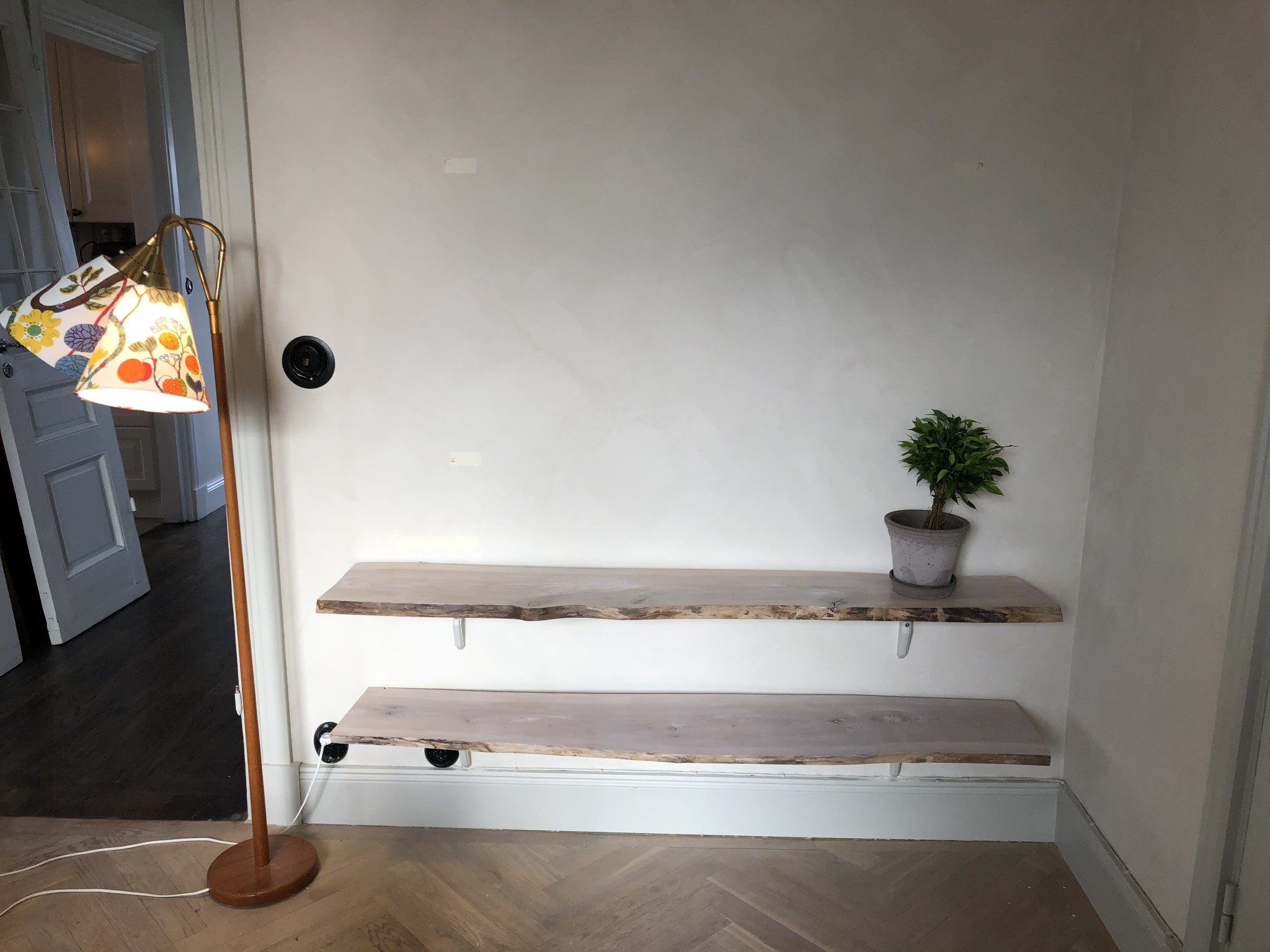
Yes, the TV will go up, but the consoles were for the shelves. The TV will be mounted on a Vesa mount that will then go up on the wall. Still uncertain about which plug to use since it's unclear what the wall is made of right in the middle. I'll have to try drilling approximately where the mount should be and see if it's wood or drywall there.
O Oxymoron said:Yes, the TV is going up, but the brackets were for the shelves. The TV will be mounted on a VESA mount that will then go on the wall. Still uncertain which anchor to use because it's unclear what the wall in the middle is made of. I will have to test drill roughly where the mount is going to be and see if it's wooden board or drywall there.
Why test drill? Try screwing the mount with long screws, pull on the mount and see if it holds. The second step is to add any anchor if needed. Why complicate things?O Oxymoron said:Yes, the TV is going up, but the brackets were for the shelves. The TV will be mounted on a VESA mount that will then go on the wall. Still uncertain which anchor to use because it's unclear what the wall in the middle is made of. I will have to test drill roughly where the mount is going to be and see if it's wooden board or drywall there.
Good question, because everyone we've talked to says that a TV of this weight must be mounted with proper plugs? (and as we all know, different walls need different plugs)GoC said:
This all started because I couldn't say what the wall was made of to the TV store, so they wanted me to find out before they could send an installer. To test, I chose to try putting up the shelves first. Now I know the wall is made of different materials but I'm unsure where the "border" is.
Just tighten the screws and hang yourself on the bracket. You'll feel when the screws start to hold properly. If they don't, then you either have to change the screw or use plugs. The bracket is probably attached with at least four screws, and a five-kilo load per screw isn't a very large load.O Oxymoron said:Good question, because everyone we've talked to says that a TV with this weight must be mounted with proper plugs? (and as we all know, different walls need different plugs)
This all started because I couldn't tell what the wall was made of to the TV store, so they wanted me to find out before they could send an installer. To test it out, I chose to try putting up the shelves first. Now I know the wall is made of different materials but I'm unsure where the "boundary" is.
I would assume that the TV store only has modern single plaster walls in mind, or if it's a brick wall, plug-ins are needed.

A trick is to attach the mount to a larger wooden board (same format as the TV but 5-10 cm larger), and screw the board to the wall instead. This way, you are freer to find places where the screws will hold. Countersunk screw holes, of course, which are filled in. The board can be painted, for example, in the same color as the door frames or in some other pleasant color.
Click here to reply