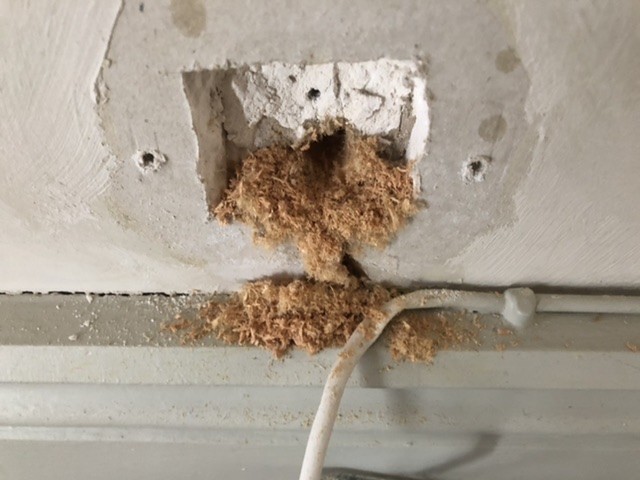
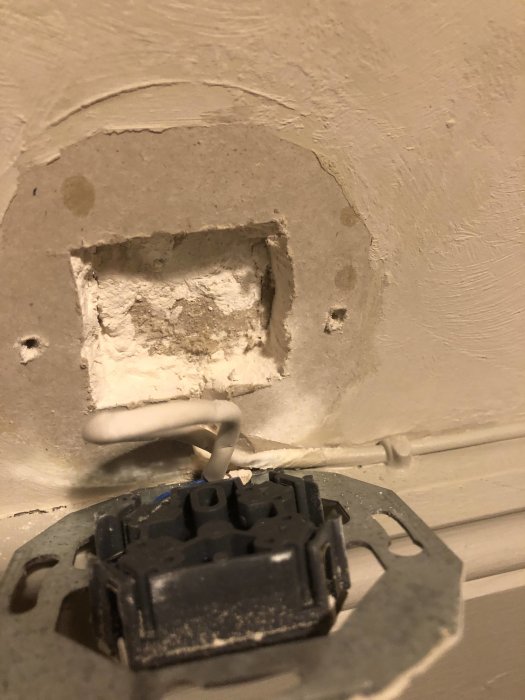
Hi, I hope this is the right department. I would like to mount a TV on the wall and then have two shelves below. Shelves and brackets are purchased. My problem is that I have no idea what the wall is made of, so I'm having difficulty knowing what kind of plugs I should get. I've used a stud finder, and the TV won't be able to be attached to a stud. The house is originally from the 1920s, but this wall might be newly constructed for all I know. I have removed the phone jack and it looks like this.
I have also drilled a hole here to see if it comes out on the other side, so to speak. But what comes out feels more like wood fibers. Do you have any tips on what I should use here? The TV will weigh about 20 kilos plus the VESA mount. Each plank is then 140cm long and weighs about 5 kilos each. I was thinking of using two brackets per plank.
Help, I've been putting this off for 6 months but now they have to go up.
The core of the wall can (most likely) only consist of one of two options. It's either planks of wood, probably 3 inches thick, or it's brick masonry. In both cases, there's plaster on the outside which in modern times has been covered with drywall. If it's a plank wall, there's probably splinterboard and reed mat between the planks and the plaster.
The easiest way to determine what it is, is to measure the wall's thickness at a window. If it's a brick wall, the thickness should be around 30 cm. If it's a plank wall, the thickness is around 15 cm.
For installation in a plank wall, it’s important to have screws that are long enough. Go to a real hardware store. They may need to be narrower than what's normal for the length. In a brick wall, I suggest using so-called nail plugs.
Thank you, perhaps I should have mentioned that this is an interior wall between the living room and the hallway. It is about 11 cm thick. I tried to buy plugs at two different hardware stores, but they insisted that I must know exactly what material it is, otherwise, this won't work. Right now, I have bought 70 mm screws for my brackets which are about 35mm thick. Not sure if that will be enough now.
Looks like someone put drywall over a plastered/masonry wall. I hope the other electrical installations don't look like the one for the phone.
No, I don't think so. All the electrical work was checked a couple of years ago. Admittedly, that's no guarantee, but it was a reputable company. But of course, there is also electricity where I want to mount the TV.
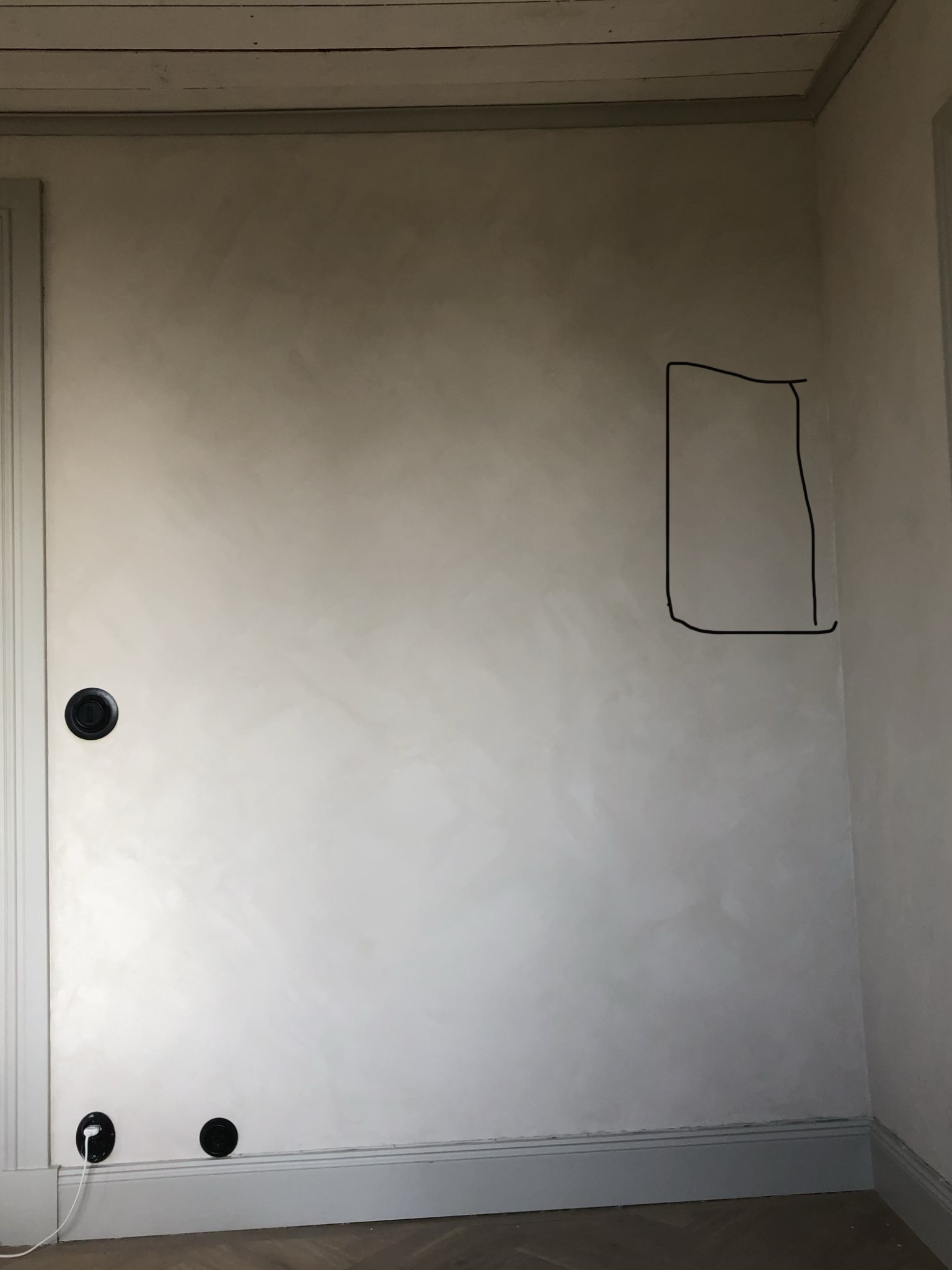
Here is a picture of the whole wall. Where I have marked, on the other side of the wall is the fuse box.
Then it is a plank wall with plaster and gypsum on both sides. 13+15+50+15+13 = approximately 106 mm plus some old layers of wallpaper. A 70 mm screw is too short if the bracket builds 35 mm. You need to go up to 90 mm. If you're unlucky, you'll end up in a joint between the planks, then you'll need to adjust the mounting sideways.
Then it is a plank wall with plaster and plasterboard on both sides. 13+15+50+15+13 = about 106 mm plus some old layers of wallpaper. A 70 mm screw is too short if the bracket builds 35 mm. You need to go up to 90 mm. If you're unlucky, you'll end up in a joint between the planks, in which case you'll need to shift the mounting sideways.
Double-checked with my husband now, he says it's not planks but more like chipboard. That what came out with the drill was more like fuzz. I couldn't determine what it actually was myself. Regarding the screws, they're only 4mm thick and 70. I can definitely switch them for longer ones. The question is, as mentioned, what type of plug I should use for the whole thing.
Chipboard did not exist in the 1920s. You can clearly see in the moldings and door casings in the last image that it is an original wall. Try screwing in a really long screw and see if it grips. There is no need for a plug for a plank wall even if it is plastered.
The lint could be treetex, whatever it might be used for, it was previously used as insulation on the inside of exterior walls.
Try drilling a large hole behind the phone socket so you can check what the different layers look like there. The hole will be covered by the socket anyway, so it's just as well to make it substantial.
I have also been thinking about three-tex but don't believe (i.e., don't know) it existed in the 1920s. The wall doesn't need to be symmetrically constructed either. It can have different layers on the different sides. I have personally lived for quite a while in various plank houses. In the one built in 1929, I had to arm myself with screws ranging from 30 to 100 mm in length when I wanted to hang something up. You couldn't take anything for granted.
The fuzz could be treetex, whatever it has to do with it used to be used as insulation on the inside of exterior walls.
Try drilling a large hole behind the telephone socket so you can check how the different layers look there. The hole will be covered by the socket anyway, so it's just as well to make it big.
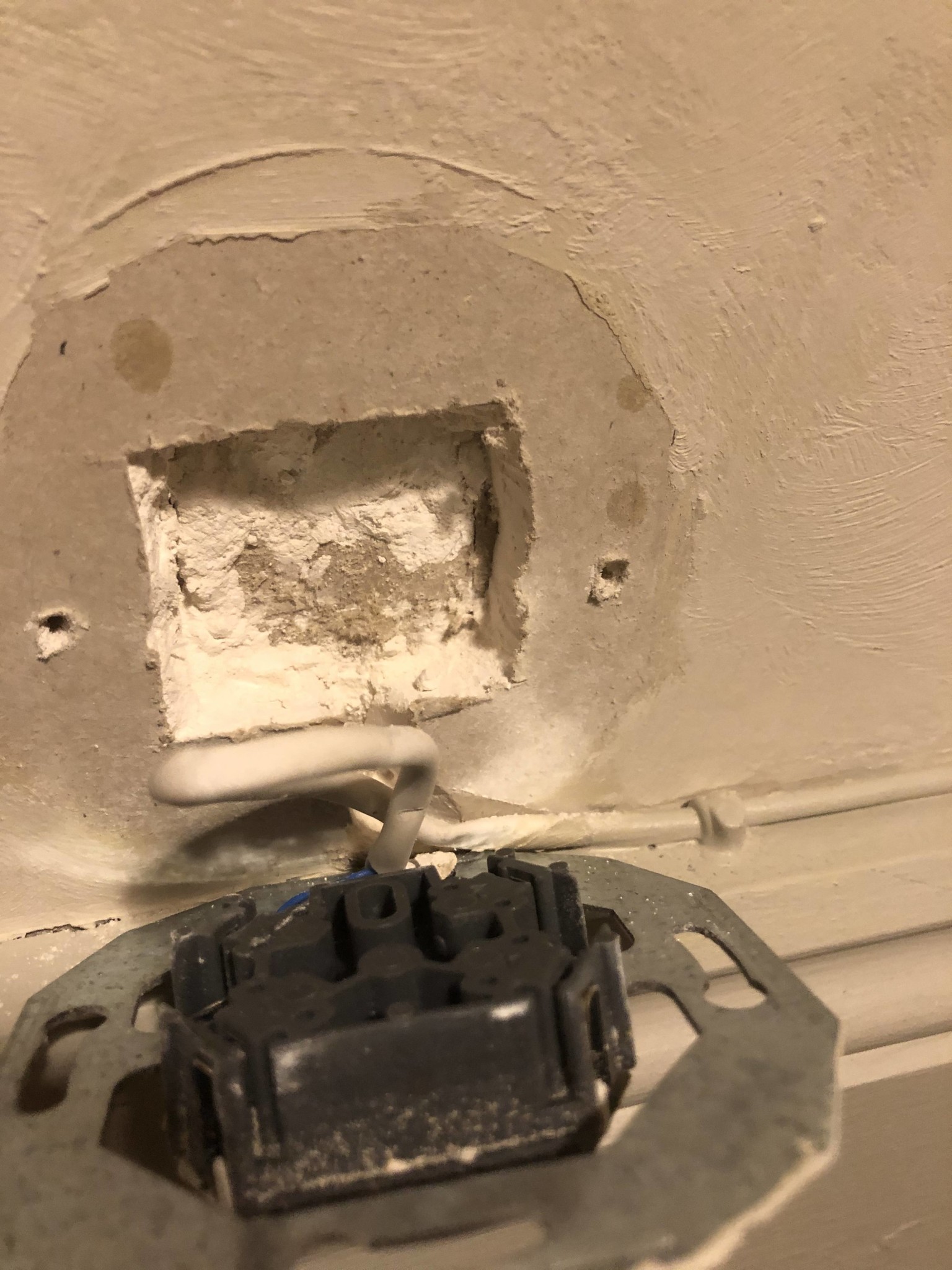
Hi, that's exactly what we just did. Here's how it looks.
The moldings are not original but installed by the previous owner. This wall might be original or recently installed. I simply don't know.
It looks like some form of wood wool board, but it must be attached to something. I now see that the skirting board is not from the 1920s. It might be a newer wall after all. Can't you post a floor plan so we can see the context better?
Unfortunately, realtor drawings are not completely reliable, but it still seems that the wall has always been there. I also can't see any sensible reason for it to be different in construction from the other interior walls. The more I look at the chips, the less I think it looks like treetex or some other variant of wood fiber, but rather some kind of damaged wood that splinters when you drill. Try to see if you can get a reasonably long screw to attach at another location. The solution to your problem might be to use a plywood board with many attachment points as an intermediary?
Vi vill skicka notiser för ämnen du bevakar och händelser som berör dig.


Stefan N said: