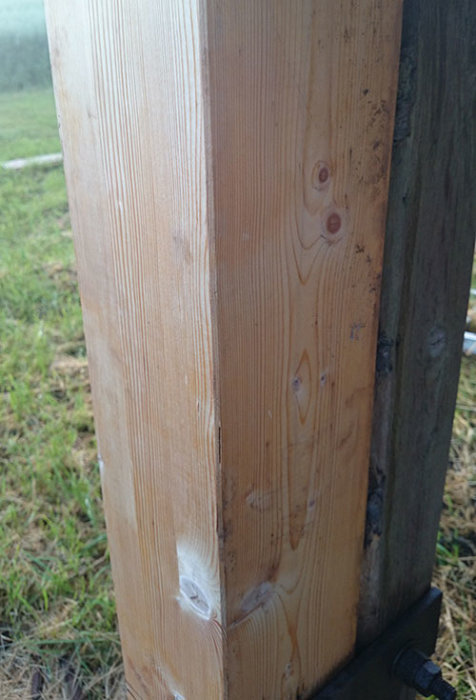
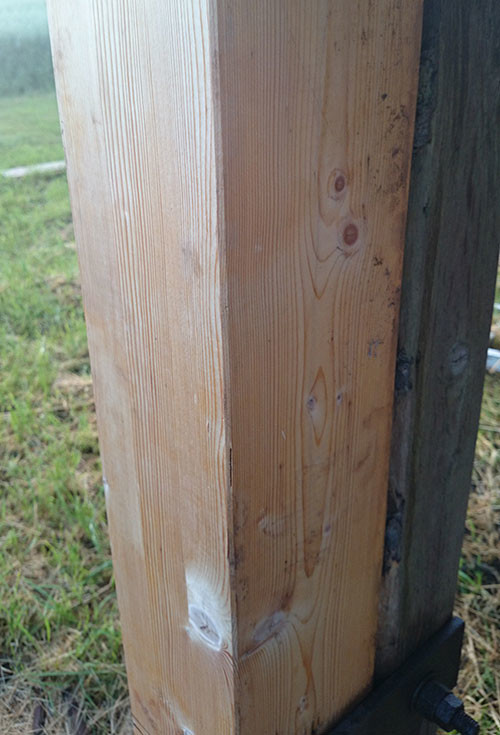
The change of the pillar was last minute, hence I made the mistake of not having the seller cut down the beam for me. I thought it would be easy to solve on site.
But now I'm a bit unsure. 14cm thick. My plunge saw can't handle that depth - so I'll have to make cuts on each side. Ideally, the cut shouldn't be completely straight either but slightly angled since the pillars are a bit tilted.
Or should I use the reciprocating saw, risking a wobbly result.
Or a chainsaw... With a rough surface as a result that might be more easily damaged?
How would you have done it?
(so I need to cut vertically)
Should it be cut or split? (I interpret the text as it should be split)
What is the end goal?
Why should it be split?
Requirements for the surface/finish?
Is it a window recess or should the entire length of the beam be split?
I would probably think about whether I really need to split it on the spot.
Use a plunge saw or circular saw and then finish the rest with a handsaw.
Then plane down any blemishes.
And if it just needs to be cut, it's easily done with the handsaw...
Split approximately 3cm. The column might be 2.6m.
I'm going to build a new wall, and in order for the new wall to be straight, it currently ends up that far out. The column's dimensions were a bit too large, and the foundation is not aligned either. Every cm I can gain would be beneficial to avoid extending the wall. Approaching the end of the ceiling.
(the new wall is currently maybe 5-6cm outside its original place, to make the wall straight)
There will be a panel on top of the column. So the surface is not important other than I don't want it to become unnecessarily sensitive.
Initially, I thought to have the panel up to the column, so the panel and column are aligned. And then clad the column. But that doesn't feel right to do.
Plunge saw from both sides should be within a few mm accuracy, and then finish with a handsaw or reciprocating saw. Finish with a couple of plane strokes to tidy up. That's how I would have done it...
Tigersaw is hopeless, go for the chainsaw, if the chain is sharpened it will be done in 20 minutes.
Otherwise, as mentioned before, the handsaw is the way to go, one of the best tools available when doing carpentry.
What kind of screws should I use for the angle brackets that support my long heavy joists?
I think they are 45x140.
I used stainless steel construction screws. The joists were able to support me when I tested standing on them. However, a colleague commented on my choice of screws, so I'm a bit concerned if I'm doing something wrong.
You probably need to provide a sketch if you are going to recommend a screw, but for screwing iron, an ankarskruv is probably best, as it handles shear forces well.
Well.. Nah.. I can show a picture of the summer project.
I know that the mounting screws are a bit soft, it's good when mounting since the head adjusts even if you've screwed at an angle, but I suspect they might eventually break in this construction when you don't want them to. View attachment 117651
As you can see the post on the right.. the studs stick out a bit.. just to make the wall straight.. hence splitting the one furthest to the left and then pushing in the others.
Last edited:
Click here to reply
Vi vill skicka notiser för ämnen du bevakar och händelser som berör dig.