
877 views ·
2 replies
877 views
2 replies
How best to connect frame to offset bearer

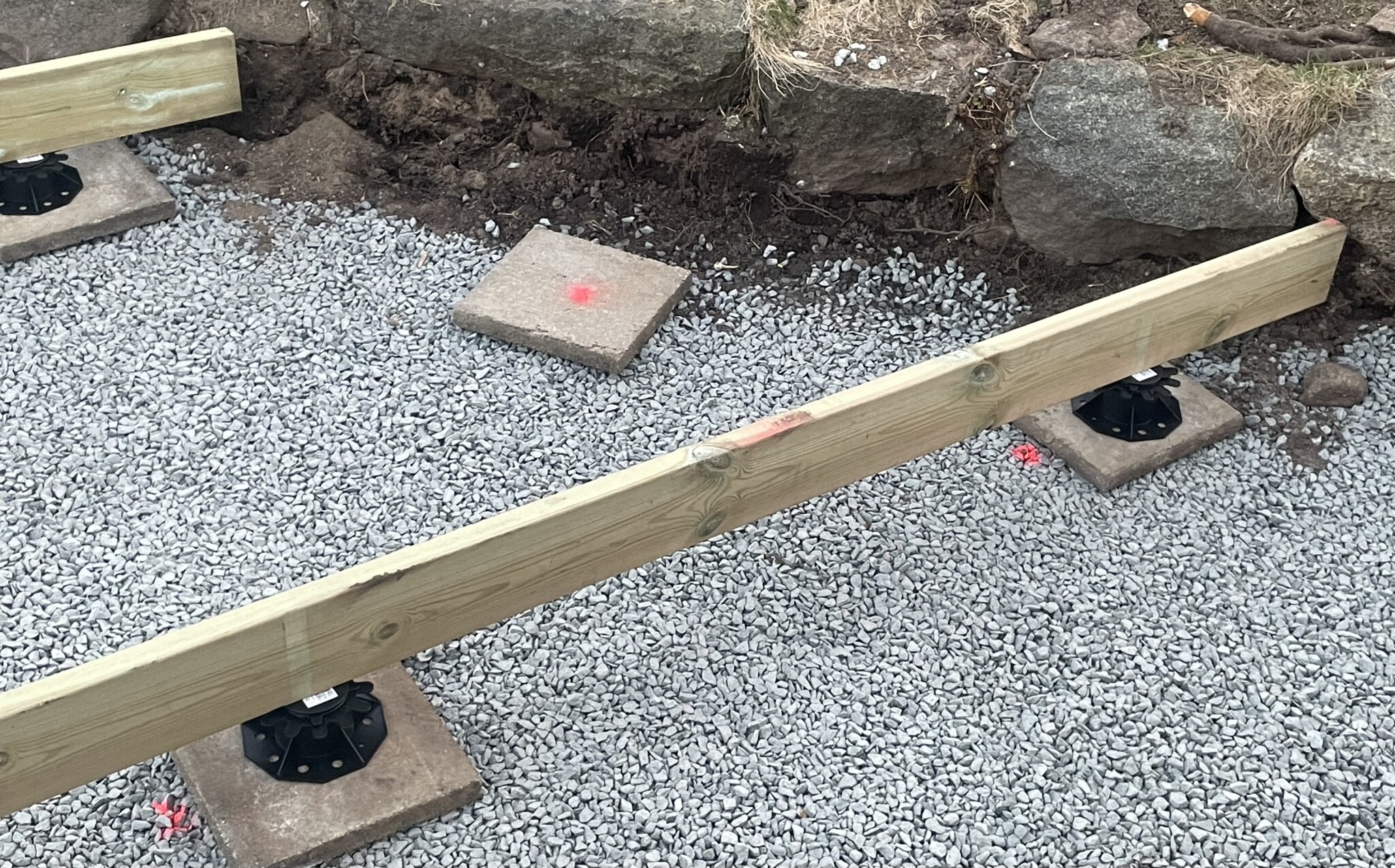
The decking will meet the wall at an angle to the patio. Therefore, I intend to place noggings between the offset beams to create a frame that can secure screws.
I chose not to place a long board as a frame because the wall is not symmetrical, which would have resulted in too large a gap in some areas.
I intend to use construction screws, but I am wondering if there are also suitable brackets or methods to handle these angles. For example, can you achieve an appropriate angle on a perforated plate with anchor screws and a hammer?
I will support each nogging with a terrace foot like the rest of the patio.
Edit: or am I overthinking this, and is it sufficient to get the right angles on the nogging and drive two construction screws into each end?
I chose not to place a long board as a frame because the wall is not symmetrical, which would have resulted in too large a gap in some areas.
I intend to use construction screws, but I am wondering if there are also suitable brackets or methods to handle these angles. For example, can you achieve an appropriate angle on a perforated plate with anchor screws and a hammer?
I will support each nogging with a terrace foot like the rest of the patio.
Edit: or am I overthinking this, and is it sufficient to get the right angles on the nogging and drive two construction screws into each end?
Last edited:
Common 90-degree angles without reinforcements are usually easy to bend in a vise or screwed into two pieces of timber (use the timbers as levers) Bend and apply a coat of galvanizing paint, mainly over the bend area but while you're at it, paint the whole thing.
However, I would rather double the angled ones to have more to screw into and, as a bonus, be able to adjust the screw line angles more... Plus, it ends up being cheaper and faster.
Not that screws in a single timber don't hold, but once you start thinking about it, it's just as well to add a little extra effort.
However, I would rather double the angled ones to have more to screw into and, as a bonus, be able to adjust the screw line angles more... Plus, it ends up being cheaper and faster.
Not that screws in a single timber don't hold, but once you start thinking about it, it's just as well to add a little extra effort.
Click here to reply