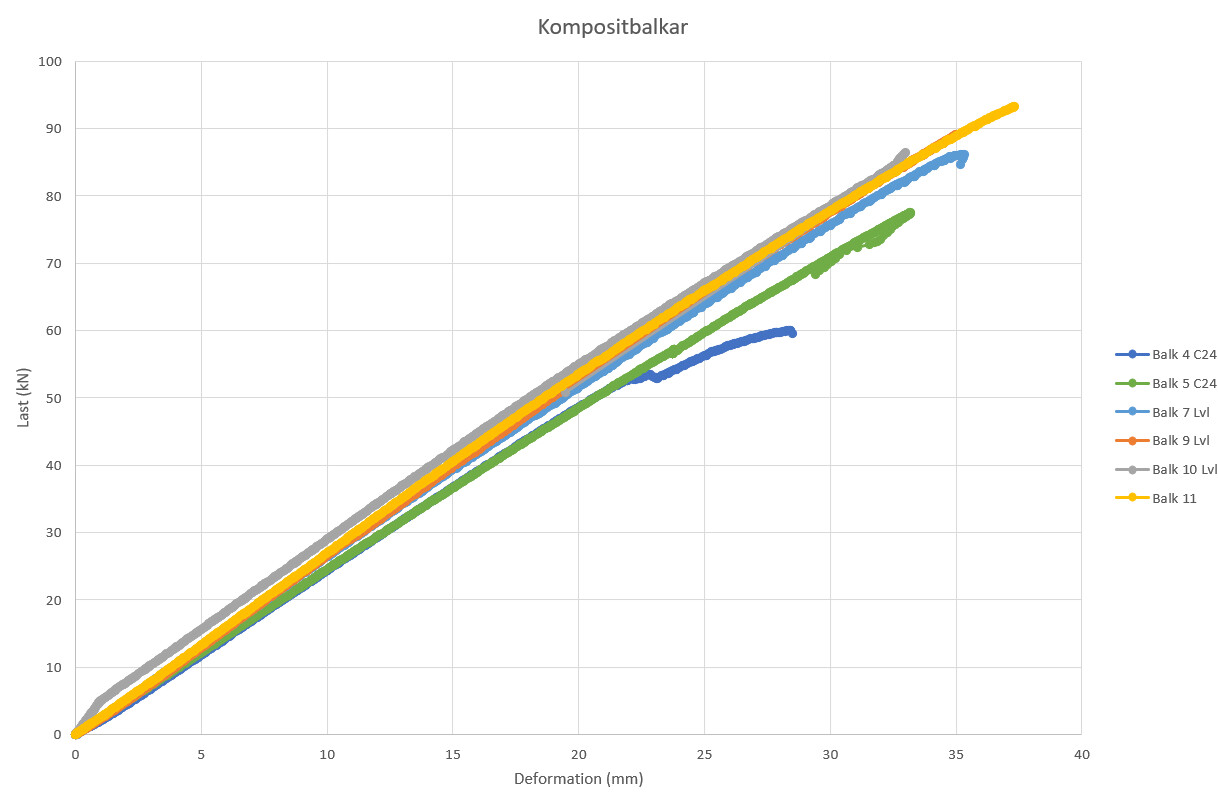
The question is whether it might be cheaper to buy a ready-made I-beam with just one board in the middle instead of building your own with double boards and XPS. The insulation in the beam hardly adds anything, apart from being needed when constructing the beam as a box.
It will probably be cheaper, but I'm not after the price; I'm more interested in doing as much as possible myself. I actually experienced tensile failure in the XPS, which shows it transfers load. I used XPS with a compressive strength of 250 KPa, but there is XPS with a compressive strength of 700 KPa, which should be even better. However, this is more of an academic consideration as the capacity is perfectly fine. I will use both screws and glue to ensure extra safety in case of fire. The height plays a significant role, check the bending resistance. However, in an NNE house, you should have 400 mm of insulation or more.
I actually don't know. In my case, I could manufacture them custom-made according to my design, which was worth a lot to me. I manufactured these when an OSB cost around 100 SEK for 2.4x1.2m
Yes, you can, but it requires more work because you have to mill and glue/press the board into the studs. With box beams, it's easy to nail the construction together.
Primarily for energy efficiency. In my case, the beams are placed so that the outside of the beam maintains the outdoor temperature and the inside the indoor temperature. Without insulation, the air inside the beam could move freely and create cold bridges.
Can't you nail-glue a stud on each side of the life? Are homemade beams approved by an inspector?
Can't one glue and nail a stud on each side of the beam? Will homemade beams be approved by an inspector?
Yes, that's probably an excellent way to do it.
Regarding your second question, it's harder to give a clear answer – approved for what and inspected in what regard?
If they are to be used as load-bearing elements in a building, there can often be requirements to demonstrate actual strength, which can be difficult. Obtaining any CE marking or certification for the beams is also not easy to achieve. However, it is still a relatively simple and inexpensive way to build beams yourself.
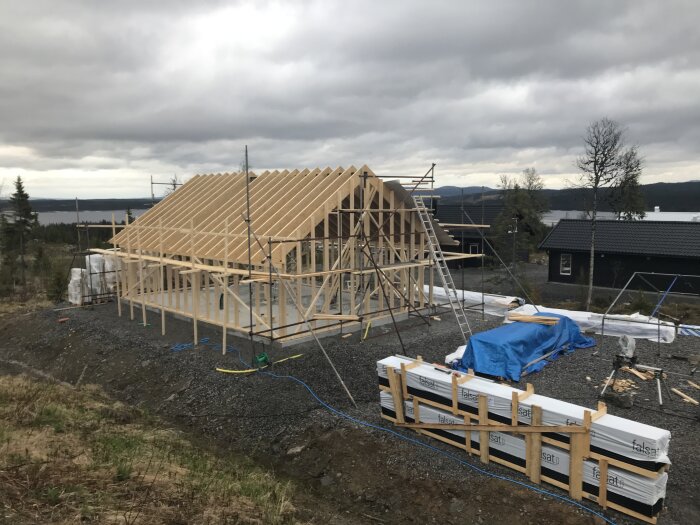
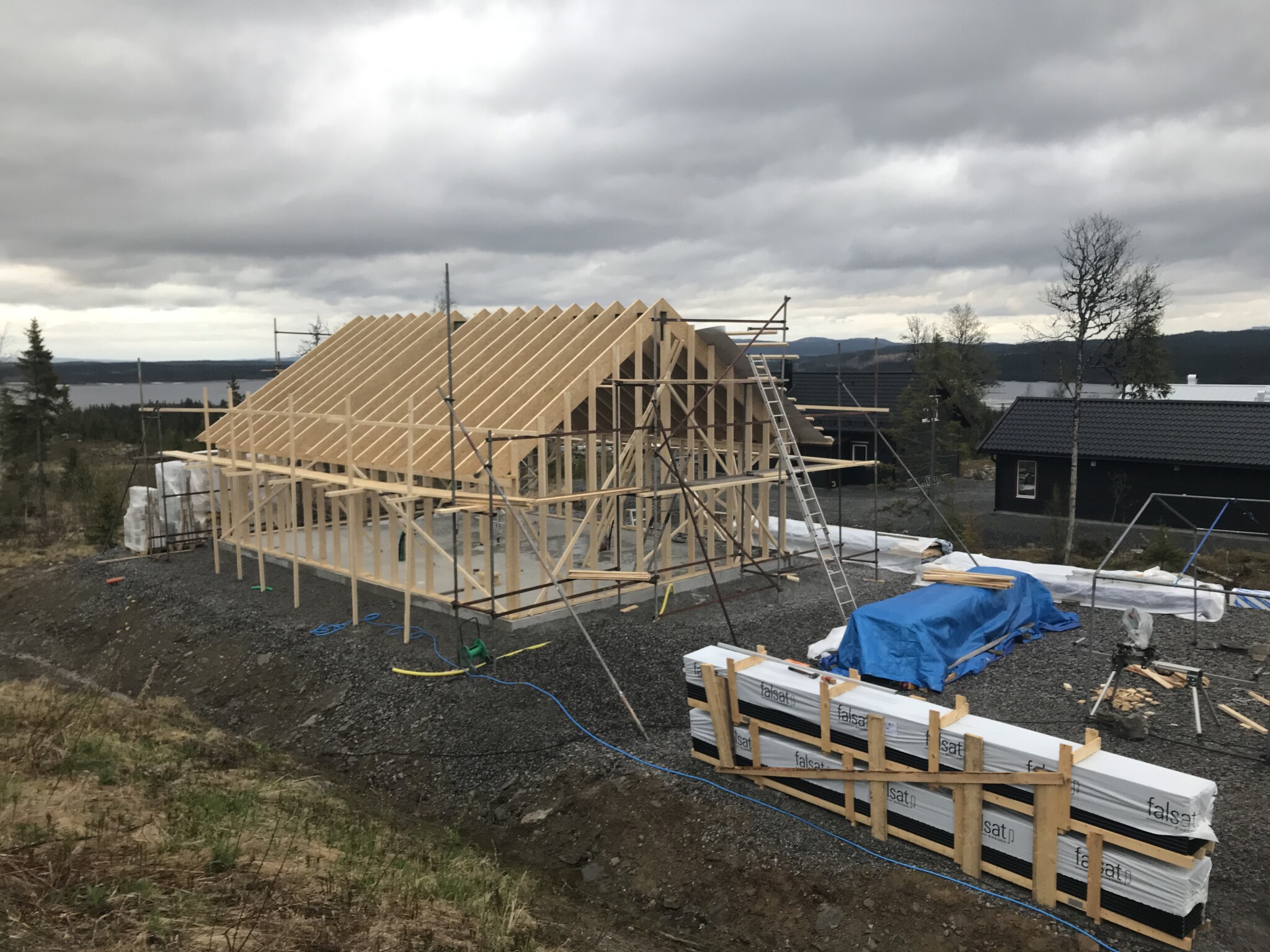
I wouldn't dare promise that. However, I know that it went well in my case, I've had these lightweight beams as rafters in my house for two years now. Neither the municipality nor the control architect had any comments or required any papers/certificates.
Can't you nail-glue a stud on each side of the life. Are homemade beams approved by an inspector?
OOrem Lipsum said:
Can't you nail-glue a stud on each side of the life. Are homemade beams approved by an inspector?
OOrem Lipsum said:
Can't you nail-glue a stud on each side of the life. Are homemade beams approved by an inspector?
OOrem Lipsum said:
Can't you nail-glue a stud on each side of the life. Are homemade beams approved by an inspector?
OOrem Lipsum said:
Can't you nail-glue a stud on each side of the life. Are homemade beams approved by an inspector?
OOrem Lipsum said:
Can't you nail-glue a stud on each side of the life. Are homemade beams approved by an inspector?
OOrem Lipsum said:
Can't you nail-glue a stud on each side of the life. Are homemade beams approved by an inspector?
OOrem Lipsum said:
Can't you nail-glue a stud on each side of the life. Are homemade beams approved by an inspector?
Hello, partly it depends on which glue you use. PVA glue has a short open time and is not gap-filling. I don't have much experience with these glues for construction purposes. When it comes to PU glue, you can get it with an open time of 30 minutes or more. Furthermore, PU glue is gap-filling, which suits me well. Since PU glue should have a glue pressure of 2 to 8 kg/cm2, it is not certain that the glue joint will be good enough. Whether you get it through probably depends on the person in question. I am currently building new beams, both box beams and i-beams, which I will test. I have now abandoned C24 timber and now use lvl beams instead as these have better dimensional stability. I will test 6 different types of beams, two of which are single tests, i.e. only one sample. The others I test as double tests or quadruple tests. I will report back with the results when the tests are completed. The tests will be conducted as 4-point tests to get maximum moment on a larger part of the beam.
Hi, it partly depends on which glue you use. PVAc glue has a short open time and is not gap-filling. I don't have much experience with these glues for constructive purposes. When it comes to PU glue, you can get it with an open time of 30 minutes or more. Furthermore, PU glue is gap-filling, which suits me well. Since PU glue requires a glue pressure of 2 to 8 kg/cm2, it's not certain that the glue joint will be sufficiently good. Whether you get it accepted probably depends on the person in question. I am currently building new beams, both box beams and I-beams, which I will test. I have now abandoned C24 timber and am now using LVL beams instead, as these have better shape stability. I will test 6 different types of beams, two of which are single tests, i.e., only one example. The others I will test as double or quadruple tests. I will get back with results when the tests are completed. The tests will be conducted as 4-point tests to get the maximum moment on a larger part of the beam.
Feel free to quote the person you're responding to 😉
The quoting worked so-so. I didn't get a reply box up, so I tried several times, then everything stayed and couldn't be removed. I will probably learn.
It worked so-so with the quoting. Didn't get a reply box, so I tried several times, then everything was stuck and couldn't be removed. I'll probably learn.
@Per Lindh how did it go with this?
I have a bunch of OSB boards that I would like to use for this and then manufacture wall elements according to my own measurements. So I'm very interested to know how this has worked out.
I have made similar beams in the form of box beams. However, they were not optimized at the end supports. I also considered using regular insulation but switched to XPS after some consideration. Tested the beams, a total of five, with both three-point and four-point loading to failure.
Material: C24 45x95 studs that were split to 70 mm, OSB 3 11 mm, XPS 70 mm, PU glue, and construction screws W 6.0x40 were used for beams 1, 3, and 5.
Beams 1 to 3 were 2500 mm, i.e., one OSB long. Beams 4 and 5 were 4200 mm long. The short beams were loaded with three-point loading and the long ones with four-point loading.
Beam 1 was constructed with only screw joints and a core of XPS. Beam 2 was both screwed and glued with PU glue. The XPS was also glued to the studs and OSB. I then removed all screws to simulate only gluing, i.e., the screws were only there to hold sufficient glue pressure. Sure, the screw holes theoretically provide a slight weakening, but considering the other distribution in material parameters, it is negligible in the grand scheme of things.
Beam 3 was both screwed and glued just like beam 2, but with the difference that the screws were left in place.
Beam 4 was the first beam I made and served as a bit of a pilot project. This beam was also screwed and glued. However, countersunk screws were used.
Beam 5 had the same dimensions as beam 4 but different screws, see above.
Since this is a hobby project, it may take a while before the full report is ready.
Hope this can inspire others.[image][image][image][image]
Hello, I got a question about how it's going, and I'm working on a slightly updated version where I'm trying a couple with construction plywood and actually four beams with OSB. I will test these sometime in January and will probably post the results in February. All depending on available time.
In the first ones, I used construction lumber (C24), 45x95, which I split to 70 mm to match the thickness of the XPS insulation. In the new variant, I tried splitting a Lvl (Kerto) beam. The beam was originally 51x400x4000, which I later split to 51x45x4000. The reason for choosing Lvl was that they are significantly more dimensionally stable and therefore easier to handle. So far, I have pressed 4 beams with OSB as the core and have very good repeatability in my trials. I will press two beams where the core consists of 12 mm k-plywood for comparison. I will return with more information when time permits.
I have now started printing my updated beams, can be seen here. [link]
In the first ones, I used construction timber (C24), 45x95 which I split to 70 mm to match the thickness of the XPS insulation. In the new version, I tried splitting a Lvl (Kerto) beam. The beam was originally 51x400x4000 which I later split to 51x45x4000. The reason for choosing Lvl was that they are significantly more shape-stable and therefore easier to handle. So far, I have printed 4 beams with OSB as the web and have a very good repeatability on my tests. I will print two beams where the webs consist of 12 mm k-plywood as a comparison. I will provide more information when time permits.


Per Lindh said:
Hi, it partly depends on which glue you use. PVAc glue has a short open time and is not gap-filling. I don't have much experience with these glues for constructive purposes. When it comes to PU glue, you can get it with an open time of 30 minutes or more. Furthermore, PU glue is gap-filling, which suits me well. Since PU glue requires a glue pressure of 2 to 8 kg/cm2, it's not certain that the glue joint will be sufficiently good. Whether you get it accepted probably depends on the person in question. I am currently building new beams, both box beams and I-beams, which I will test. I have now abandoned C24 timber and am now using LVL beams instead, as these have better shape stability. I will test 6 different types of beams, two of which are single tests, i.e., only one example. The others I will test as double or quadruple tests. I will get back with results when the tests are completed. The tests will be conducted as 4-point tests to get the maximum moment on a larger part of the beam.