
I will remove a load-bearing wall during my upcoming kitchen renovation, which has a thickness of 160mm. For practical reasons, I want to maintain this thickness (160mm) for the beam that will be installed, which means I will construct the beam myself. The span will be about 2500-2700mm. I have raw rafters with dimensions of 75*200 that I could plane and glue, as well as screw together with a plywood of suitable thickness in between to achieve the desired thickness. Alternatively, I could purchase already planed timber in the appropriate dimension and glue and screw these together to the desired thickness. I have more or less skipped the option with 75*200 due to the lack of a jointer/planer, and also because they are a bit cumbersome to handle due to their dimension/weight.
The remaining options, I think, are to glue and screw together 3 pieces of 45*145 and clad them with suitable sheet material (2*12mm gypsum/plywood/particle board) to achieve 160mm, or to take 2 pieces of 45*145 and 2 pieces of 45*70, glue and screw them together to directly achieve a thickness of 160mm, creating a hollow space in this construction. I prefer the latter since I can avoid cladding the beam, but the question is, will it hold? It's also worth mentioning that the wall to be removed contains a sliding door, which means the ceiling from the floor above currently hangs about 15-20mm lower, which I will press up with this beam, and I will probably overspan by maybe 5mm as well.
I don't doubt that 2*75*200 and 3*45*145 can handle the load, but will 2*45*145+2*45*70 be able to handle it?

The remaining options, I think, are to glue and screw together 3 pieces of 45*145 and clad them with suitable sheet material (2*12mm gypsum/plywood/particle board) to achieve 160mm, or to take 2 pieces of 45*145 and 2 pieces of 45*70, glue and screw them together to directly achieve a thickness of 160mm, creating a hollow space in this construction. I prefer the latter since I can avoid cladding the beam, but the question is, will it hold? It's also worth mentioning that the wall to be removed contains a sliding door, which means the ceiling from the floor above currently hangs about 15-20mm lower, which I will press up with this beam, and I will probably overspan by maybe 5mm as well.
I don't doubt that 2*75*200 and 3*45*145 can handle the load, but will 2*45*145+2*45*70 be able to handle it?

Why build a hollow beam?
I have done a similar relief where the span is about 240cm. Glued and screwed together 2 pieces of 6-inch joists. The rest of the wall consisted of standing planks and I saved about 80cm on each side, the wall was load-bearing but the load wasn't that large. If I were you, I would choose the option with 3 pieces of 45*145 Especially since you don't mention any loads on top. Cladding a piece of beam with gypsum takes about 10 minutes.
I have done a similar relief where the span is about 240cm. Glued and screwed together 2 pieces of 6-inch joists. The rest of the wall consisted of standing planks and I saved about 80cm on each side, the wall was load-bearing but the load wasn't that large. If I were you, I would choose the option with 3 pieces of 45*145 Especially since you don't mention any loads on top. Cladding a piece of beam with gypsum takes about 10 minutes.


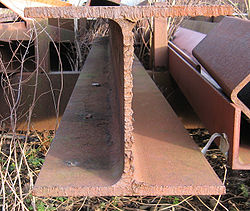
I assume you mean that the screwed-on 45*70 pieces would have the same effect as the wider flanges in an H-beam compared to an I-beam, but I doubt it would make any difference in a screwed-together wooden beam; the deformation would likely be too large.
Really strong H-beams (HE-M) are made not with wider, but thicker, flanges precisely because the stresses become so large.
I can't recall seeing wide-flanged wooden beams. I would rather view the beam as four separate parts.
Well, not my area of expertise, so there might be more opinions.
EDIT: OK, I've calculated: IF one can consider the box construction as SOLID, option #1 becomes about 16% stiffer than option #2. If the 45*70 pieces are not secured tightly (like glued and screwed), the box construction gets only 2/3 of the strength of option #2.
This is calculated straightforwardly. I haven't checked stability, etc.
Really strong H-beams (HE-M) are made not with wider, but thicker, flanges precisely because the stresses become so large.
I can't recall seeing wide-flanged wooden beams. I would rather view the beam as four separate parts.
Well, not my area of expertise, so there might be more opinions.
EDIT: OK, I've calculated: IF one can consider the box construction as SOLID, option #1 becomes about 16% stiffer than option #2. If the 45*70 pieces are not secured tightly (like glued and screwed), the box construction gets only 2/3 of the strength of option #2.
This is calculated straightforwardly. I haven't checked stability, etc.
Last edited:

I don't have sufficient knowledge to calculate it, but what strikes me is maybe 2X7" at the top and bottom and a 70X70 in the middle. Glued plus screwed. Preferably with a through bolt.
It will be a cm wide but you can fix that with a circular saw or something like that.
It will be a cm wide but you can fix that with a circular saw or something like that.
Thank you for your interest in the matter.
I think I'll go with three pieces of 45*145 and then clad it with gypsum; that seems to be the simplest and best option.
Maybe I'll even use 45*170 to get a beam that's higher than its width, we'll see...
I think I'll go with three pieces of 45*145 and then clad it with gypsum; that seems to be the simplest and best option.
Maybe I'll even use 45*170 to get a beam that's higher than its width, we'll see...
Click here to reply