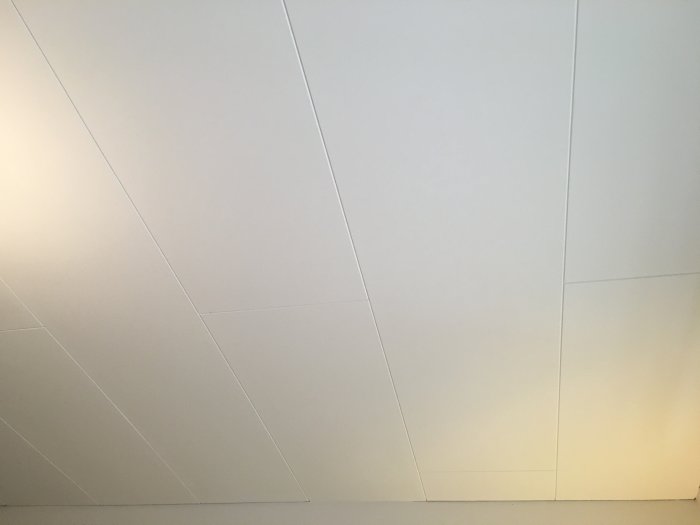
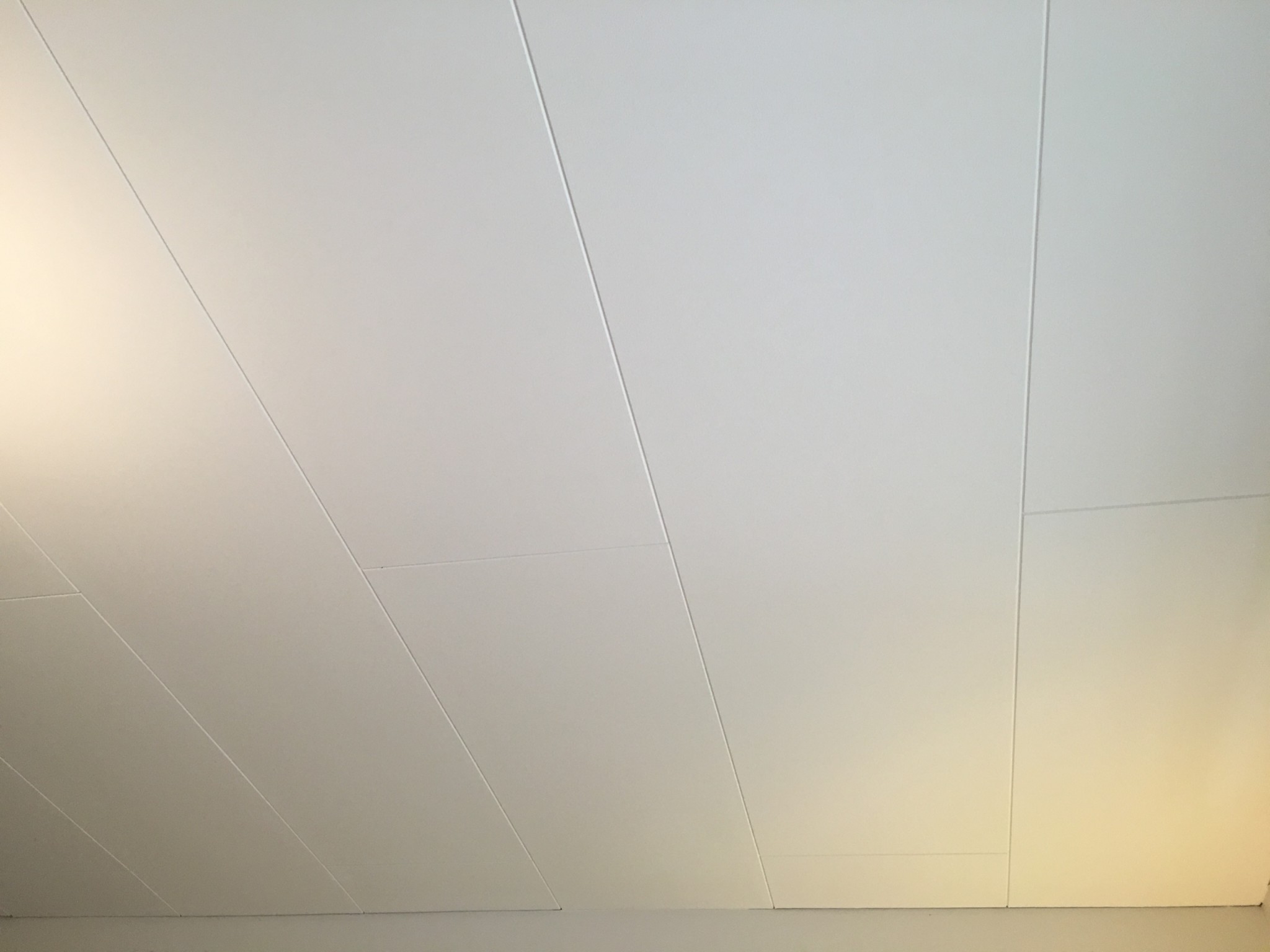
I have a ceiling on the first floor (house built in 1998) whose panels have beveled edges. See attached image. I don't know how these ceilings are constructed and I need to hang a projector about 7kg and a projection screen about 14kg.
I have called the home builder but they have no information and it seems difficult to get hold of someone there who knows anything. I hope there is someone here who can help me and tell me how to find a stud that I can hang from?
After googling a bit about drop ceilings, it seems that the panels are attached to thinner studs which in turn are attached to more sturdy studs. Is that correct? Can I hang 7 & 14kg on these lighter studs or should I find the thicker ones?
If you have an attic above, it's a simple task to add a new beam. I have a similar ceiling and added a new beam from the attic to hang the projector from. Try tapping to see if you can figure out where you might have a beam in the ceiling, or if it can work with a stud finder. Good luck.
If you have an attic above, it's a simple matter to put in a new beam. I have a similar ceiling and installed a new beam from the attic to hang the projector from. Try tapping to see if you can find where you might have a beam in the ceiling, or see if it might work with a stud finder. Good luck.
Unfortunately, I don't have an attic above. This would have made things easier
Above is the second floor.
How old is the house? Tapping your way around usually works well if a stud finder doesn't catch anything. Otherwise, you might be able to measure your way to where the joists are located as well. But most of the time, you can hang very heavy items on smaller mounts than you might think, but of course, you want to anchor them to something sturdy.
The house is from -98. How is the roof constructed? Do the large beams run along the short side of the drywall panels, or do they run along the long side? (If you understand what I mean). Under the drywall, there are probably smaller beams, and they are attached to the larger beams. If the smaller ones are on the long side, then the larger ones might cross, i.e., they run parallel to the short side?
I guess the roof is built so that you have supporting beams running between the house's long sides, then there are battens underneath these in the other direction to screw the panels into.
Can't you see anything at the edges when you don't have the molding installed?
I guess the roof is constructed so that you have load-bearing beams running between the long sides of the house, and then there are laths underneath these in the other direction to screw the panels into.
Can't you see anything at the edges when you don't have the molding mounted?
It's hard to see anything. But what you say makes sense. Laths running along the long side of the gypsum. And load-bearing ones crossing it. Do you think the load-bearing ones always cross on the short side of the gypsum? Or have they also placed laths there because you also screw the ceiling gypsum on the short side, right?
I'm not a carpenter, but you usually batten very densely, cc 30 if I'm not mistaken. So the load-bearing ones don't necessarily need to go in a way that fits the boards. I would guess that the boards are also tongue and groove with each other?
Therefore, there should be battens placed closest to the wall and you can measure from there. I don't think you need to screw into the joist for those weights
Click here to reply
Vi vill skicka notiser för ämnen du bevakar och händelser som berör dig.