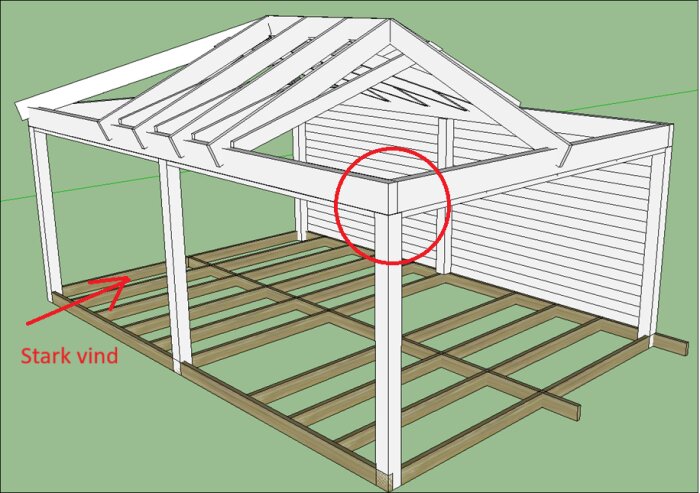
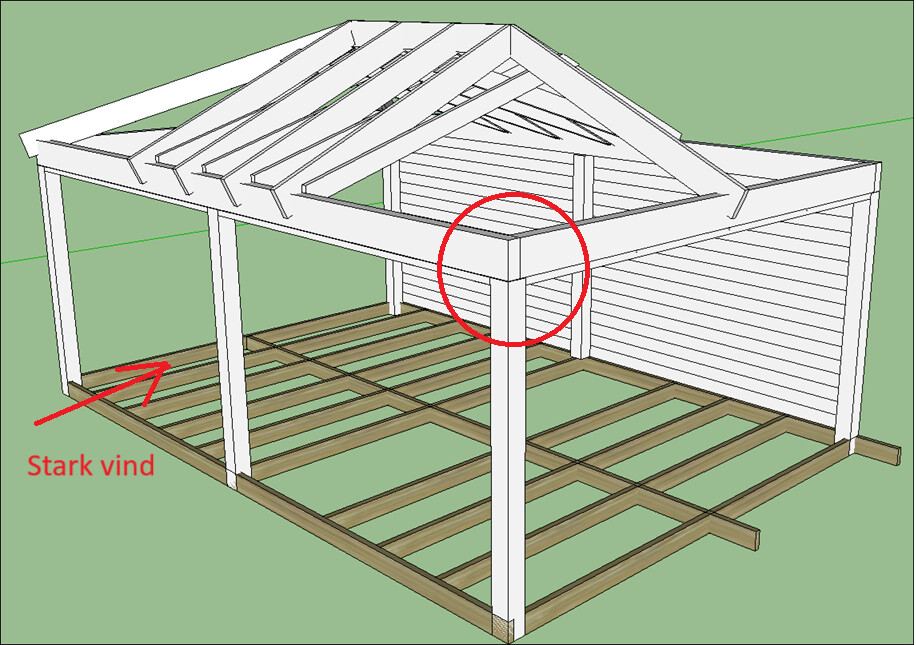
I'm planning to build a 24 sqm conservatory with one wooden frame wall and three walls with glass sliding doors. The roof will be hipped and insulated with concrete roof tiles.
The posts will be attached to the load-bearing beam. The laminated timber beam is intended to be placed on top of the posts and fastened with angle brackets to the posts. Is there a risk that the construction might "buckle" if a storm blows against the long side? It is not possible to place any "hidden" diagonal braces on the short sides to support between the posts and the roof (the beam).
I am planning to build a 24 sqm sunroom with one wall of wooden studs and three walls with glass sliding doors. A hipped insulated roof with concrete tiles.
The posts are attached to the beam. The laminated timber top plate is intended to be placed on top of the posts and fastened with angle brackets to the posts. Is there a risk that the structure might "give way" if there's a storm blowing against the long side? It's not possible to install any "hidden" diagonal braces on the short sides to secure between the posts and the roof (the top plate).
[image]
Generally speaking, stability = triangles.
That sketch looks vulnerable to forces in the direction of the arrow!
However, it might hold, or not - it very much depends on how strong the wind is, the permeability of the fence, attachment, etc.
Diagonal braces would clearly be preferable. And perhaps real trusses with an under chord - then at least the upper part would be much stiffer.
The diagonal braces don't need to block completely but if you place them about 2-3 dm down and in on both sides of each post, it would become much stiffer.
In general, strength = triangles.
That sketch looks vulnerable to forces in the direction of the arrow!
However, it might hold, or not - it depends a lot on how strong the wind becomes, the permeability of the fence, anchoring, etc.
Diagonal braces would definitely be preferable. And maybe real roof trusses with bottom chords - this would make the top part much stiffer.
The diagonal braces don't need to block completely, just place them about 20-30 cm down and in on both sides of each post, and it will definitely become much stiffer.
The roof truss is designed by a structural engineer, and together with the frame of glulam beams, that part should probably become quite stiff. However, I'm starting to think a bit like you, to still put a "small" diagonal brace at the back between the glulam beam and the post on each short side. It will obscure the sliding door slightly, but maybe that's not so bad. You could use a metal variant to make it a bit more delicate
Click here to reply
Vi vill skicka notiser för ämnen du bevakar och händelser som berör dig.