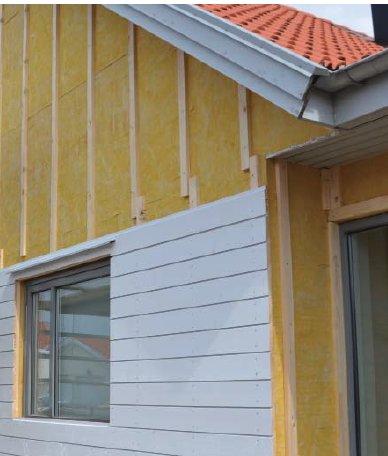
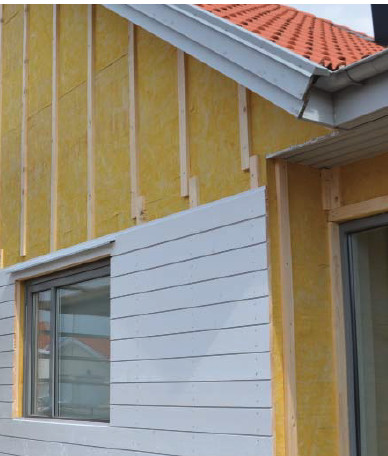
I hope to get started with facade replacement with additional insulation within a few weeks and have looked at Isover's Fasadskiva.
What I don't understand is if you get an air gap between the nail battens and the insulation when using their spacer sleeve. To get that, the spacer sleeve needs to be slightly longer than the board's thickness - is that the case?
Standing tongue-and-groove, double-sided is the idea so there will be no ventilation in the panel itself, hence my question. If there isn’t an air gap automatically with the spacer sleeves, I might have to first lay battens vertically and then nail battens horizontally, but it would be nice to avoid that.
Of course, one could go up a size in spacer sleeves (in my case probably 50->80), but if there already is an air gap with the "correct" sleeves, it's simpler and cheaper.
How thick is the insulation, i?
How long are the spacers, d?
d - i = air gap, so that must be it, right?
Isover only shows how to mount with horizontal cladding, so this seems to be something they haven't thought of.
Call and ask, why don't you! I myself would probably have put criss-crossed nail battens as you write. And if you use "too long" a spacer, the board won't hold in place properly.
The boards are held in place by nails/screws with plastic washers, so if you want, you can certainly use longer spacers. I would be satisfied with the gaps that form between the battens and the panel, as the panel is often grooved on the back and the panel itself is quite a distance from the insulation, and that's probably what's most important.
I'm thinking like this:
* The insulation is held in place with plastic washers according to the installation instructions
* The battens provide an air gap between the insulation and the panel, but there will be no circulation as the battens fit (almost) tightly against the insulation and panel (there will be enclosed spaces behind the panel)
* Grooves on the back of the panel, there will likely be minimal air movement there?
* Depending on which façade board you choose, you may or may not need a wind barrier
* Paroc has a similar system, which is also interesting. However, I want to minimize thickness and Isover seems to have a better lambda.
As others have already pointed out, wind barrier on the outside is not needed since the board itself is equipped with wind barrier on the back.
The spacers are meant to have something solid to attach the battens to when you nail. That is, they should go through the insulation and base against the underlying wall.
I myself used spacers that were as thick as the boards, followed by battens and nail battens. To create a reasonable air gap.
In newly built houses, the wind barrier is installed behind the facade board, also known as the west coast board. There is no reason to install double battens; it works fine regardless. The most important thing is that the panel does not rest against the insulation. The air does not move significantly there, regardless of the system.
On newly built houses, the wind barrier is installed behind the façade board also known as the west coast board. There is no reason to install double battens; it works fine anyway. The most important thing is that the panel does not rest against the insulation. The air does not move significantly there regardless of the system.
As houses become more well-insulated, there might be a reason to install a ventilation batten under the battens so that the air has "free" passage in a vertical direction. Moreover, it is beneficial from an insulation standpoint that any wind pressure has a free path out and not into the insulation.
I takt med att hus blir mer välisolerade finns nog en anledning att sätta en luftläkt under spikreglarna så att luften har "fri" passage i vertikal riktning.
Dessutom är det en fördel isoleringssynpunkt att eventuellt vindtryck har fri väg ut och inte in i isoleringen.
Kan inte tänka mig att det gör någon skillnad. Är väl ingen som bygger med luftspalt upp mot råsponten tex. Nej där har du fel.
Can't imagine it makes any difference. Surely no one builds with an air gap against the roof decking for example. No, you're wrong there.
The air gap in the wall is always connected with the roof's air gap so that the air from the wall can escape. (if done correctly)
It works in old houses without or with a poor air gap, but that's because the temperature is maintained by leaking heat from inside.
Example of a Correctly Constructed Wall Energy Wall Construction:
1. 22 mm wooden facade
2. 28 mm nail battens
3. 50 mm facade board/insulation
4. Windbreaker
5. 170 mm stud + insulation
6. 0.11 mm plastic foil
7. 45 mm stud + insulation
8. 11 mm OSB board
9. 13 mm gypsum
Source: A-hus
Vi vill skicka notiser för ämnen du bevakar och händelser som berör dig.




larsbj said:
