
50,010 views ·
320 replies
50k views
320 replies
Does Isover's spacer sleeve provide an air gap (facade board)?
You build without an air gap in new houses nowadays.larsbj said:
I am doing the same job, but with the west coast board, you get an air gap with the diatance sleeves because you have nails. No additional wind barrier anyway when it comes to the west coast board, but I can't imagine that Isover has created a system where you would need to fuss with a wind barrier either.
If you were to mount longer distances, the battens would probably be wobbly, so don't complicate it unnecessarily!
If you were to mount longer distances, the battens would probably be wobbly, so don't complicate it unnecessarily!
According to the image above, it seems very strange to have a vapor barrier almost in the middle of the wall. It makes it so that the old building method, which has worked for ages, isn’t good. The vapor pressure in winter goes in and stays there, it can’t come out. Houses are now supposed to be so airtight (like a thermos) according to experts and Boverket, and mechanical ventilation is a must and should be present. I can imagine that the reasoning is if the fan runs 24/7, there should be a negative pressure, and the vapor pressure won’t become an overpressure. I’d bet that in a few years, someone will say it wasn’t wrong; maybe it will emerge that it wasn’t quite right, and then quite a few people will be left holding the short straw, just like the plastic paints that came in the 70s, which were too tight, the moisture stayed in the panel, and it rotted. For my part, I would never build without an air gap behind the panel.
The vapor barrier is only 45 mm from the inside as the installation layer. All of this is based on the houses being very airtight inside and mechanical ventilation, mainly exhaust air, but I personally think controlled supply air is also preferable. larsbj I wrote a bit unclearly, of course, air as shown in the picture on the walls, but not ventilated eaves, and then the air stands still behind the panel anyway since there is no ventilation at the top. Therefore, there is no need for double battens.

Can buy it
The one with the plastic 45 in is probably because, as you say, the electrical installations, then there won't be a bunch of holes in it, which need to be taped, similarly in the ceiling with taping (ceiling boxes and other things) but not to be without an air gap
The one with the plastic 45 in is probably because, as you say, the electrical installations, then there won't be a bunch of holes in it, which need to be taped, similarly in the ceiling with taping (ceiling boxes and other things) but not to be without an air gap
Here it is obviously open for air to circulate from below and up (or possibly vice versa) since the horizontal battens are positioned slightly out from the insulation/weather barrier. Wouldn't you want to achieve that even with façade board/westhouse board? In the A-hus image, there are enclosed spaces between the battens since the panel and board close fairly tightly against the battens - or can you be satisfied with the small gaps that probably occur where the panel boards meet?R RoBo said:
Since it involves additional insulation, I want to maximize the insulation thickness but minimize "unnecessary" depth of the construction, so having 28 mm of air feels annoying if it's not absolutely necessary...
I can't imagine there being any problems at all with only having horizontal battens on the outside of the west coast board. Use 22 mm and a max of 600 mm between the spacers, that way you build less. A panel isn't completely airtight either. But I would probably have put wind barrier paper inside the board.
It is an air gap so that moist timber should not be directly against the insulation, it is not an air channel where large amounts of air should pass, and there will be enough gaps behind the panel, and I assume it is grooved.
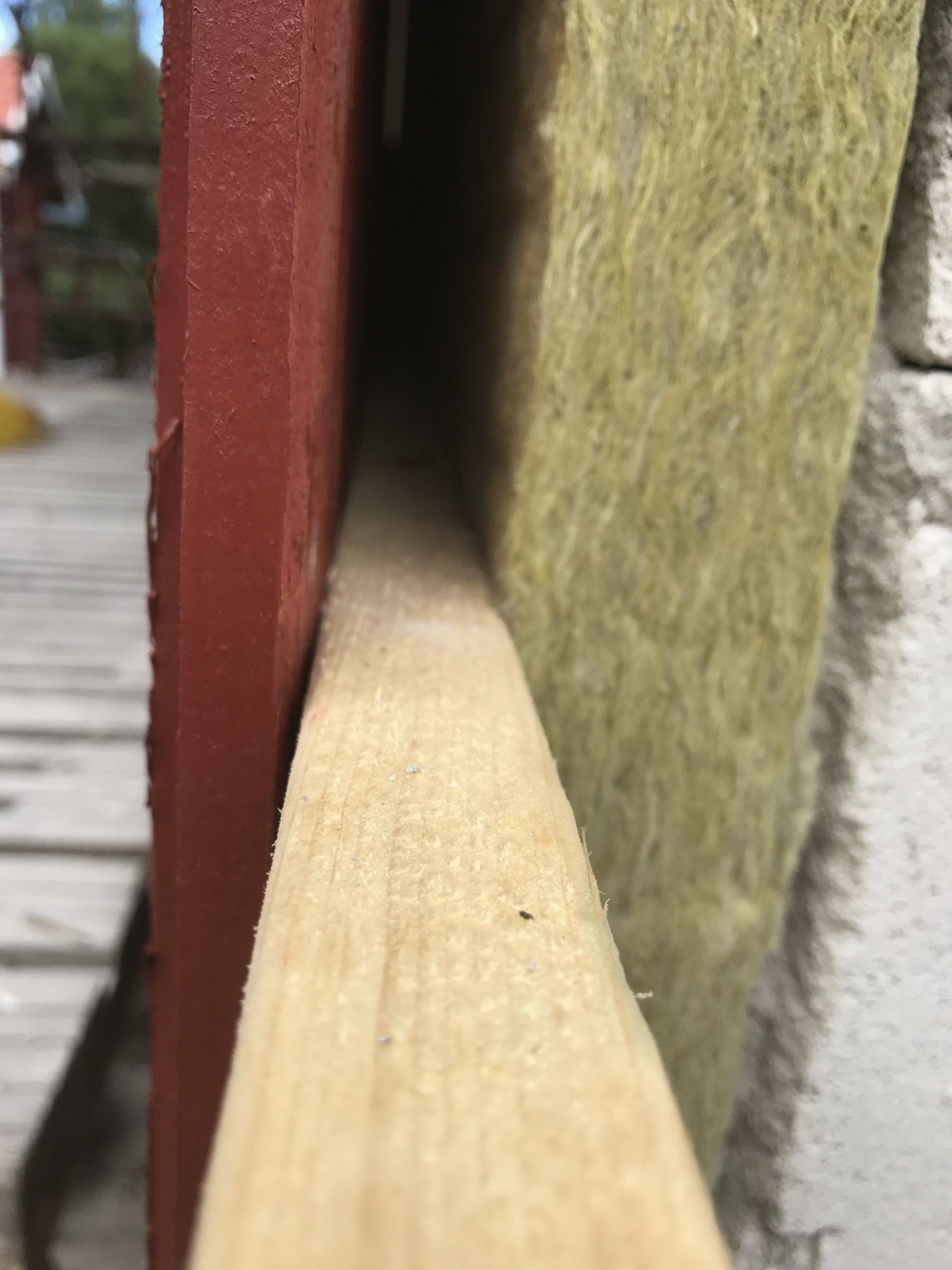
That it is a fiberglass layer I can accept as windproof, but with horizontal nailing rules, the air will not be pulled upwards, as there is a stop between them. Maybe I belong to the older generation and cannot embrace new findings, but rather build with the old proven methods that I know have worked for almost 100 years.
100 years, is that timber or chip-filled walls? In any case, it's very difficult to meet today's building requirements with methods that are almost 100 years old.L Liteavvarje said:I accept that it's a layer of fiberglass, making it windproof, but with horizontal nailers, the air won't rise because it's blocked between them. Maybe I belong to the older generation and can't embrace new findings, so I build with the old tried-and-true methods that I know have worked for almost 100 years
Looked at some panel boards (double tongue-and-groove) that I have lying around and there are two milled grooves on the back, about 10 mm wide each and equally deep, so it might not be as dense between the spaces between the battens as I thought.
The question is, should one settle for that and only use horizontal battens (vertical panel)?
The question is, should one settle for that and only use horizontal battens (vertical panel)?