
Hello
Searched around the forum without success. I have a question regarding roofing felt.
I currently have a garage roof with a 4-degree slope. It measures 8.5x5 m.
The roof is 18 years old.
I plan to extend about 4 m2 so new felt is needed there. But the question is: isn't it just as well to replace it all?
How long will the old one last?
Or can one apply/paint/tar something suitable on the surface?
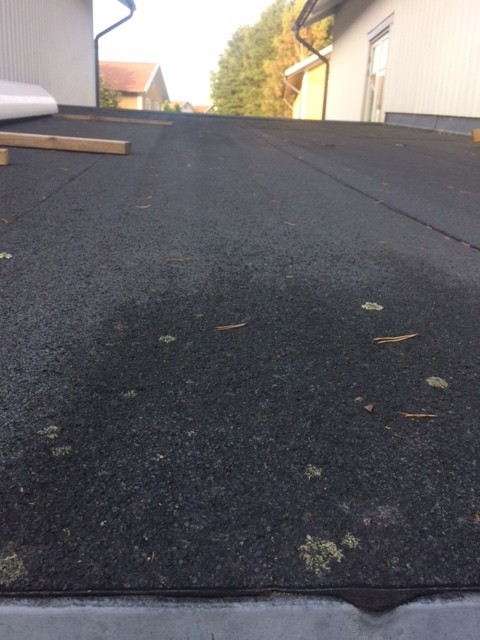
See attached image.
The felt is on tongue and groove boards.
Parts of the garage will now be insulated, so it would be good if it remains tight and doesn't start leaking for a few years.
Regards, Stefan
Searched around the forum without success. I have a question regarding roofing felt.
I currently have a garage roof with a 4-degree slope. It measures 8.5x5 m.
The roof is 18 years old.
I plan to extend about 4 m2 so new felt is needed there. But the question is: isn't it just as well to replace it all?
How long will the old one last?
Or can one apply/paint/tar something suitable on the surface?
See attached image.
The felt is on tongue and groove boards.
Parts of the garage will now be insulated, so it would be good if it remains tight and doesn't start leaking for a few years.
Regards, Stefan
Last edited:

Self-builder
· Stockholm
· 8 638 posts
This is how one usually talks about lifespan:
Tile roofs last at least 100 years
Concrete roofs about the same
Metal roofs (galvanized) 20-30 years
Modern felt roofs 25-30 years
So if it's more than 10 years, maybe it's just as well to redo it?
Then you must also consider special things when the slope is so low - i.e., seal between the overlaps?
/K
Tile roofs last at least 100 years
Concrete roofs about the same
Metal roofs (galvanized) 20-30 years
Modern felt roofs 25-30 years
So if it's more than 10 years, maybe it's just as well to redo it?
Then you must also consider special things when the slope is so low - i.e., seal between the overlaps?
/K
Member
· västragötaland
· 1 560 posts
Where do you actually get your made-up numbers from?
Tile roofs last at least 100 years: Very rarely do they last 100 years, usually around 60 years, so at least 100 years is made up.
Concrete roofs about the same time: I've never seen them last over 60 years, they are usually replaced at 40-50 years and are really bad by then. There are no concrete tiles that are 100 years old.
Metal roofs (galvanized) 20-30 years: Nowadays, there is a 30-year warranty on the metal, so it easily lasts 40-60 years, depending on the type and maintenance; it can easily last 100 years.
Modern felt roofs 25-30 years: This is the only one that is actually correct.
To ts, in the picture, the felt roof looks nice and should last another 10 years, but you need to have someone come to lay the felt on the new roof, so they can inspect the old one.
Tile roofs last at least 100 years: Very rarely do they last 100 years, usually around 60 years, so at least 100 years is made up.
Concrete roofs about the same time: I've never seen them last over 60 years, they are usually replaced at 40-50 years and are really bad by then. There are no concrete tiles that are 100 years old.
Metal roofs (galvanized) 20-30 years: Nowadays, there is a 30-year warranty on the metal, so it easily lasts 40-60 years, depending on the type and maintenance; it can easily last 100 years.
Modern felt roofs 25-30 years: This is the only one that is actually correct.
To ts, in the picture, the felt roof looks nice and should last another 10 years, but you need to have someone come to lay the felt on the new roof, so they can inspect the old one.


In which direction(s) should the garage be extended?
Closest to the camera?
Along the left edge?
Furthest from the camera?
Is there a ridge on the roof?
You always start laying the felt from the bottom, regardless if it is horizontal or vertical strips. If you do it the other way around, the roof will start leaking quite quickly.
So if the extension is closest to the camera, the entire roof needs to be redone up to the ridge, and at the ridge, the felt should be laid so there's an equal amount on both sides.
Closest to the camera?
Along the left edge?
Furthest from the camera?
Is there a ridge on the roof?
You always start laying the felt from the bottom, regardless if it is horizontal or vertical strips. If you do it the other way around, the roof will start leaking quite quickly.
So if the extension is closest to the camera, the entire roof needs to be redone up to the ridge, and at the ridge, the felt should be laid so there's an equal amount on both sides.
Member
· västragötaland
· 1 560 posts
When laying welded felt, it doesn't matter if the seams are facing the wrong way.
Self-builder
· Stockholm
· 8 638 posts
A search on this forum gave the numbers above, and I've seen these before - of course, there are huge variations...johan ivarsson said:Where do you actually get your made-up numbers from?
Tile roofs last at least 100 years: Very rarely do they last 100 years, usually around 60 years, so saying at least 100 years is made-up.
Concrete roofs last about the same: I've never seen them last over 60 years, usually replaced at 40-50 years, and they're really bad by then. There are no concrete tiles that are 100 years old.
Metal roofs (galvanized) 20-30 years: There's a 30-year warranty on the metal today, so it easily lasts 40-60 years depending on the type and maintenance; it can easily last 100 years.
Modern felt roofs 25-30 years: This is the only one that's actually accurate.
To ts, the felt roof looks nice on the picture and should last another 10 years, but you'll need someone to lay the felt on the new roof, so they can inspect the old one then.
/K

Some comments on the durability of different roofing materials: Regardless of material, roof slope and surrounding natural environment play a significant role. Today's roofing felt often doesn't have a paper core but instead uses materials like polyester or similar plastics that are less sensitive to movements in the substrate. It should therefore last longer than the old days' fabric- or mineral-based felt. The durability of a tile roof (clay or concrete) is also affected by using the correct dimensions for battens (1-inch battens, not the old half-inch ones) and the correct quality of nails (acid-resistant). With the right substrate and proper construction (and at least a 27-degree slope), a roof with unfazed clay tiles should last about 70 years. If using glazed clay tiles, you can probably add at least 10 years. When re-roofing with clay tiles, most of the tiles can be reused. For concrete tiles, I believe a realistic lifespan is about 40 years (plus or minus 10 years). When re-roofing, the tiles must be discarded. Modern felt roofs (2-layer coverage) should last at least 30 years and have the advantage that they can be used even at very low roof slopes. In my opinion, an underrated option. The lifespan of metal roofs (sheet or standing seam) depends on the location in the country, metal quality, and maintenance. A very good option is Rheinzink. Price-wise between galvanized and copper roofing. Certainly lasts 100 years without maintenance. However, there are many roofs with blackplate that have stood since the mid-1800s thanks to good maintenance (painting)!
Thanks for the answers.
I will have tar paper on the roof.
as I believe it is recommended with a 4-degree slope.
But the question is whether I should replace everything or put something on top of the old to extend its lifespan?
and if you lay new tar paper, can you lay it on the existing one or must it be removed?
Kind regards, Stefan
I will have tar paper on the roof.
as I believe it is recommended with a 4-degree slope.
But the question is whether I should replace everything or put something on top of the old to extend its lifespan?
and if you lay new tar paper, can you lay it on the existing one or must it be removed?
Kind regards, Stefan
Whether you should lay new felt on the new part and retain the old on the other part, or lay new felt on the entire roof, is more a philosophical than a technical construction question. Since the extension is a smaller part, it is cheaper to splice it in and then replace everything after 12 years or whatever it might be. If you plan to sell the house before then, it might not be so good to have a roof with different conditions on separate parts. How to splice depends on which products were previously used. It might not look very nice either, depending on who does it and how.
Self-builder
· Stockholm
· 8 638 posts
I would say remove the old one... it probably won't be good or look nice otherwise, there are no real advantages to keeping it, and besides, you won't see if there are any potential damages underneath...Stesod said:Thank you for the answers.
I will have felt on the roof.
as I believe it is recommended with a 4-degree slope.
But the question is whether I should redo everything or lay something on top of the old to extend its lifespan?
and if you lay new felt, can you put it on the existing one or does it need to be removed?
Best regards, Stefan
/K
Click here to reply