I think the two 45x220s are there to replace the heart wall where you have a 3m opening.
That is, to ensure that the roof doesn't sag in the opening.
I guess you mean that the beam is not critical and the roof holds without it but with unaesthetic 'sagging' in the winters?
That could be a natural explanation.
It strikes me that the truss factory (Derome) delivered with steel bands for my split trusses. But the carpenters built on the 220-millimeter trusses with a 70 mm stud instead. The steel bands are lying around somewhere...
If I've understood you correctly, that's the kind of solution I've been thinking about.
That on top of a new beam, something like 45x95s are placed crosswise and attached to the trusses either inside the truss with an adapted angle (see later example) or screwed on the outside into both the leg and upper arm.
It works just as well to place a beam on top of the truss's bottom chord as it is already done.
I have realized that the new beam must be much more load-bearing as the double span requires significantly greater bending resistance than just double.
I have tested a couple of calculation programs (guides) online that indicate:
1. The original beam in its environment is undersized and should be three 45x220 instead of two.
2. The new beam with new span should be a Kerto-S 75x600 or glulam 115x495.
I assume that maybe a little less is required with my conditions (compare 2 vs 3 45x220 today).
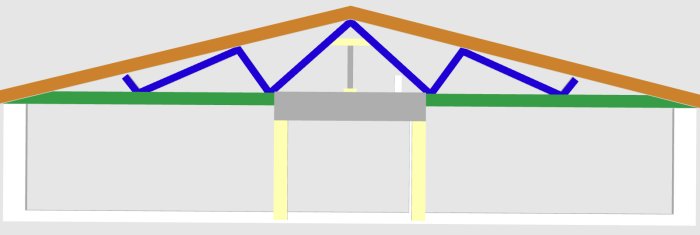
The parts being removed are in white (bear wall and small beam).
New additions are:
Kerto-S 75x600 in gray at the top.
Kerto-S 45x360 in gray (crosswise to move the load sideways).
- This is reinforced on the sides with 45x170 each to ensure proper support.
Two columns 45x170 in yellow on each side of the 15.3 door.
Support platform 45x170x170 in yellow.
Cross support for each chair leg (in yellow).
The other side will be as before on the gable chair which I've supplemented with two 45x170 and an additional platform for proper support.
I guess you mean that the beam is not critical and the roof holds without it but with an unsightly 'sag' in the winters?
That could be a natural explanation.
Well, no...
I mean that I don't know what your trusses are sized for.
They might be sized to require a load-bearing wall.
Or!
They might be sized to be self-supporting, in which case they manage completely without a load-bearing wall.
Considering that you have a load-bearing wall and a beam, I wouldn't take a chance that they are self-supporting.
When the 3m opening was made, a beam was installed to support the truss above the opening by placing it on the upper side of the truss's lower frame (the two 45x220s).
Noticed that it's not possible to write 45x95r together
I drew something that might clarify:
[image]
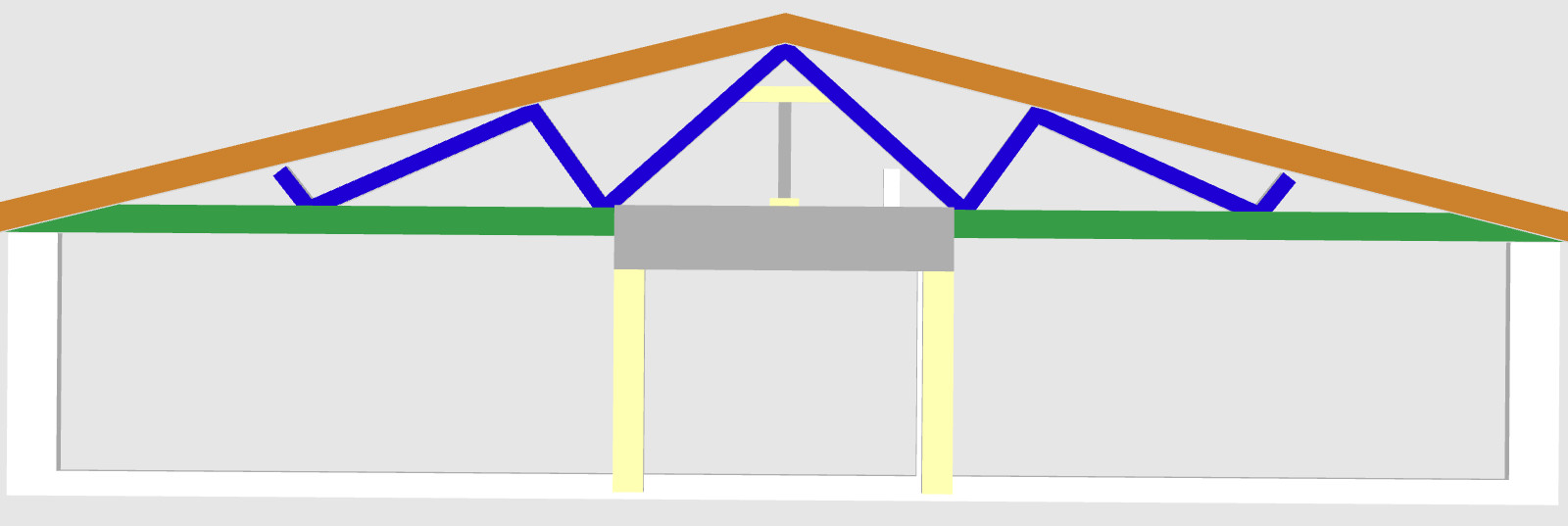
What is removed is white (load-bearing wall and small beam).
New is:
Kerto-S 75x600 in gray at the top.
Kerto-S 45x360 in gray (crosswise to move the load sideways).
- This is reinforced on the sides with a 45x170 each to provide good support.
Two Columns 45x170 in yellow on each side of 15.3 door.
Platform for support 45x170x170 in yellow.
Crossbeam for each chair leg (in yellow).
The other side will be as before on the gable chair, which I supplemented with two 45x170 and one platform for good support.
Am I thinking correctly?
Spontaneously without any specific measurements, it looks complicated.
Might be worth considering a steel beam instead to see what dimension you end up with.
A steel beam might fit where the 45x220's are now (the white ones in the picture, right?).
Regarding fire protection, the requirements are low for small houses, R15 in the actual house and R0 in the roof structure if the roof pitch is under 45 degrees. So there is no problem with steel in the roof structure, it is allowed to collapse immediately if a fire starts according to the regulations. However, if the roof structure supports the walls and ceilings, slightly higher requirements apply - it should then hold for 15 minutes...
Of course, you can build with better fire resistance if you wish.
I don't quite understand what function the white support beams have. If the roof truss is properly dimensioned, it should be able to support solely on the outer walls. That's essentially the whole point of that roof construction.
There is no guarantee that those trusses are designed to be self-supporting even though it is possible to do so with that type of truss.
There are two ways to know: look at the original drawings or measure them carefully and provide the dimensions of the timber to a structural engineer who can assess it.
Spontaneously, without any specific measurements, it looks cumbersome.
Might be worth considering a steel beam instead, to see which dimensions you end up with.
A steel beam might fit where the 45x220s are now (white in the picture, right?).
Yes, it's annoyingly cumbersome but it comes together with several changes.
I calculated a steel as a crossbeam (Tibnor's help) and concluded either IPE160 or HEA100.
They would manage to lie in the existing beam layer, but availability and weight seemed worse.
Haven't really looked at one as a main beam but suspect the same applies here.
When it comes to fire protection, the requirements are low for small houses, R15 in the house itself and R0 in the roof structure if the roof pitch is below 45 degrees. So there is no problem with steel in the roof structure, it is allowed to collapse immediately according to the rules if a fire starts. However, if the roof structure supports the walls and ceilings, slightly higher requirements apply - then it should hold for 15 minutes...
Of course, you can build with better fire resistance if you want.
Interesting, I could assume that 'R0' applies to the loft since it is complicated with all the exposed wood, so I have counted on everything collapsing, but the ceiling should be able to hold. So the ceiling should hold for 15 minutes, not 30 as I thought.
Perhaps JOW's suggested anchors/bands are still a fully reasonable approach...
I don't quite understand the function of the white support legs. If the roof truss is properly dimensioned, it should be able to carry on just the outer walls. That's basically the whole point of that roof construction.
Mmm, I haven't asked anyone to calculate or done a MATLAB race on it myself, as I still don't want to take any risk.
The dimensions in the figure are almost exactly to scale with 9400 from outer wall to outer wall. Height from ridge to the underside of the underarm is 1285. The arms are 45x170 and the legs 45x95, and I assume they are of C30 quality.
Maybe I'll sit down and play around with it for fun
Click here to reply
Vi vill skicka notiser för ämnen du bevakar och händelser som berör dig.