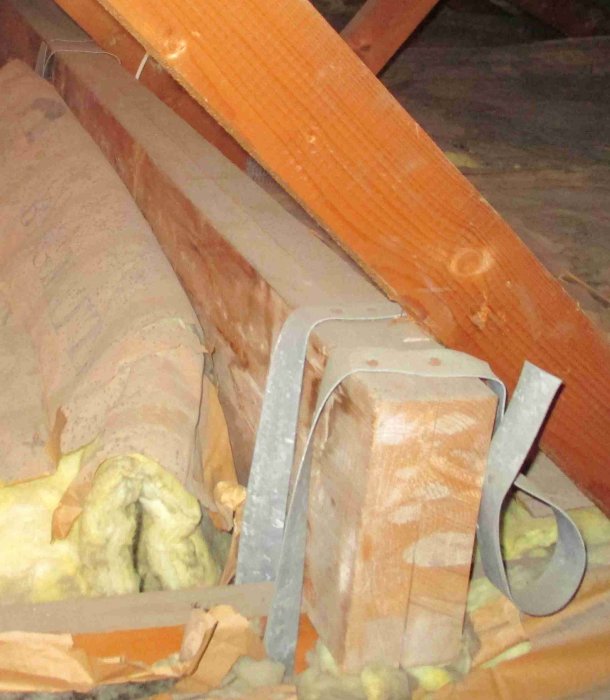
I looked up in the loft (not furnished as the roof pitch is 14°) and am considering changing the beam to expand the free space in the living room.
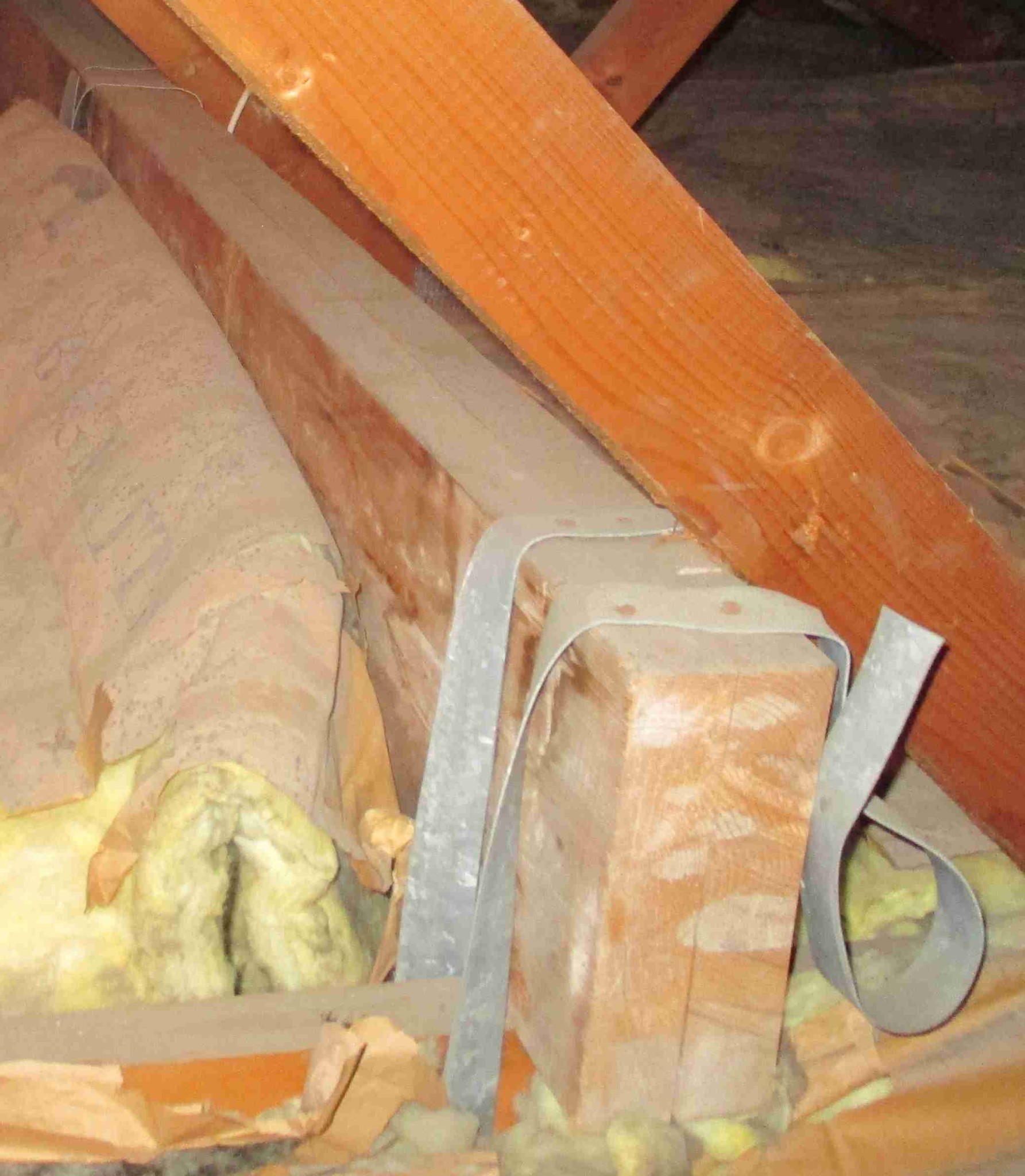
There are two nailed together 45x220 joists supporting the lower chords of three trusses (WW-type) with 1.5mm x 35mm galvanized steel straps (nailed to the beam as a loop).
Is this really done correctly?
Won't the straps break during a fire with the subsequent significant temperature increase?
They are only protected by the insulation in the lower chord compartments.
I don't really see how it connects, but I can guarantee that the entire roof isn't hanging from these steel bands, otherwise it would have collapsed after a few hours....
Is there any dormer or what is the purpose of them being there? Normally, laminated beams are mounted similarly when the rafters are shortened to build a dormer. Their role is to absorb loads that affect the entire roof structure when a roof is built at an angle to the main roof. Significant forces impact the stability of the entire roof when it is very windy, with both pressure and tension/lift forces affecting the structure. This means they must be properly anchored in each truss that needs stabilization. No roof hangs on these, but the function should be investigated. If you have drawings that match the construction, take them to someone who can calculate what this construction can withstand.
A carpenter I know, who did some work in my first house (which was from the 1820s) had a motto: Don't worry the old!
In other words, something that has held and functioned for 100 years should not be changed without very good reasons. Otherwise, you don't know where it might end.
But
I looked up in the attic (not furnished as the roof pitch is 14°) and am considering beam replacement to expand the open space in the living room.
What is it really you want to achieve? The space in the living room doesn't get bigger just because you tinker with the trusses, does it? (Open space?)
Generally speaking, if you want stronger beams, probably the easiest way is to replace wooden beams with steel ones.
Fun with so many people thinking and commenting, one bows and thanks
It has held for nearly 40 years, so it undeniably works.
The house is about 9m wide and has a load-bearing wall under the rafters (0.8m from the centerline/ridge) except in the living room which has a 3m opening. I wish to increase this by 2m, hence the considerations.
The beam is nailed to 5 rafters (with a 100mm nail) where the outermost ones are supported by gable wall and 'heart wall' (all ties have this steel band except the gable support). So, it seems three hang on the beam.
I have read that this truss construction with the right dimensions can very well handle this span on its own, but I don't understand why this beam is there, and specifically over the opening in the living room.
Apart from a couple of holes for electrical in the sub-arm, the rafters are complete (no skylight/dome) and they look prefabricated to a novice.
Yes, the beam is also nailed into the innermost W-brace if that matters.
I believe the two 45x220's are there to replace the heart wall where you have a 3m opening. That is, to ensure the roof doesn't sag into the opening.
Yes, there are trusses that can handle the dimensions you have on the house, but it's not at all certain that yours are designed for that.
If you then want to extend the opening by 2m, you will need a more robust (perhaps what you have is enough) but above all a longer beam to replace the part of the heart wall you want to remove (attached from above, thus suspended).
...
The house is approximately 9m wide and has a continuous load-bearing? wall under the trusses (0.8m from the center line/ridge) except in the living room which has a 3m opening. I wish to increase this by 2m, hence the considerations...
I have a newly built house (built in 2010) with a similar construction.
The open span over the living/dining room is 5140 mm.
The width of the house is 8400 mm.
The load-bearing wall is replaced with a 5400 mm long HEA beam with a height of 220 mm.
This beam is invisibly located in the joist, which is 290 mm thick.
The rafters are of the framework type, and the bottom chords are divided in the middle, where they are supported by the steel beam.
The attic is mostly used for storage.
Certainly a cumbersome procedure to arrange afterwards, but not impossible
It is equally effective to place a beam on top of the truss's bottom chord as it is already done.
1. Prop up the roof including the section of the heart wall that is to be removed.
2. Dismantle the existing beam (2 pieces 45x220).
3. Install a longer beam (wood or steel) that should rest on the heart wall at both ends.
4. Strap the trusses to the new beam. There are special brackets for this if you don't like steel bands.
...
4. Hang the trusses in the new beam. There are special brackets for this if you don't like steel bands.
It strikes me that the truss factory (Derome) delivered with steel bands for my divided trusses.
But the carpenters extended the 220 millimeter trusses with a 70 mm stud instead.
The steel bands are lying around somewhere...