
Hello!
I'm working on a design for an extension with a frame made of isoleca.
It will mostly be 1 1/2 stories.
One room will be completely open from ground level to the ridge (without intermediate flooring).
To the question.
Can the glulam beam at the ridge, with a column load of about 20kN, be supported by the gable peak?
It will be about 5.5m from the slab to the underside of the beam. The load will be distributed with beam blocks at several levels.
Can I build this wall with load-distributing beam blocks and vertical reinforcements considering wind loads, etc.?
Or do I need to place a steel beam on the inside to support the roof beam?
Maybe a pure construction question, just wanted to check your views.
I'm working on a design for an extension with a frame made of isoleca.
It will mostly be 1 1/2 stories.
One room will be completely open from ground level to the ridge (without intermediate flooring).
To the question.
Can the glulam beam at the ridge, with a column load of about 20kN, be supported by the gable peak?
It will be about 5.5m from the slab to the underside of the beam. The load will be distributed with beam blocks at several levels.
Can I build this wall with load-distributing beam blocks and vertical reinforcements considering wind loads, etc.?
Or do I need to place a steel beam on the inside to support the roof beam?
Maybe a pure construction question, just wanted to check your views.
Is the load really not larger than that?
How did you calculate it?
Regarding the wall's load-bearing capacity:
Stability depends on both the load, the unsupported height, and the thickness of the wall.
So it isn't possible to say anything definite without more data.
Reinforcement in the wall, both horizontally and vertically, increases the load-bearing capacity.
A last resort is to make a local thickening, a contrefort, to support the roof.
Another problem you should consider is how you will relieve the wall above your windows. Especially thinking about the top ones!
How did you calculate it?
Regarding the wall's load-bearing capacity:
Stability depends on both the load, the unsupported height, and the thickness of the wall.
So it isn't possible to say anything definite without more data.
Reinforcement in the wall, both horizontally and vertically, increases the load-bearing capacity.
A last resort is to make a local thickening, a contrefort, to support the roof.
Another problem you should consider is how you will relieve the wall above your windows. Especially thinking about the top ones!
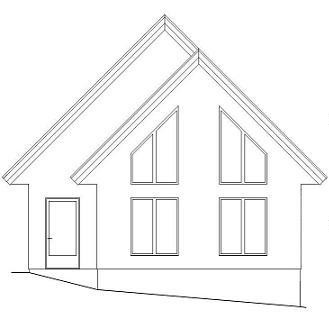
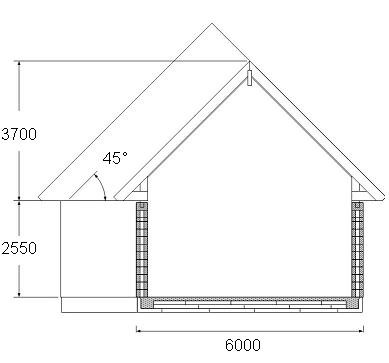
Here's what my thought looks like.
The beam's column load I got from MOELVEN.
19.8 kN for a 4.6m long beam.
Width of the house, 6m with a 45-degree roof slope and heavy roof.
About 6.3m from floor to ridge and 5.6m to the bottom of the beam.
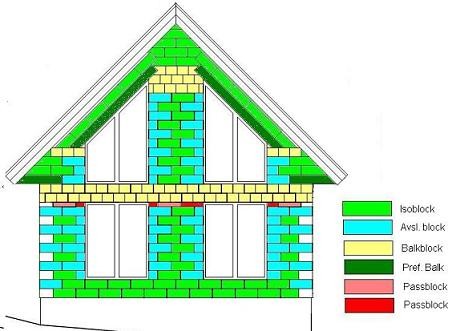
The load is distributed with beam blocks as the image shows.
I was thinking of using prefabricated beams above the upper windows.
I'm not quite sure about the reinforcement considering the wall's height.
The wall is built with 30cm isoblock, the image shows my suggestion.
Am I completely off track?
Have I missed any data?
Grateful for a continuation of this thread.
The beam's column load I got from MOELVEN.
19.8 kN for a 4.6m long beam.
Width of the house, 6m with a 45-degree roof slope and heavy roof.
About 6.3m from floor to ridge and 5.6m to the bottom of the beam.
The load is distributed with beam blocks as the image shows.
I was thinking of using prefabricated beams above the upper windows.
I'm not quite sure about the reinforcement considering the wall's height.
The wall is built with 30cm isoblock, the image shows my suggestion.
Am I completely off track?
Have I missed any data?
Grateful for a continuation of this thread.
The load seems OK!
The slenderness ratio is approximately 18.7, which strongly reduces the wall's load-bearing capacity. Maxit specifies a permissible load of 17kN per shell, i.e. 34 kN if both shells are utilized, at a wall height of 3 m. (Slenderness ratio 10) Based on what I've found in my old tables, the permissible load is reduced by about 20-30% when the slenderness ratio goes from 10 to 19. This would mean that the wall should hold.
However, I would recommend that you send your sketch to Maxit and hear their perspective on the matter.
It seems like you have thought through the window solutions. Possibly you have drawn in a few too many beams. They create thermal bridges, so don't include more than you absolutely need.
The slenderness ratio is approximately 18.7, which strongly reduces the wall's load-bearing capacity. Maxit specifies a permissible load of 17kN per shell, i.e. 34 kN if both shells are utilized, at a wall height of 3 m. (Slenderness ratio 10) Based on what I've found in my old tables, the permissible load is reduced by about 20-30% when the slenderness ratio goes from 10 to 19. This would mean that the wall should hold.
However, I would recommend that you send your sketch to Maxit and hear their perspective on the matter.
It seems like you have thought through the window solutions. Possibly you have drawn in a few too many beams. They create thermal bridges, so don't include more than you absolutely need.
Have tried reaching some of the constructors on their list without success.
What do you think about the reinforcement?
According to Maxit, the horizontal reinforcement will be inadequate given the height of the windows.
Could vertical reinforcement at all the windows be sufficient to handle the wind load?
Perhaps it will still end up being a steel beam....
Thanks for the responses...
What do you think about the reinforcement?
According to Maxit, the horizontal reinforcement will be inadequate given the height of the windows.
Could vertical reinforcement at all the windows be sufficient to handle the wind load?
Perhaps it will still end up being a steel beam....
Thanks for the responses...
Click here to reply