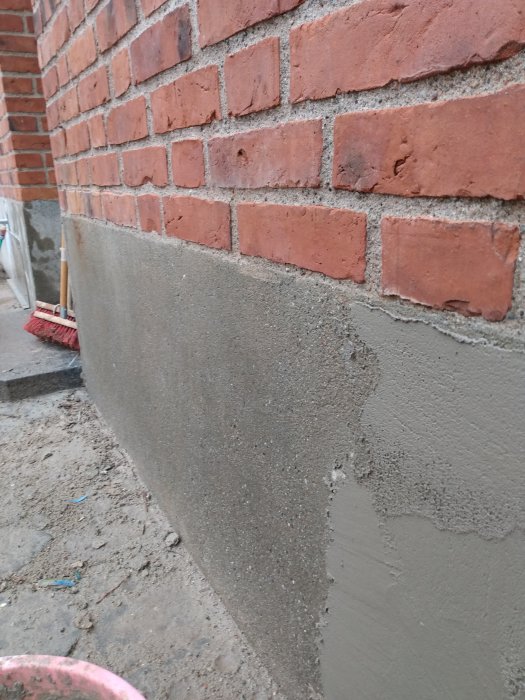
Polished the foundation wall in two sessions. Went over with rubbing yesterday and the result was probably okay.
However, today I see that there are some small issues that aren't quite perfect. I could probably live with it, but the question is if I can go over the surface again with some fine-tuning without having to apply 3mm everywhere! The risk is that it will just turn out the same, so if that's the case I'll probably skip it and settle.
By the way, plastered with C-bruk 0-3 which, according to instructions, has a minimum plaster thickness of 3mm.
I also found it quite hopeless to rub and get it even and nice like you see on YouTube Occasionally, a small grain comes up and "tears" the smooth surface.
You have too little mortar for that ballast, then the grains roll against the substrate and form so-called roses. 0-3 means that the grains are up to 3 mm, so you need at least one cm to properly plaster with such coarse mortar. Since you used c-mortar, you can buy a Weber 135 and apply with a trowel, then float it, and it will be much better. C is, however, too hydraulic and weak to use on a foundation, but since it's already done, just continue and hope it holds. It will likely last for a good while anyway, but with mortar, a good plaster should last at least 50 years, so it will last significantly less than that, but it can still stay up for 20 years even if it's the "wrong" mortar.
C was chosen because there is old plaster behind it (from the 80s) and the recommendation was that it's safest to go with C so as not to apply something stronger... Regardless, the mortar is in place, and if I have to redo this step in 20 years, that's a problem for later...
Back to the "roses," I have plastered 1cm quite precisely, so it's not because the mortar is too thin.
I have troweled the surface as it is now, but is it okay to apply Weber's 135a directly on this surface then? There's no risk that the layer will be too thin in some places?
No, the 135 is for thin coats and is suitable for troweling on and is very easy to float. Regarding floating, don't try to close too large holes; it's better to apply a little bit of material where needed.
Then it's quite crucial to catch it at just the right time; if you float too early, it follows the float, creating a vacuum between the float and the wall, causing it to stick to the wall. If you do it too late, when it's almost white, you'll get shiny spots and a very uneven surface.
When it's just right, dip the float in water at the beginning; then you don't need water as much, other than to scrape off the material a little now and then.
Ok! Thanks for the valuable info. But it doesn't sound very easy, what you're describing... Can you give a hint about the time we're talking about? I've been rubbing for about 2 hours now and it felt good to begin with, but I'm noticing that you "catch up" with what you've polished (rubbing goes faster than polishing).
If I understand the procedure correctly:
1. The surface as it is, is ok, rubbed 0-3 so I just water it
2. "apply with steel," kind of like "spreading" the wall with Weber's 135
3. Wait (according to my guess) 2 hours and start rubbing
I just want to be a bit overly clear because it's such a darn job that you don't want to make mistakes...
Water before but not just before, spray everything and go mix mortar so it's good when it's ready.
It will dry faster now but it sounds like you have it under control.
One of these is a trowel, but if you don't want to buy one you can use a spatula too, but it's more difficult since a spatula can't hold as much mortar at once. https://www.google.com/search?q=glä...Ag&biw=360&bih=616&dpr=2#imgrc=4OKAjFobxEH_NM
A bit anxious that the now relatively nice plaster will get worse. You're not supposed to move it when you trowel, so isn't there a risk that you won't get it completely flat?
When I applied the last layer, I set wooden strips to get a straight and nice "plane," but it doesn't sound like I should do that now, just let the fine plaster follow the substrate and fill in where there are imperfections of a few mm.
But do you apply this "freehand" or should you set like a 2mm strip to draw against... feels almost impossible though so I guess I'll just have to test it.

 Occasionally, a small grain comes up and "tears" the smooth surface.