I have a "problem" I can't quite get a handle on...
I need to secure the gun cabinet to the "Frame" of the house = stud in the wall or floor...
I tried using a stud finder where I intend to place it, but I'm not getting consistent results... different results at different heights...
The room is also divided (unclear how/when/in what phase/which wall came first, where the starting point was, etc.) making it difficult to measure the distance between the studs...
So I have no clue how to find the stud...
The alternative is to secure it to the floor... but I have no idea how the floor is underneath. It should be a concrete slab under the wooden floor, but how far down?
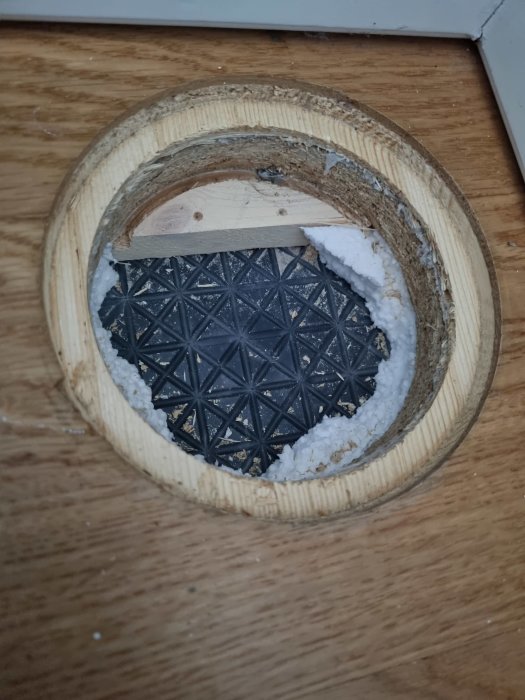
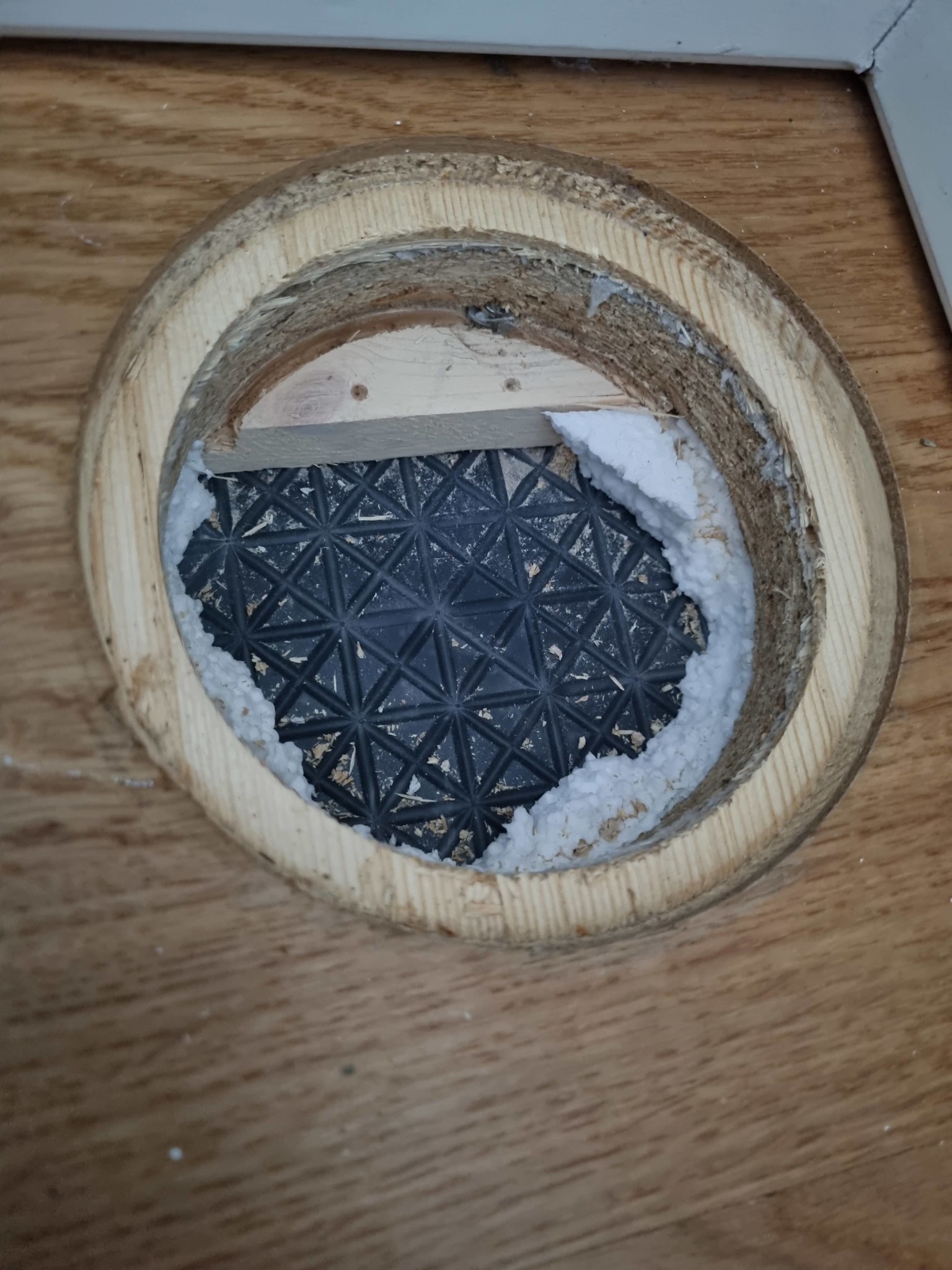
I did find the hole where they took samples to check for moisture, etc., but it's in the neighboring room where the floor is a bit higher... (former garage), see image.
How should I proceed to find the right method to secure the cabinet?
No, you don't have to attach the cabinet to the frame. You can do that or add weight to it so it exceeds 150kg.
A common alternative is to cast a concrete slab and place the cabinet on it, then attach the cabinet to it.
However, I recommend attaching it to the wall regardless, as many of the smaller cabinets tend to become a bit front-heavy when the door is open. But in that case, attaching it to a "regular" wall, like using wood screws in OSB or gypsum anchors, is often sufficient since the force required for support is not particularly large.
With a decent magnet, I usually find the screws that the drywall panels are fastened with. They are usually located in the studs. I assume now that I interpret the image as being a fairly modern house and not, for example, a plank frame.
No, you don't have to attach the cabinet to the frame. You can do that or add weight so it exceeds 150kg.
A common alternative is to cast a concrete slab and place the cabinet on it, and attach the cabinet to it.
However, I recommend attaching it to the wall nonetheless, as many of the smaller cabinets become a bit front-heavy when the door is open. But often just attaching it to a "regular" wall, like with wooden screws in OSB or drywall anchors, is sufficient since the force needed to counterbalance isn't particularly large.
If nothing else works, I would be tempted to cut a hole in the wall (plasterboard?) and see what's behind it, both for the cabinet's sake and in general. Then either just repair the gap or install studs if needed.
If it's OSB+ gypsum, I usually just tap along the wall with a hammer and listen for when the sound becomes more "dull". But if it's a nicer wall that you want to be careful with, it often works well to remove the floor/ceiling trim and look for seams.
Turn off the lights in the room and take a flashlight and hold it against the wall so you get raking light, then you can usually see the panel joints and even some screws that are screwed in the middle of the panel.
Jag ringde Polisen och de sa att kassaskåpet behöver vara fastsatt så det inte enkelt kan flyttas, men det finns ingen regel för hur—bara se till att det är stabilt och säkert.
I called Polisen and they said the safe needs to be attached so it can't be easily moved, but there's no rule on how—just make sure it’s stable and secure.
No, once again, it doesn't have to. It completely depends on which cabinet! If the cabinet weighs over 150kg, it's not necessary. If it weighs less, you can attach it to the wall, to the floor, or make the cabinet heavier by increasing its weight.
I called Polisen and they said the safe needs to be attached so it can't be easily moved, but there's no rule on how—just make sure it’s stable and secure.
Thread of the year?
The problem is, just like with the key for the cabinet, it shouldn't be accessible to the thieves. You can hide it as well as you want, but if they find it, it wasn't hidden well enough.
Just like the cabinet, if they've moved the cabinet, the licenses are at risk... but you don't know that until afterwards.
Regarding the key, I chose a code lock, and with the cabinet, it became a combo of weighing it down and bolting it...
The problem is, just like with the key for the cabinet, that it shouldn't be accessible to thieves. You can hide it as well as you like, but if they find it, it wasn't hidden well enough.
Just like the cabinet, if they've moved the cabinet, the licenses are in a bad position... but that's something you only find out afterward.
Regarding keys, I chose a code lock, and with the cabinet, it was a combination of weighting it down and bolting it in place...
/Jocce
I have a 154kg cabinet with a code lock. Perfect with a slightly larger cabinet if you have room for it.
I had the same issue when I moved into a house with lightweight walls. I ended up using chem anchors into the concrete floor instead. If you're still trying to figure out the best option, you can check out https://www.libertysafe.com/collections/home-safes —they've got some good info and options that might save you some time and guesswork.
Click here to reply
Vi vill skicka notiser för ämnen du bevakar och händelser som berör dig.



Jocce81 said:
Thread lift of the year?