

Hi,
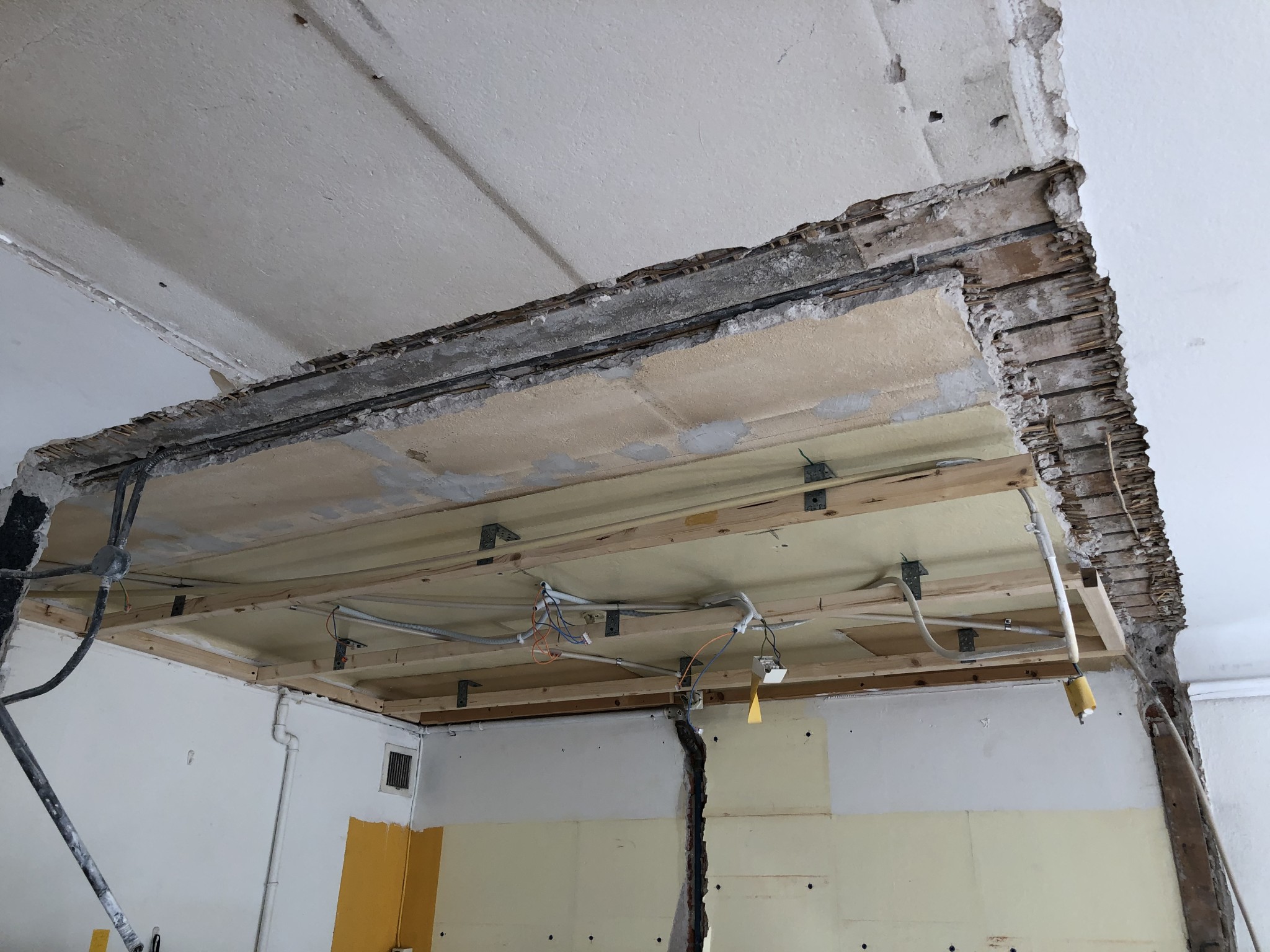
I have torn down lightweight concrete walls in my apartment and now I have a couple of "channels" where the walls previously stood that need to be filled. They are about two centimeters deep, a decimeter wide, and a couple of meters long, as seen in the image below. Now it’s time to fill these in so I can proceed to paint the ceiling.
My idea was to fill in with plaster, and add a few nails for stability and then sand it down to make it even. Am I on the right track? Anything else important to consider?
I have torn down lightweight concrete walls in my apartment and now I have a couple of "channels" where the walls previously stood that need to be filled. They are about two centimeters deep, a decimeter wide, and a couple of meters long, as seen in the image below. Now it’s time to fill these in so I can proceed to paint the ceiling.
My idea was to fill in with plaster, and add a few nails for stability and then sand it down to make it even. Am I on the right track? Anything else important to consider?
Building conservationist
· Malmö
· 256 posts
Try to bring out a bit more reed, about 5 cm, then you need to prime all the wood with a suitable primer.
kloasong walls and similar structures were discontinued in the 1940s, so it's most likely a lime mortar that is there.
Prime, then screw (nails will loosen even more due to movements) a plaster mesh with stainless screws that overlap the reed.
Then plaster with lime mortar, first a layer that covers everything but not all the way out to the surface.
However, it's important that you throw the mortar on when plastering up and down. There is no room for weaker vacuum on the ceiling, especially not when there's mesh as well.
The next day, you can apply the next layer, also a lime mortar but with less ballast and then finish it.
kloasong walls and similar structures were discontinued in the 1940s, so it's most likely a lime mortar that is there.
Prime, then screw (nails will loosen even more due to movements) a plaster mesh with stainless screws that overlap the reed.
Then plaster with lime mortar, first a layer that covers everything but not all the way out to the surface.
However, it's important that you throw the mortar on when plastering up and down. There is no room for weaker vacuum on the ceiling, especially not when there's mesh as well.
The next day, you can apply the next layer, also a lime mortar but with less ballast and then finish it.
How big is the room? When it's damaged like this, I would consider putting drywall on the ceiling to create a uniform surface throughout the room.
I had a dropped ceiling that was taken down and found it extremely difficult to first get something to attach upside down in a dusty hole with reeds and plaster and then to make it completely smooth with putty.
I first made sure to remove all high points, then I screwed the drywall directly to the ceiling (looks more difficult in your case).
I had a dropped ceiling that was taken down and found it extremely difficult to first get something to attach upside down in a dusty hole with reeds and plaster and then to make it completely smooth with putty.
I first made sure to remove all high points, then I screwed the drywall directly to the ceiling (looks more difficult in your case).
Click here to reply