
186,070 views ·
173 replies
186k views
173 replies
Filling crawl space with foam glass / cellular glass / hasopor?
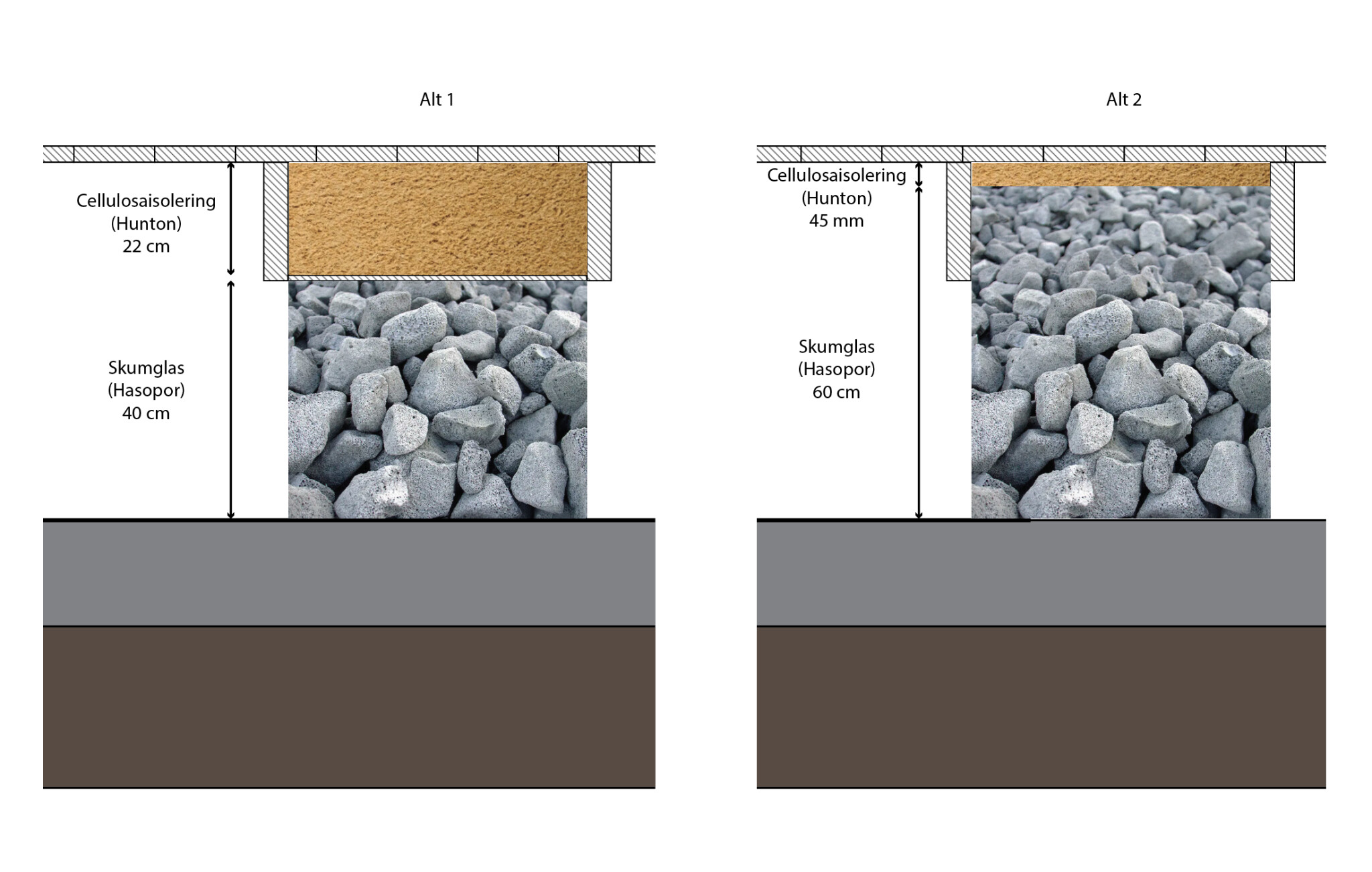
Thank you! If I understand you correctly, this sounds similar to my original idea (Image 1). Do you recommend Hasopor up to the joists and then cellulose insulation in the compartments instead of the alternative with Hasopor all the way up to the floor?
U
Utsliten och utdömd
Building conservationist
· 2 840 posts
Utsliten och utdömd
Building conservationist
- 2,840 posts
Yes, at least if the Hasopor layer is thinner than 50cmA andrhedb said:
It's also easier to get the insulation tighter against the underside of the floor if you use cellulose or wood fiber. If you're going to have Hasopor up to the top edge of the joists, you'll almost need to apply a clay layer or something similar to avoid drafts under the floorboards.
U
Utsliten och utdömd
Building conservationist
· 2 840 posts
Utsliten och utdömd
Building conservationist
- 2,840 posts
I've chosen option 1 there. Shoveling Hasopor is not fun, so preferably as little as possibleA andrhedb said:

Pretty expensive too
As an addition, the moisture in the crawl space can come from the ground, but it’s typically when the air warms in the spring, which then enters the cold crawl space and condenses against the cold wooden structure.MathiasS said:
If you want to handle the issue of moisture in the crawl space, you usually lay building plastic.
If you have major problems with radon (do you have any problems at all with radon?), it might be worth considering a radon mat, but that feels like a completely different project than what you're working on. Moreover, if you use building plastic and ensure that it is TIGHT at the joints and against the walls, etc., you will definitely reduce radon levels enough that you don't need to consider an expensive radon mat. IF it turns out that this cheap measure is not enough, prepare for a small radon suction by laying a drain pipe under the plastic where you can create a slight underpressure with a fan. In that way, you have cheaply acquired a radon-secured solution.
...but, before you even think about radon - do a measurement. If you have no radon, go back to sleep and do a new measurement in a few years.
Why not replace the crushed stone with foam glass?
Then @ Utsliten och utdömd why would it cause floor drafts?
Aren't alba-beams and crushed stone/bearing layer + 30 cm of foam glass sufficiently airtight?
Then @ Utsliten och utdömd why would it cause floor drafts?
Aren't alba-beams and crushed stone/bearing layer + 30 cm of foam glass sufficiently airtight?
U
Utsliten och utdömd
Building conservationist
· 2 840 posts
Utsliten och utdömd
Building conservationist
- 2,840 posts
Because the air under the plank floor (or chipboard, etc.) can circulate in the joist bays. Very common phenomenon.Oldboy said:
It's not about the tightness against the external climate, but just that there shouldn't be a pocket or space directly under the floor where the air can circulate.
We have a foundation wall that is plastered inside and outside and filled the foundation with hasopor. We took in three opinions from carpenters when we did it; all recommend either clay on the hasopor or wood fiber/cellulose insulation to avoid drafty floors.
I still have difficulty understanding how or why air under the floorboards would circulate/draft unless there is air leakage in and out of the foundation.
From personal experience and according to literature, it drafts cold if there is air leakage in the foundation or a structural beam. This effect is very noticeable when it's cold in the winter and even more so if it's windy.
I suspect this is because a brick foundation can crack, and a natural stone foundation is naturally leaky between the stones. It's an effect I can also imagine through macadam and/or foam glass. So, eliminating the air gap is probably an extra protection against the ravages of time and unforeseen events.
Hmm, I seem to have answered my own question..., or are there more aspects? 🤔
From personal experience and according to literature, it drafts cold if there is air leakage in the foundation or a structural beam. This effect is very noticeable when it's cold in the winter and even more so if it's windy.
I suspect this is because a brick foundation can crack, and a natural stone foundation is naturally leaky between the stones. It's an effect I can also imagine through macadam and/or foam glass. So, eliminating the air gap is probably an extra protection against the ravages of time and unforeseen events.
Hmm, I seem to have answered my own question..., or are there more aspects? 🤔

Building conservationist
· 3 534 posts
I have had the same question: how can there be a draft from a closed foundation? But maybe there can be air movements between warm and cold, humid and non-humid? So, even without contact with the outdoors?I still have trouble understanding how or why air under the floorboards would circulate or cause a draft if there are no air leaks in and out of the foundation.
From my own experience and according to literature, it drafts cold if there are air leaks in the foundation or a floor structure. This effect is very noticeable when it's cold in winter and even more so if it's windy.
I suspect it's because a masonry foundation can crack, and a natural stone foundation is naturally not sealed between the stones. I can also imagine this effect through gravel and/or foam glass. So, eliminating the air gap is probably an extra protection against the ravages of time and unforeseen events.
Hmm, now it seems I've answered my own question..., or are there more aspects? 🤔
In any case, I have now taken all floor draft warnings seriously and am placing a layer of clay between the filling and floorboards, even though the project is delayed and more expensive.
Yes, that's difficult to definitely say that it can't happen, but in my world it's quite unlikely. Air can "flow" like water but it's always that cold air settles in a hollow and warm air rises. These effects become more noticeable the greater the height and temperature difference (e.g. chimney effect). I recall that Harrysson in some study of wall insulation noted that air pockets were much worse if they extended from top to bottom than if they ran horizontally. Floors are horizontal, and not much of an air gap is needed for it to cause a draft. It doesn't seem likely/probable that a draft would occur if the foundation is completely sealed. However, if the foundation is the slightest bit unsealed, it becomes extremely likely/probable that there will be a draft. This is due to the thermal effect present in all heated houses, where the warm air rises and needs to be replaced, which is done by cold air being drawn in from below.
I don't know whether moisture affects air movements. However, I haven't heard anything about it. If there is such an effect, it's presumably marginal in this context.
We are considering a similar setup, a foundation of albabalks plastered on the outside, a diffusion-open wind barrier on the inside of the balks, Hasopor in the foundation, and cellulose insulation in the floor joist cavities.U Utsliten och utdömd said:
I am now wondering if the insulation can be placed directly on the Hasopor? Or is a wind barrier and/or air gap needed between the Hasopor and the insulation?
It should be possible to place insulation directly against the hasopor. However, a wind barrier in between would prevent any potential air leakage at the foundation wall from passing through the top layer of the hasopor.A andrhedb said:

What dimension did you choose for the floor joists? I'm going to fill my old cottage with foam glass this summer but I'm not quite sure what to choose for the floor structure.Z Zebula said: