
186,177 views ·
173 replies
186k views
173 replies
Filling crawl space with foam glass / cellular glass / hasopor?


I have now read through the entire thread and plan to do something similar myself. But why don't many people use perlite? It seems to have much better insulating properties, which means you don't have to dig out as much.
Does the perlite need to be compacted, or is it packed directly when you lay it out? How does the perlite support, can you cast a slab directly on it (perhaps with some geotextile in between)?
Those of you sealing the foundation stones against the sill beam with clay mortar, how do you think about moisture migration etc. through the clay from the ground up into the sill? I am a bit worried about that even if I probably have nothing to worry about.
In my case, the house is situated on a gravel ridge and everything is dry and nice after several hundred years even though it had linoleum flooring for at least 50 of those years.
I plan to frame the floor joists and fill up with perlite, then underfloor heating pipes between the joists and "cast" them in with clay mortar for the top 3 cm. Then onto solid wood flooring. Except where I will have a bathroom, there I plan to cast a slab directly on the perlite.
Does the perlite need to be compacted, or is it packed directly when you lay it out? How does the perlite support, can you cast a slab directly on it (perhaps with some geotextile in between)?
Those of you sealing the foundation stones against the sill beam with clay mortar, how do you think about moisture migration etc. through the clay from the ground up into the sill? I am a bit worried about that even if I probably have nothing to worry about.
In my case, the house is situated on a gravel ridge and everything is dry and nice after several hundred years even though it had linoleum flooring for at least 50 of those years.
I plan to frame the floor joists and fill up with perlite, then underfloor heating pipes between the joists and "cast" them in with clay mortar for the top 3 cm. Then onto solid wood flooring. Except where I will have a bathroom, there I plan to cast a slab directly on the perlite.

One advantage of hasopor over perlite is the dust. For various reasons, I had both in the chamber, starting with perlite along the foundation wall and then hasopor inside the room. Despite wearing a mask, my airways were quite displeased with me in connection with the perlite. Apart from that, I can see certain advantages with it, as it is so much smaller, I found it to be much more 'resistant to drafts,' (it was windproof, but the cold from the cold foundation wall seemed to flow out, the perlite stopped it faster than hasopor). I seem to recall that the threshold for capillary breaking is lower as well, but that was a year ago and my memory isn't always entirely reliable.
The perlite doesn't support at all?
Hasopor/foam glass is quite difficult to handle with high friction, hard to get into small spaces - but once it is packed and in place, it provides a stable foundation.
The perlite flows more like water and is good for filling small spaces, but as mentioned, it doesn't support anything.
Hasopor/foam glass is quite difficult to handle with high friction, hard to get into small spaces - but once it is packed and in place, it provides a stable foundation.
The perlite flows more like water and is good for filling small spaces, but as mentioned, it doesn't support anything.
Clay always has a lower moisture content than wood in dry conditions. Wood is preserved by clay. I used perlite between the floor joists and the foundation wall/sill. My floor joists are not attached to the sill but were constructed roughly according to the same principles as they did over 100 years ago. Drained foundation, gravel, XPS slab, and then Leca blocks as carriers of the floor joists. I used XPS to distribute pressure so that the Leca blocks don't "settle" afterward. To create a pocket for the perlite, I screwed boards that follow the foundation stones. Then I crammed in steel mesh which I then sprayed with foam to secure it. From above, I then poured perlite so that it became insulated between the sill and the floor joists. I didn't want foam in between because the floor joists should be able to move slightly compared to the house, and perlite breathes more than foam.
I have sealed the stone foundation with clay, it is a perfect material for this. Easy to work with from both sides, if you are worried about moisture movement, you can spray foam between the stones and then clay plaster over it. Where it is not visible, you can use foam to "cut off" the clay, making moisture movement impossible. In practice, the clay is always very dry, and if it were to absorb so much moisture that it reaches the sill, there is a drainage error.
Clay adheres excellently to foam
Why not just use joist plates and install underfloor heating? Then you skip the whole step of clay plastering the floor. It is very important that the joists or the foundation are airtight. Instead, focus more on that. In all areas where clay meets wood, they had sealed with moss in my house a hundred years ago. The reason for this is that moss flexes and can seal even after the clay has dried. If you only put clay against the sill etc., there will always be gaps where air can move.
I have sealed the stone foundation with clay, it is a perfect material for this. Easy to work with from both sides, if you are worried about moisture movement, you can spray foam between the stones and then clay plaster over it. Where it is not visible, you can use foam to "cut off" the clay, making moisture movement impossible. In practice, the clay is always very dry, and if it were to absorb so much moisture that it reaches the sill, there is a drainage error.
Clay adheres excellently to foam
Why not just use joist plates and install underfloor heating? Then you skip the whole step of clay plastering the floor. It is very important that the joists or the foundation are airtight. Instead, focus more on that. In all areas where clay meets wood, they had sealed with moss in my house a hundred years ago. The reason for this is that moss flexes and can seal even after the clay has dried. If you only put clay against the sill etc., there will always be gaps where air can move.
Thank you for your opinions.
I like perlite mainly because it seems easy to work with and flows well into all the nooks and crannies. But foam glass seems good too.
Regarding the clay on top, it's to ensure it's cozy and windproof, which I'll do along the outer walls regardless. It feels good to do it around the underfloor heating as well, I just like clay mortar. I'm not too fond of the expanding foam that was suggested, so I'll skip that, but thanks for the tip anyway.
I think you are wrong KMNelhas about the perlite not bearing. There are instructions on how to pour a slab on it in a building. But there it needs to be compacted with a 60kg tamper before casting. I'm wondering if you can achieve the same effect by stomping or walking around on the material. However, I have emailed and asked for more information, so we'll see if I get a reasonable answer.
I like perlite mainly because it seems easy to work with and flows well into all the nooks and crannies. But foam glass seems good too.
Regarding the clay on top, it's to ensure it's cozy and windproof, which I'll do along the outer walls regardless. It feels good to do it around the underfloor heating as well, I just like clay mortar. I'm not too fond of the expanding foam that was suggested, so I'll skip that, but thanks for the tip anyway.
I think you are wrong KMNelhas about the perlite not bearing. There are instructions on how to pour a slab on it in a building. But there it needs to be compacted with a 60kg tamper before casting. I'm wondering if you can achieve the same effect by stomping or walking around on the material. However, I have emailed and asked for more information, so we'll see if I get a reasonable answer.
I would like to point out that perlite dust is very irritating. I would never, ever walk around with a pad on perlite. It's terrible.O Octavianus said:
I really recommend a joint between different building parts that flexes. Clay in the transition between floor and wall is not applicable. There will also be a gap between the floor and your clay layer where you risk getting drafts. Floor decking plates on top of insulation will give you a significantly better construction.
Clay is absolutely nice, but I wouldn't combine clay and underfloor heating under a wooden floor. If you want clay, I would skip the wooden floor. If you want a wooden floor, I would go with floor decking plates. You want full contact under the boards for heat transfer from the underfloor heating system, and no air gap.

I chose against it due to the lack of clear and detailed design and "installation" instructions. Something that unfortunately applies to several "alternative" insulation materials.O Octavianus said:
Please report back, it would be interesting to hear. I've only felt a little bit of the perlite and it felt roughly like water, but I could be wrong.O Octavianus said:I think you're wrong KMNelhas about the perlite not bearing weight; there are instructions on how to pour a slab on it in a building. But it needs to be compacted with a 60kg compactor before pouring. I wonder if you can achieve the same effect by stomping or walking around on the material. However, I have emailed and asked, so we'll see if I get a sensible answer.

Building conservationist
· 3 534 posts
Perlite "flows," which is why I choose to fill the foundation with foam glass. Compacted foam glass is stable and withstands pressure from different directions. I understand that it helps stabilize the foundation walls, without the risk of moisture that concrete casting involves. It's also possible to use perlite. The craftsman I spoke to explained that he usually lays a kind of fabric over it. Otherwise, you can't even walk on the perlite without sinking in!O Octavianus said:I have now read the entire thread and plan to do something similar myself. But why don't many people use perlite? It seems to have much better insulating properties, which means you don't have to dig out as much.
Does the perlite need to be compacted at all, or is it packed directly when you lay it out?
How does the perlite support weight, can you cast a slab directly on it (maybe with some geotextile in between)?
Those of you sealing the foundation stones to the sill beam with clay mortar, how do you consider moisture migration, etc., through the clay from the ground into the sill? I'm a bit worried about that even though I probably have nothing to worry about.
In my case, the house is on a gravel ridge and everything is dry and fine after a few hundred years, despite having a plastic mat for at least 50 of those years.
I plan to frame up floor joists and fill with perlite, then lay underfloor heating pipes between the joists and "cast" them in clay mortar for the top 3 cm. Then finish with solid wood flooring. Except where I will have a bathroom, there I plan to cast a slab directly on the perlite.
You can compact the perlite without much dust. You lay down geotextile and reinforcement mesh and strangely enough, pack on the reinforcement mesh! I actually thought the hasopor dust was worse. But it's only a day or so you have to wear the mask😂 It was dusty when I laid out the perlite but not during compaction. You can cast on it if you compact 15-17% according to their description. Then it is like EPS. Same insulation and same strength. They have a brochure on their site. I think people mostly consider what it costs per cubic meter and miss that you need much less amount with perlite.O Octavianus said:I have now read through the entire thread and will do something similar myself. But why don't many people use perlite? It seems to have much better insulation capacity, which means you don't have to dig out as much.
Does the perlite need to be compacted or is it packed directly when you lay it out?
How does the perlite support, can you cast a slab directly on it (perhaps with some geotextile in between)?
Those of you sealing the foundation stones against the sill with clay mortar, how do you think about moisture migration etc. through the clay from the ground into the sill. I'm a bit concerned about that although I probably have nothing to worry about.
In my case, the house is on a gravel ridge and everything is dry and nice after a few hundred years even though there has been linoleum flooring for at least 50 of those years.
I plan to set up floor joists and fill with perlite, then floor heating pipes between the joists and "cast" them in with clay mortar for the top 3cm. Then on with solid wood flooring. Except where I'm going to have a bathroom, there I'm thinking of casting a slab directly on the perlite.
First and foremost - thank you all in the thread for sharing so generously! I have been looking for more information on the use of Hasopor for a while, and this thread has been invaluable.
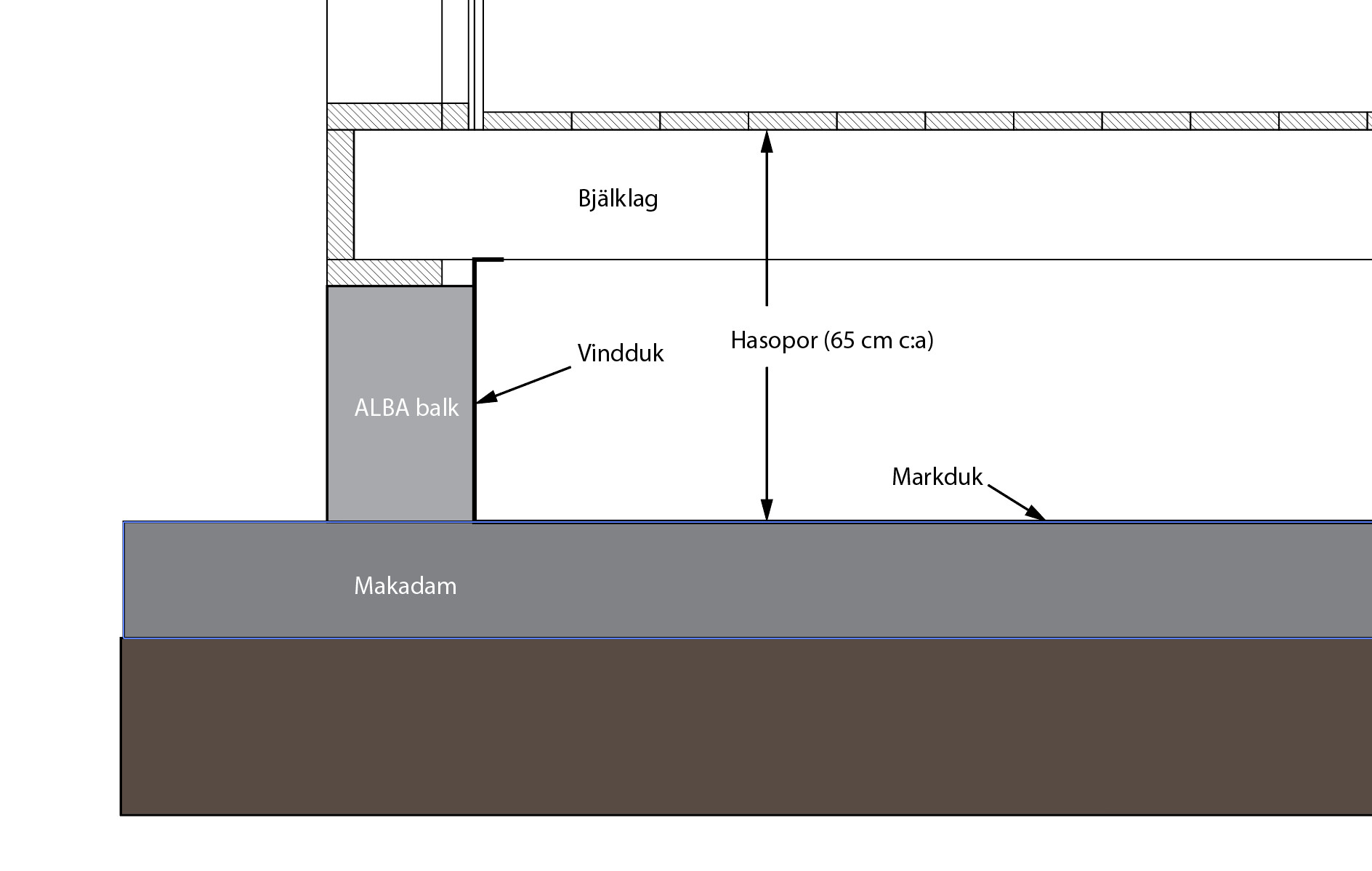
I am planning to build a guest house at our cottage in Bergslagen. I am planning for a diffusion-open construction with an ALBA beam crawl space and inspired by this thread, I want to insulate the foundation with Hasopor. Initially, I envisioned a solution according to Image 1.
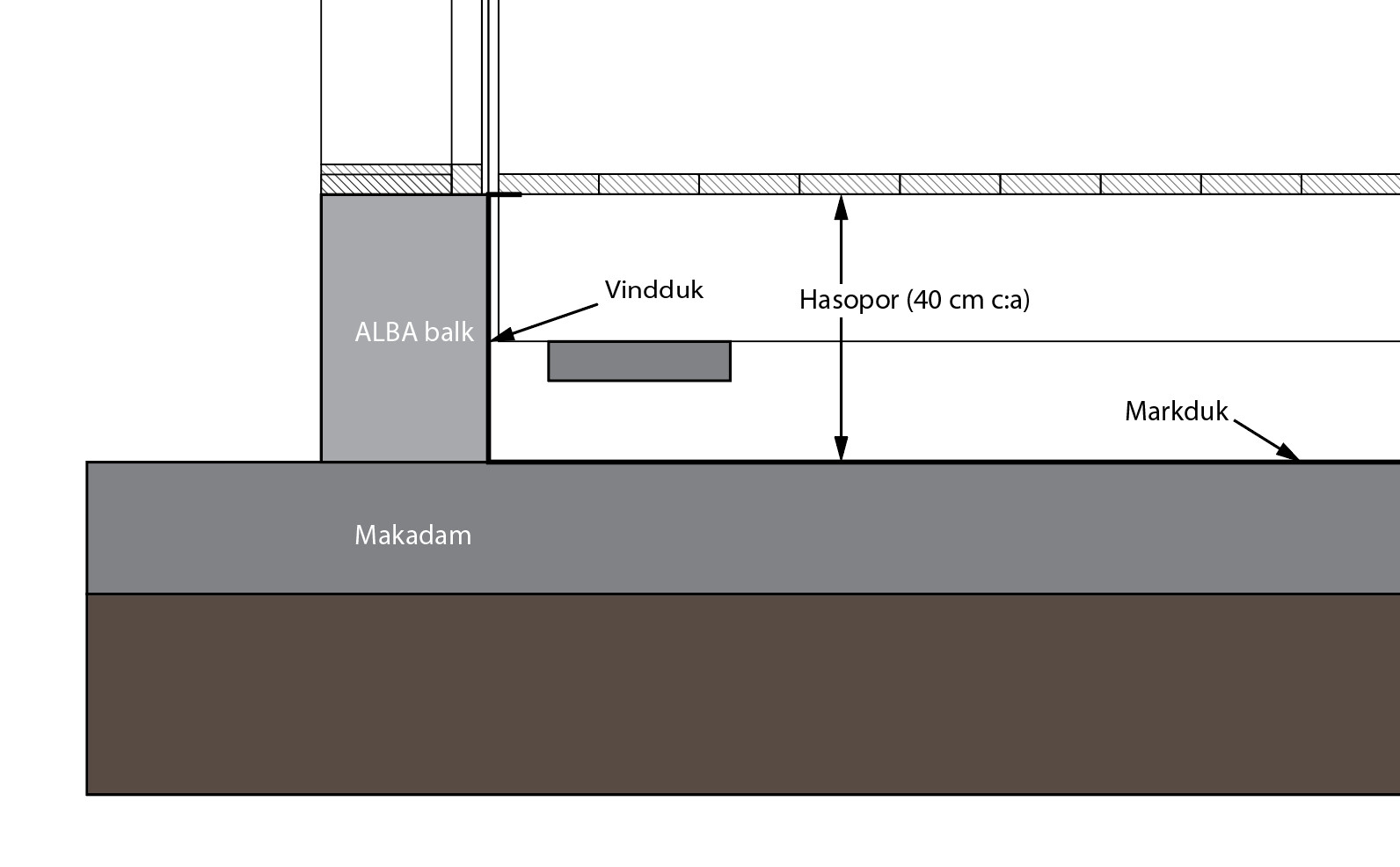
One challenge with the entire house-building project is that we need to adhere to a maximum height for the house and want to have as spacious a sleeping loft as possible. Now, after reading the later posts in this thread and seeing pictures of floating floor joists not attached to the sill, I've started considering another solution to "buy" myself approximately 25 cm extra height for the sleeping loft. The solution would be to lower the floor joists inside the ALBA beam and let it rest on concrete slabs (or directly in Hasopor?), according to Image 2.
Could it work, or are there any obvious risks or misconceptions?
I am planning to build a guest house at our cottage in Bergslagen. I am planning for a diffusion-open construction with an ALBA beam crawl space and inspired by this thread, I want to insulate the foundation with Hasopor. Initially, I envisioned a solution according to Image 1.
One challenge with the entire house-building project is that we need to adhere to a maximum height for the house and want to have as spacious a sleeping loft as possible. Now, after reading the later posts in this thread and seeing pictures of floating floor joists not attached to the sill, I've started considering another solution to "buy" myself approximately 25 cm extra height for the sleeping loft. The solution would be to lower the floor joists inside the ALBA beam and let it rest on concrete slabs (or directly in Hasopor?), according to Image 2.
Could it work, or are there any obvious risks or misconceptions?
U
Utsliten och utdömd
Building conservationist
· 2 841 posts
Utsliten och utdömd
Building conservationist
- 2,841 posts
Hasopor recommends having at least 30cm of foam glass up to the wood concerning moisture (the capillary rise in foam glass is 12-15cm).
50-65cm is needed to achieve adequate insulation.
In your case, I would have 30cm of foam glass to the underside of the joists and then place wood fiber insulation in the joist spaces to achieve a higher degree of thermal insulation.
50-65cm is needed to achieve adequate insulation.
In your case, I would have 30cm of foam glass to the underside of the joists and then place wood fiber insulation in the joist spaces to achieve a higher degree of thermal insulation.
U
Utsliten och utdömd
Building conservationist
· 2 841 posts
Utsliten och utdömd
Building conservationist
- 2,841 posts
I can't know the dimensions of the intended construction, but it will probably involve laying them on the Albabalken but cutting so they hang halfway underneath.U Utsliten och utdömd said:Hasopor recommends having at least 30cm of foam glass up to the wood in regard to moisture (the capillary rise in foam glass is 12-15cm).
50-65cm is needed to achieve adequate insulation.
In your case, I would have 30cm of foam glass to the underside of the floor joist and then place wood fiber insulation in the floor joist cavities to achieve a higher degree of thermal insulation.
The advantage of the old "mullbänk" when you had a completely floating floor construction was that they were easy to replace when they rotted. So, maintenance was taken into consideration. If you drain the house, use hasopor, and have the correct distance to the ground, with all the knowledge we have today, it won't be a problem that you need to replace everything every 30-50 years.