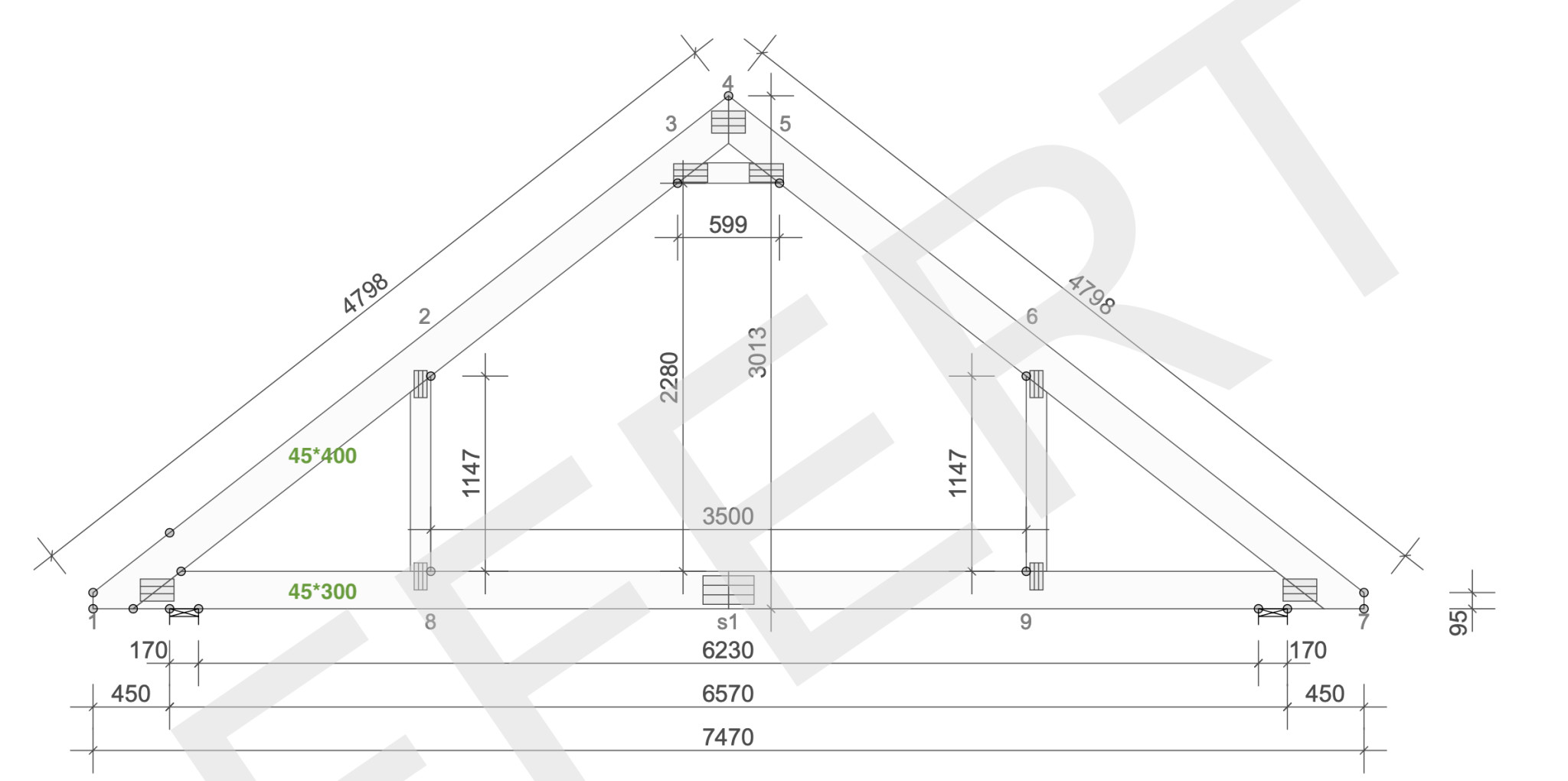
We will soon be constructing a loft garage, and the builders have suggested the following structure. What I would like feedback on is whether you think the loft will be stable enough to be furnished as a simple guest house.
Additional information:
Wall frames in 45x170 with c/c 600
Rafters in c/c 1200
Supplementary floor joists in laminated wood 56x270 that are both screwed into the lower arms and between the spaces, so c/c 600 is achieved
No central beam
Furthermore, I'm wondering which floor would be the stiffest?
floor chipboard 22mm as subfloor + laminate
solid pine flooring at 25mm
Do I gain anything from cross-bracing the floor joists, or is it just overkill? I think I should do it right once...
Stuck with chipboard, you also need a surface layer, laminate or something else. The wood flooring is good as it is, possibly with some varnish or something else.
But with particle board, you also need a surface layer, laminate or other.
The flooring wood is good as it is, possibly with some varnish or something else.
I agree that in terms of appearance and feel, the pine floor is preferable. However, regarding stability, it adds almost nothing since the interaction effect is nearly absent.
Thanks for the responses - I realize I forgot to mention the number of trusses and the dimensions of the garage. The garage is 7.3m deep and 6.7m wide. It will be supported by 7 trusses.
The only walls downstairs are the exterior walls, which will be clad with OSB and gypsum.
Agree that aesthetically and emotionally the pine floor is preferable. But in terms of stability, it provides almost nothing as the cooperation effect is almost completely absent.
But does it really? It is tongue-and-groove and should be glued and screwed at each contact point when I checked around. Additionally, chipboard flooring is heavier (higher density) followed by laminate/parquet.
Our small stable, 9 x 5.5 m, only has a "heart wall" of 3 m, between the wash stall and the tack room. The bottom chords of the trusses and the intermediate floor joists are 145 x 45 as I recall, and for flooring, I have laid ordinary rough board 22x95. And it suffices as a storage/warehouse for a bit of everything.
One can discuss which requirements are reasonable for a loft where you can't stand upright, but I think the subframes and intermediate glulam beams are quite weak considering the span. I would prefer to increase to 45x400 for the subframes as well and 66x360 for the glulam beams. With these dimensions, you can lay regular flooring. If you use screwed laminated board material, you can slightly reduce the beam dimensions.
One can discuss what requirements are reasonable for a loft where you can't stand upright. However, I think the lower frames and intermediate glulam beams are rather weak considering the span. I would like to go up to 45x400 on the lower frames as well and 66x360 on the glulam beams. With these dimensions, you can use regular flooring wood. If you use glued laminated sheet material, you can slightly reduce the beam dimensions.
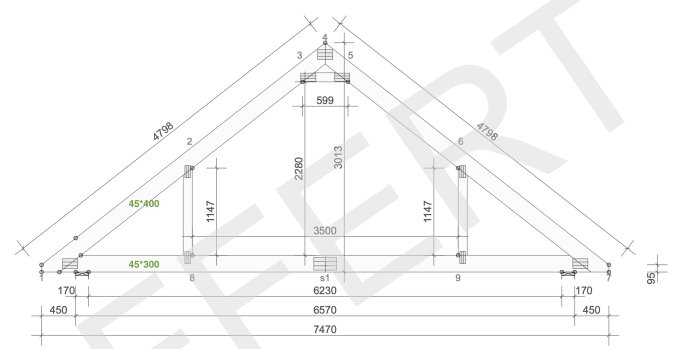
I now realize that the lower frame dimension is incorrect. I need to check exactly what it is and get back to you. The green text does not match 45x400 and 45x300.
But does it really? It is spontaneous and should be glued and screwed at every contact point when I checked around. Additionally, plank flooring is heavier (higher density) followed by laminate/parquet.
Didn't think it would be glued. Then it's a bit better, but just a little. Screw-glued board flooring still provides much more strength.
Click here to reply
Vi vill skicka notiser för ämnen du bevakar och händelser som berör dig.



KnockOnWood said:
AmirGBG said: