If there is space underneath, so you can access and nail or screw entire boards from below, it is naturally best.
You can fit more insulation and easily seal against air leakage.
A simpler option might be to do this.
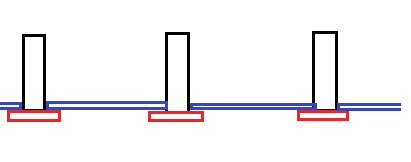
Namely, 22x45 planks under the floor joists, on which 10 mm construction plywood rests, forming the subfloor. Then you can seal with outdoor sealant where the subfloor boards meet the planks.
Black = 45 mm floor joists
Red = 95 mm support planks
Blue = 10 mm subfloor
The reason I'm careful to seal underneath is largely because our first house had a very drafty crawl space and was located in a windy area.
And it wasn't fun when the water froze in the toilet bowl due to the draft in -20°C winter storms.
A simpler alternative could be to do it like this. So 22x45 boards under the floor joists, on which 10 mm construction plywood rests, forming the subfloor. Then you can seal with outdoor sealant where the subfloor panels rest against the boards. [image] Black = 45 mm floor joists Red = 95 mm support boards Blue = 10 mm subfloor The reason I'm meticulous about sealing underneath is largely because our first house had a very drafty foundation and was located in a windy area. And it wasn't fun when the water froze in the toilet due to the drafts in -20°C winter storms.
That's how our subfloor is constructed, but instead of plywood we've used subfloor panels. Sold in the "right" dimensions so they fit directly at cc600.
screwed fiber cement boards from underneath on a project
good if you pre-drill the boards
but what about vapor diffusion resistance?
Isn't it wrong to have a completely vapor-tight material, which I assume the fiber cement boards are,
on the outside of the insulation?
A simpler alternative might be to do it this way.
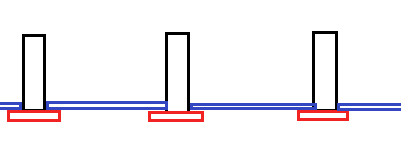
That is, 22x45 boards under the floor joists, on which 10 mm construction plywood rests, forming a subfloor. You can then air seal with outdoor sealant where the subfloor panels rest against the boards.
[image]
Black = 45 mm floor joists
Red = 95 mm support boards
Blue = 10 mm subfloor
The reason I'm careful with air sealing underneath is largely due to our first house having a very drafty crawl space and being in a windy location.
And it was not fun when the water froze in the toilet due to the drafts in -20°C winter storms.
Turns out the carpenters had already prepared for this solution
It was a bit silly of me not to check properly before I asked the question.




KnockOnWood said:
A simpler alternative could be to do it like this. So 22x45 boards under the floor joists, on which 10 mm construction plywood rests, forming the subfloor. Then you can seal with outdoor sealant where the subfloor panels rest against the boards. [image] Black = 45 mm floor joists Red = 95 mm support boards Blue = 10 mm subfloor The reason I'm meticulous about sealing underneath is largely because our first house had a very drafty foundation and was located in a windy area. And it wasn't fun when the water froze in the toilet due to the drafts in -20°C winter storms.
