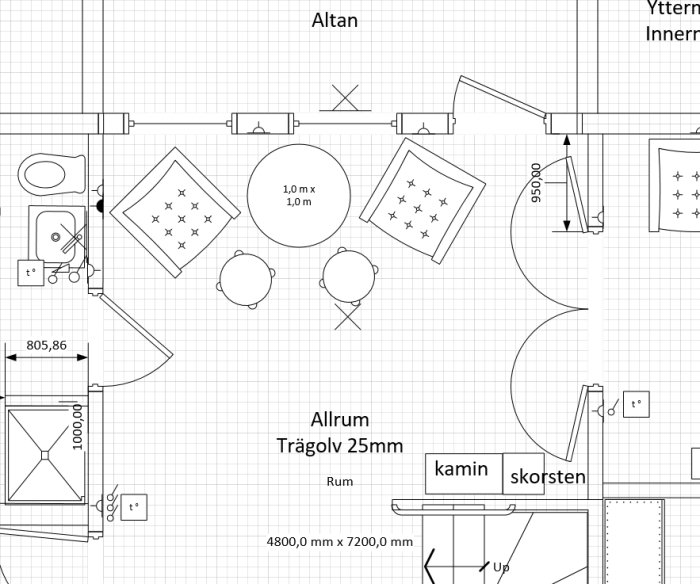
What in your post is made up, if something is discovered, you have to do something about it, either fix it with a stamp or move the weight to another location and distribute it
He has both told and shown pictures that it has already been moved...
It is likely a combination of the mounting and the steel beam. You should see what the manufacturer suggests for a suitable remedy. By the way, did the sag in the ceiling get less when you removed the pile of gypsum? If it was the steel beam that was the issue, it should have gone up again after you removed the pile.
The sag definitely lessened after the load was moved. I think this is an easy fix, just some straightening and proper fastening. But of course, I'll let the house manufacturer handle it.
Lucky though that I placed the pile of gypsum there now and installed the underfloor heating in the other rooms first. It would be a bit more troublesome if this was discovered when everything was done and our 500kg heavy stove was in place.
Unfortunately, I got the cold shoulder from the house manufacturer. They referred me directly to Garbo, which has a hefty deductible and a questionable history of willingness to compensate.
This will probably end up with me doing the work myself again. A jack and solid screws aren't too expensive.
Does anyone have good tips on how I can best reinforce this floor structure a bit extra considering the cracking and the future fireplace weighing 500kg? The chimney is on the tile stove/base on the lower floor.
I have already placed double 45x220 beams on the joists that the fireplace rests on directly.
Right behind the fireplace, there is a load-bearing inner wall, so the span is about 3.6m to the outer wall.
Well, they thought it sounded like a likely cause unless the attachment is behind the beam shoes. However, they claim that since this is being pointed out 4-5 years after the house was built, it is no longer their problem.
That's unfortunate... but it's not likely that the fastening would be behind the joist hangers since the current beam is supposed to be nailed to the floor joists from the outside and screwed to the wall from the inside, so the floor joist should already be in place when everything is to be screwed to the wall
That's unfortunate... but it's not likely that the attachment would be behind the joist hangers because the relevant beam should be nailed to the floor joists from the outside and screwed to the wall from the inside, meaning the floor joist should already be in place when everything is screwed to the wall
You are absolutely right and I have now found pictures from the construction showing that the intermediate floor was built before the walls of the upper floor were put in place. So, in other words, it is completely established that attachment is missing.
How does it look otherwise on the upper floor, can they see any screw attachments in other places? Was it the manufacturer who installed it or was it another contractor?
How does it look upstairs otherwise, can they see any screw fittings in other places? Was it the manufacturer who assembled or was it another contractor?
I've searched and I can't see any screw holes or nail holes on the joists where the joist hangers are attached.
Now, the rest of the house seems to stand on the ground floor's inner wall somehow and feels stable but they should probably also be screwed into the posts and also toe-nailed into the wall plate according to the drawing. I hadn't thought of that, but you might be right that it's the entire floor structure that lacks fastening. If one wants to be unkind, one could almost say that it's the outer panel that is holding the floors together.
According to the drawing, there should be double 6x120 screws on cc60 at the balcony and cc120 elsewhere. Is there any advantage here to increasing the dimension now that I have both cracks and also plan to install a heavy stove? Other reinforcement tips are gladly welcomed.
Update: the house manufacturer has reconsidered and will address the deficiencies. Relieving as I already have enough on my to-do list.
Gladly accepting tips on reinforcements for the fireplace that I posted above. Considering cc30 and possibly kortling. Is that enough or should I do something about the "bärlina" as well?
Great that it worked out
cc300 and noggings in the compartments below as well as the compartments nearest outside and it should work. If the stove's location was included in the plans when you bought the house, the number of screws in the "support beam" to the wall should be okay. Maybe worth double-checking with the manufacturer. Otherwise, it might become a slightly trickier solution as there isn't room for more screws. But that can be discussed when you've got a response from the manufacturer
I encountered a similar problem when I remodeled the kitchen upstairs and placed a kitchen island with a granite top "right above" a room on the lower floor. I thought it wouldn't be a problem at all, as I, like you, compared it to the weight if a group of people were standing there, and it was evenly distributed along three beams.
After a few weeks, I started noticing that things dropped on the floor rolled toward the island. I noticed there were paint flakes on the floor from the ceiling, which clearly bulged. My evening panic was to quickly open the ceiling and insert two laminated beams. But in my case, it's generally a poorly built house from the 70s, so I should have realized that beforehand.
However, I might have some suggestions regarding the stove.
When I moved in, there was a *gigantic* structure that was 1.2mx1.2mx1.2m of bricks with a cast iron insert (and then a bit more bricks on top, but that didn't really make a difference one way or another).
It was reinforced by having four strong L-irons at the bottom, which then went straight out through the wall and were embedded in the chimney outside.
That is, it would more or less be possible to remove the floor under it without affecting anything.
However, the "chimney pipe" through the wall was a spiro duct surrounded by a few centimeters of fiberglass and then masonite. (Did I mention shoddy construction?) So even though it functioned for significantly more years than anyone could understand afterward, it met its end when the fire department tore it down to access and extinguish the fire in the wall...
So when I finally replaced the stove two or three years ago with a new soapstone stove with a chimney through the roof, I solved it by adding joists CC 30 resting on the wall. But with the kitchen island as a reference, I don't trust it to hold in the long run without causing any subsidence, so I've also added an angle iron under the beam that is "farthest out" from the wall and carries the weight from the stove, then two more at ~30-degree angles against the wall where a fourth transfers the force to the wall. (First bolted and then welded together on-site) If I remember correctly, they are 40x40x4mm, which is hopefully a gross overestimation, but as it's in the ceiling of the hobby room, the "intrusion" is acceptable.
Great that it worked out
cc300 and noggins in the compartments below as well as the compartments closest outside should make it work. If the stove's position was included in the floor plans when you bought the house, then the number of screws in the "bearer" for the wall should be okay. Maybe worth a double-check with the manufacturer. Otherwise, it could become a bit trickier since there's no room for more screws. But that can be discussed once you get an answer from the manufacturer
I took the opportunity to bring it up with the manufacturer, and they were going to investigate and get back to me, so this is starting to sort itself out. Thanks to you and everyone else who has engaged in the thread.
Vi vill skicka notiser för ämnen du bevakar och händelser som berör dig.