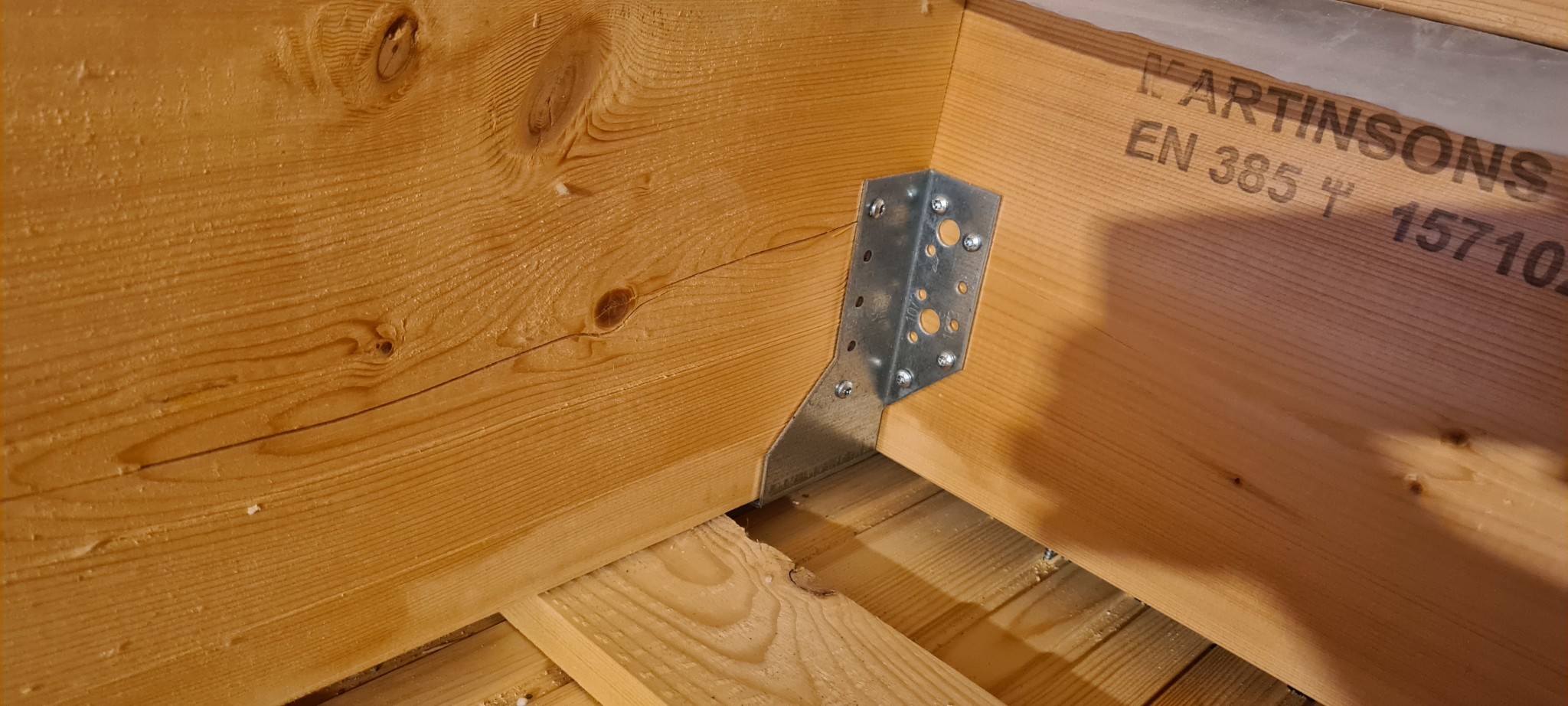
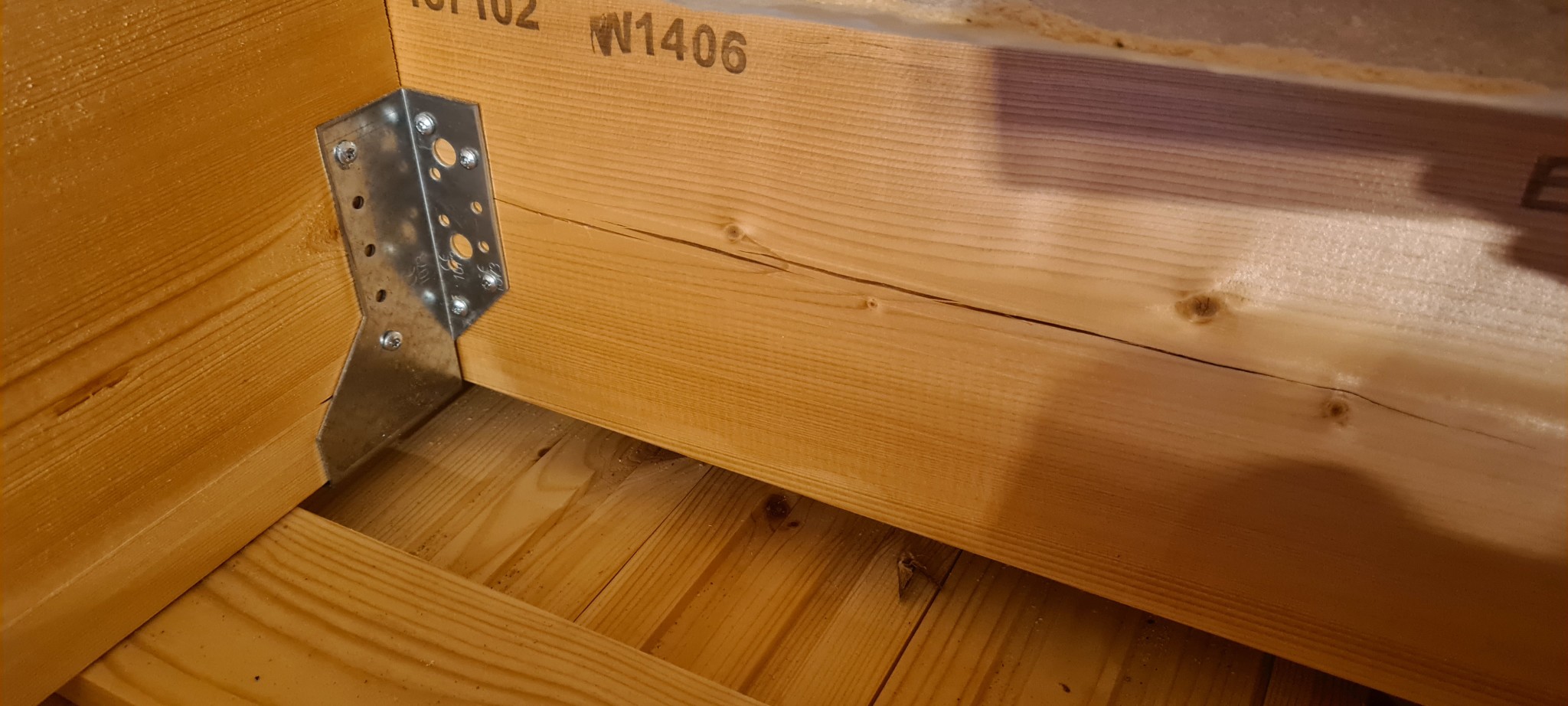
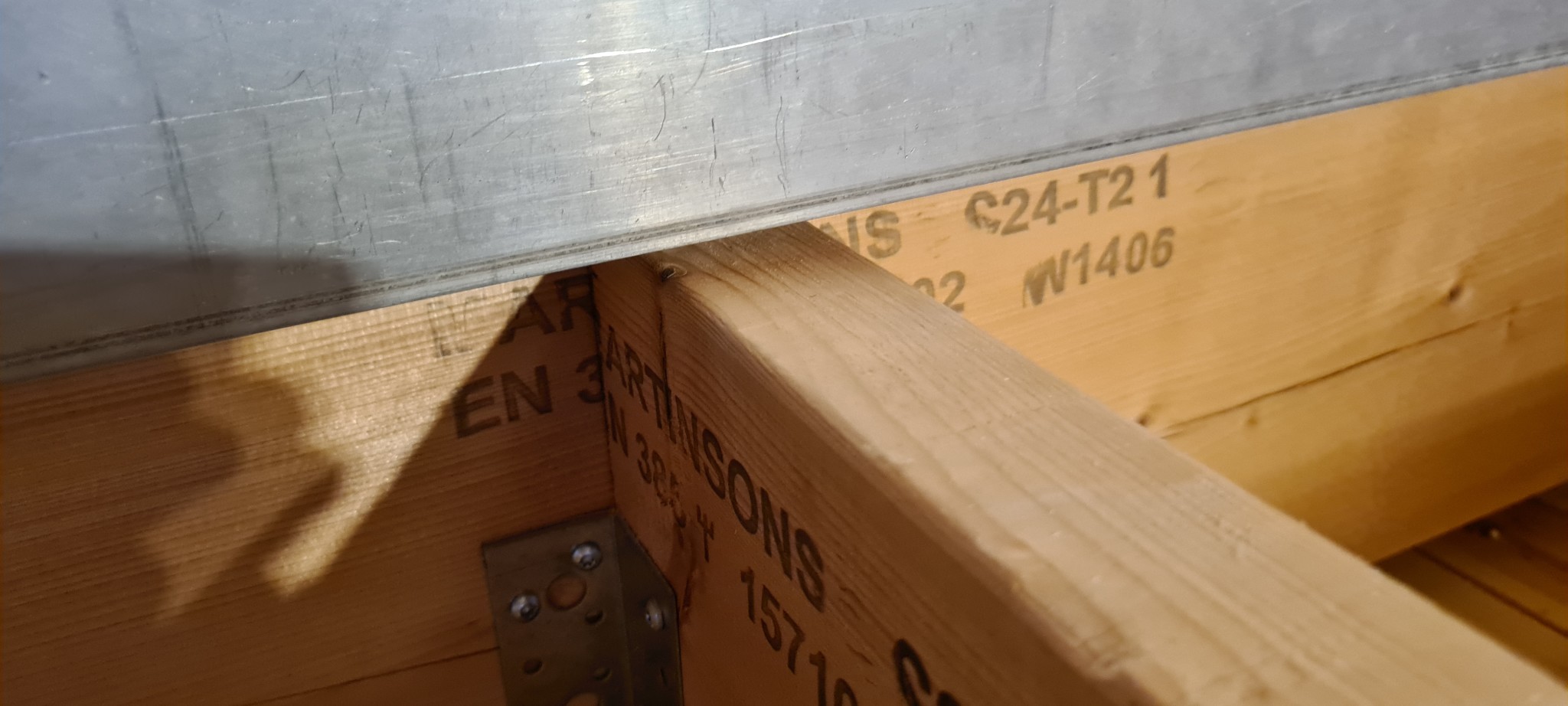
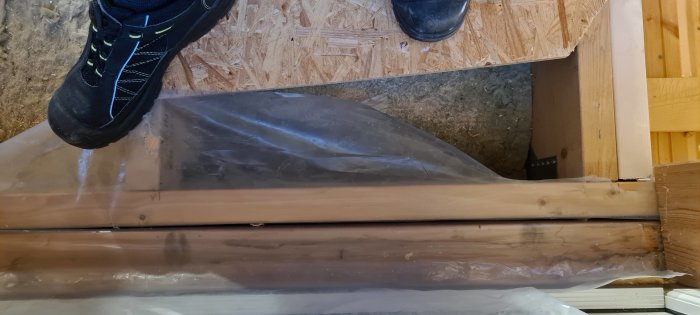
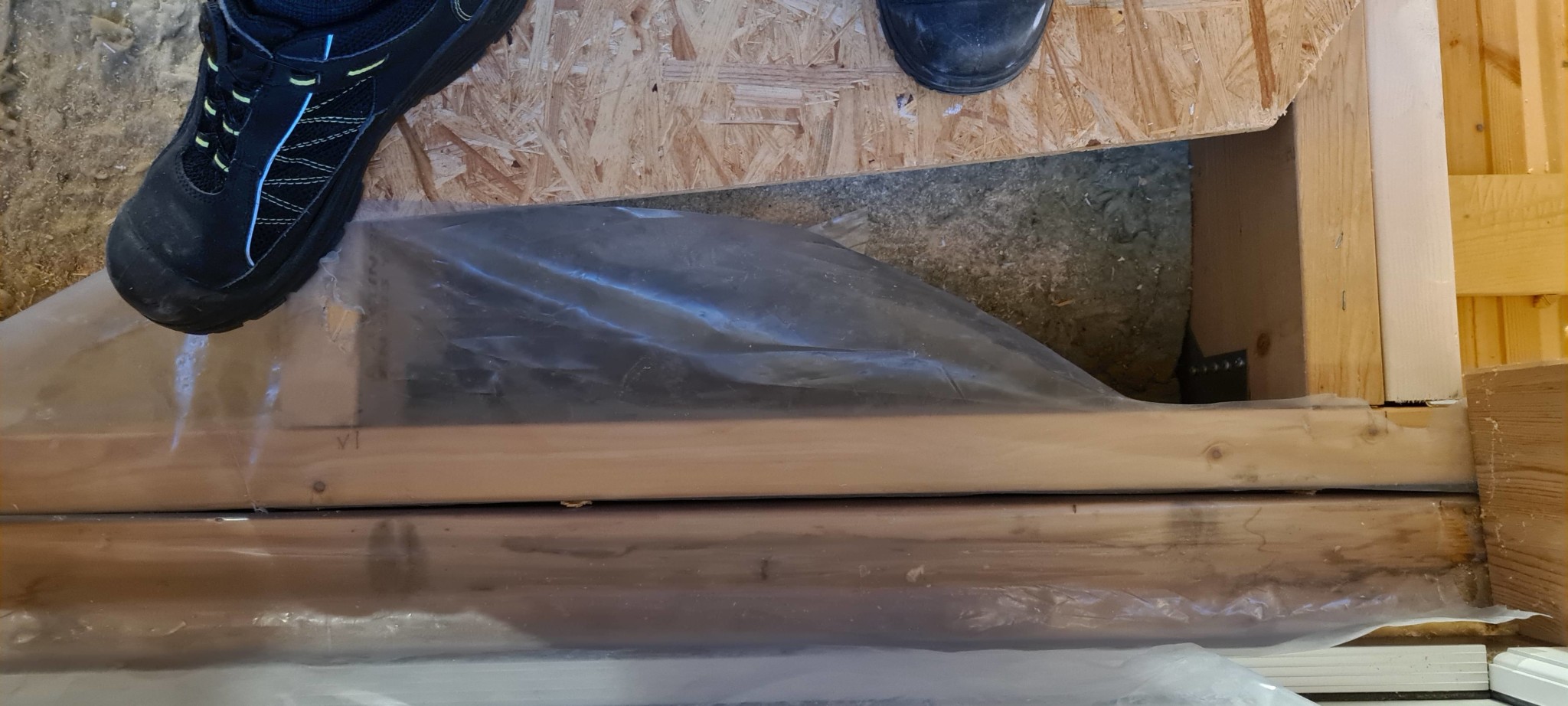
Based on the image and drawings, it is likely not the steel beam that is bending down but the attachment of the flooring (joist and joist hanger) that has moved and is pressing on the cladding around the steel beam.
That's exactly how I perceive it too. Isn't the steel beam's task precisely to prevent this?
In itself, 5m is quite a long span, but the gypsum pile shouldn't push the beam down that much; if so, the beam is incorrectly dimensioned. However, they always bend down slightly, and if the gypsum cladding around the beam is fixed to the beam, it will crack with the slightest deflection. Does it look like a crack in the cladding? The beam takes care of the load that ends up on the beam. If there are movements in the fastenings on the way to the beam, the beam can't do anything about it.
The floor structure sways noticeably when I, weighing around 80kg, "sway with my knees".
The leveling tool shows a settling now in the floor structure without load.
My concern is that the floor structure is not anchored to the wall that rests on the floor structure. Or that the anchoring has given way. Shouldn't it be possible to see this anchoring, or is it hidden on the "backside"?
At work, we use shoring for stacks of drywall up to the concrete slab. Static loads are not to be taken lightly. In a wooden floor structure, I would definitely consider this as normal, especially after you've placed the stack at a sensitive point as well. If it had been near a load-bearing wall, it probably would have been fine.
But as mentioned, always use shoring under large point loads.
I'm also wondering how the rule is attached to the steel beam? If it just lies parallel to the beam on the same support without being attached to the steel beam anywhere, it instinctively feels like it would be too weak. There's also far too few screws in the joist hangers.
As I interpret your drawings, there are a few screws missing in the outer wall. There should be 2 pcs 6x120 with a c-c of about 60cm. That is, centered where the plasterboards in the wall are joined.
Yes, exactly, it's currently cc60 between the floor joists, but I don't see any screws at all in the entire wooden beam that the joist hangers are attached to. It would have to be that the screws are behind the joist hangers then, but the give and the picture by the patio door that shows how widely apart they are speaks against that.
In with the jack, lift so the joist becomes straight without deflection, prop up with a beam in the ceiling and one on the floor and some beams in between, everything should be under your stack of gypsum so you're good. As for calculating the strength, don't worry about it, the prop takes the force, and the joist holds for what it is calculated for when the gypsum is gone.
As you say, the gap suggests that the attachment of the joist to the wall may not have been correctly executed according to the plans. Does the gap open when you stand and bounce on it? Did the joist also come in modules? If so, it's difficult to conceal the attachment behind the joist hangers. The number of anchor screws in the joist hangers follows the plan, and 8 screws are sufficient for the load from the floor joist. You should demand that the manufacturer come and look at this and also send over a calculation for the beam.
Do not make up your own fixes before the manufacturer has looked at your problem. Fixing it is simple, but it is not your task or cost if it is not done correctly.
As you say, the gap suggests that perhaps the connection of the floor joist to the wall is not executed correctly according to the drawing. Does the gap open when you stand and sway? Did the floor joist come in modules too? If so, it's difficult to hide the connection behind the joist hangers. The number of anchor screws in the joist hangers follows the drawing, and 8 screws are enough for the load coming from the floorboard. You should demand that the manufacturer comes and looks at this and sends over a calculation for the beam.
The gap becomes larger when I "rock" on the floor joists. Even when my 59kg partner does it.
It is certainly a combination of attachment and steel beam. You should see what the manufacturer says about the appropriate measure. By the way, did the deflection in the ceiling become less when you removed the gypsum pile? If it were the steel beam that was the problem, it should have risen again after you removed the pile.
What is it about your post that is made up, if something is discovered, you have to do something about it, either fix it with a stamp or move the weight to another location and distribute it.
Vi vill skicka notiser för ämnen du bevakar och händelser som berör dig.