If there is a slope on the outer roof, I would insert an angle on the duct right before so that it connects perpendicularly to the outer roof. But then the hole ends up in a different place ...
Feels like you're exaggerating the precision a bit, the placement of the fan is what's important, but neither the duct nor the box will care if they're not completely perfect. If it had been my job, I would have let the customer mount the hood inside and give an approximate measurement outside. Then I would have opened a maximum of 30x30, put a tube in the "socket," and checked with a level; when it's straight, it's just a matter of measuring the box's placement and finishing the cut.
When it's done, you can make adjustments if any stuffing or vapor barrier is needed from below by temporarily taking down the fan.
If it looks straight it is straight
Thank you so much!
Yes, I know my need for control is a bit beyond the usual
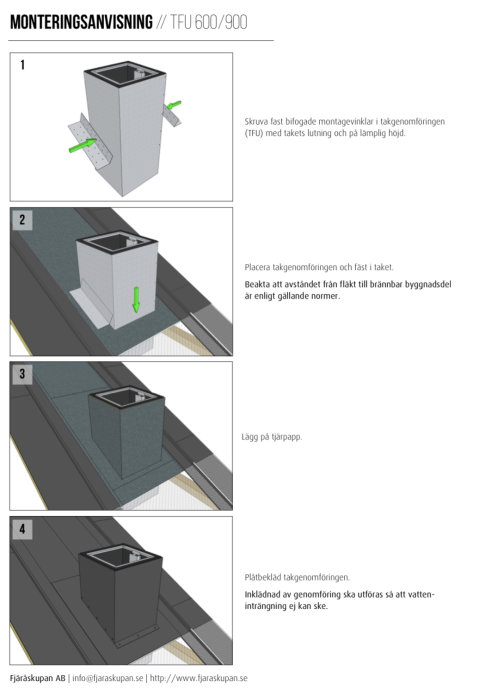
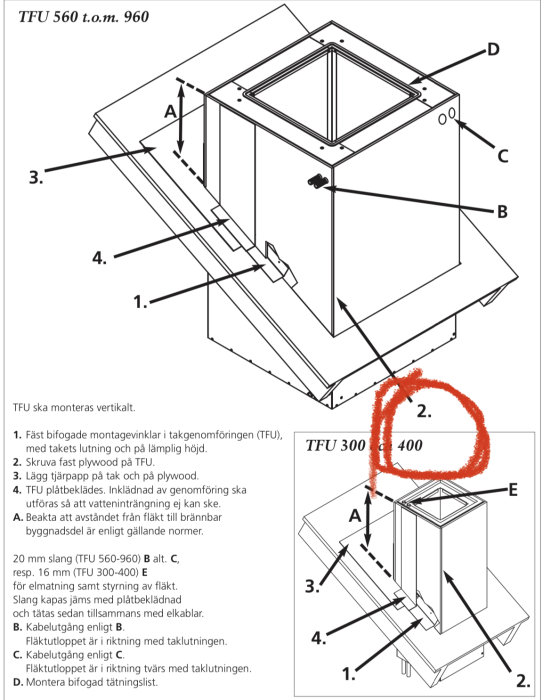
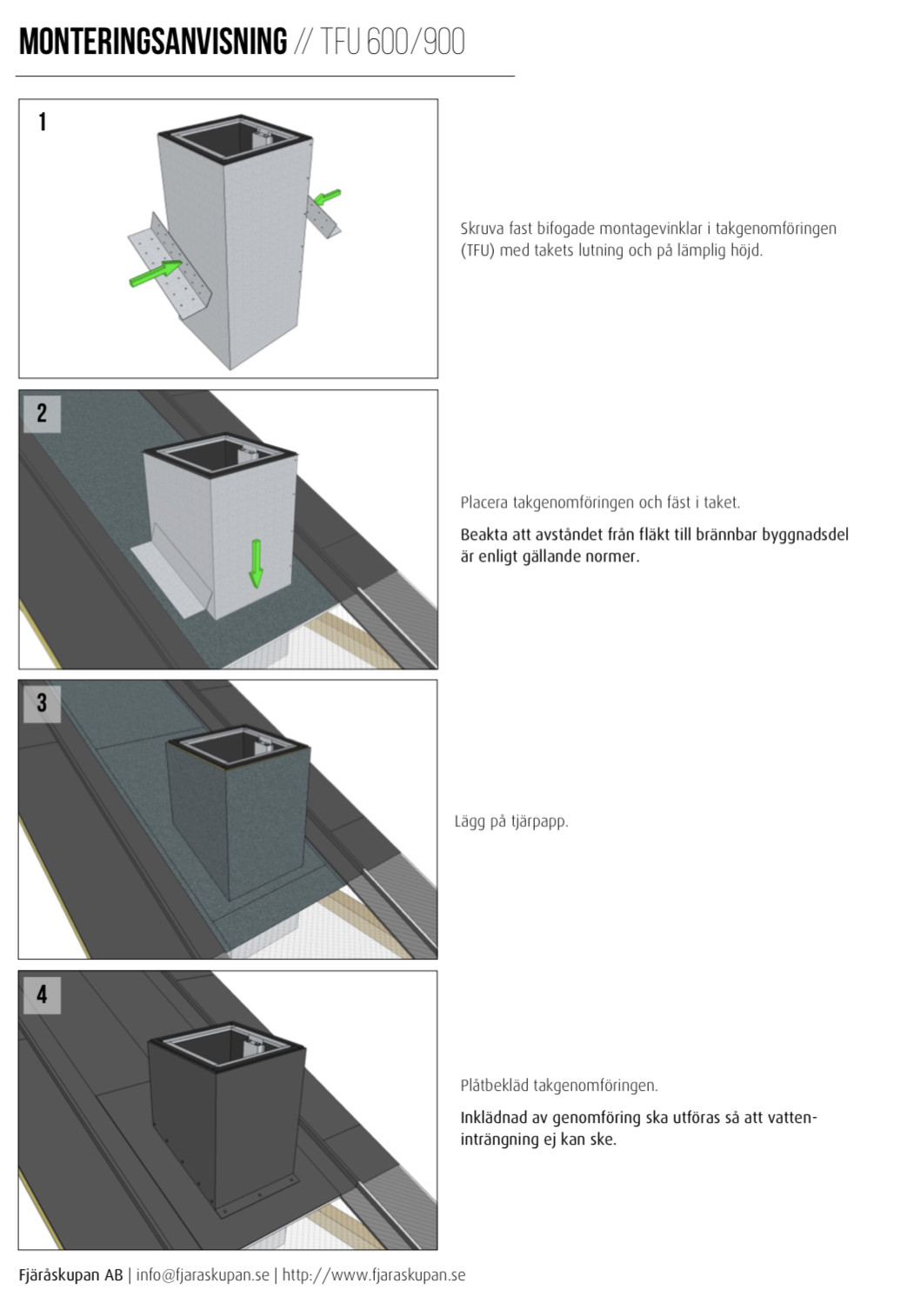
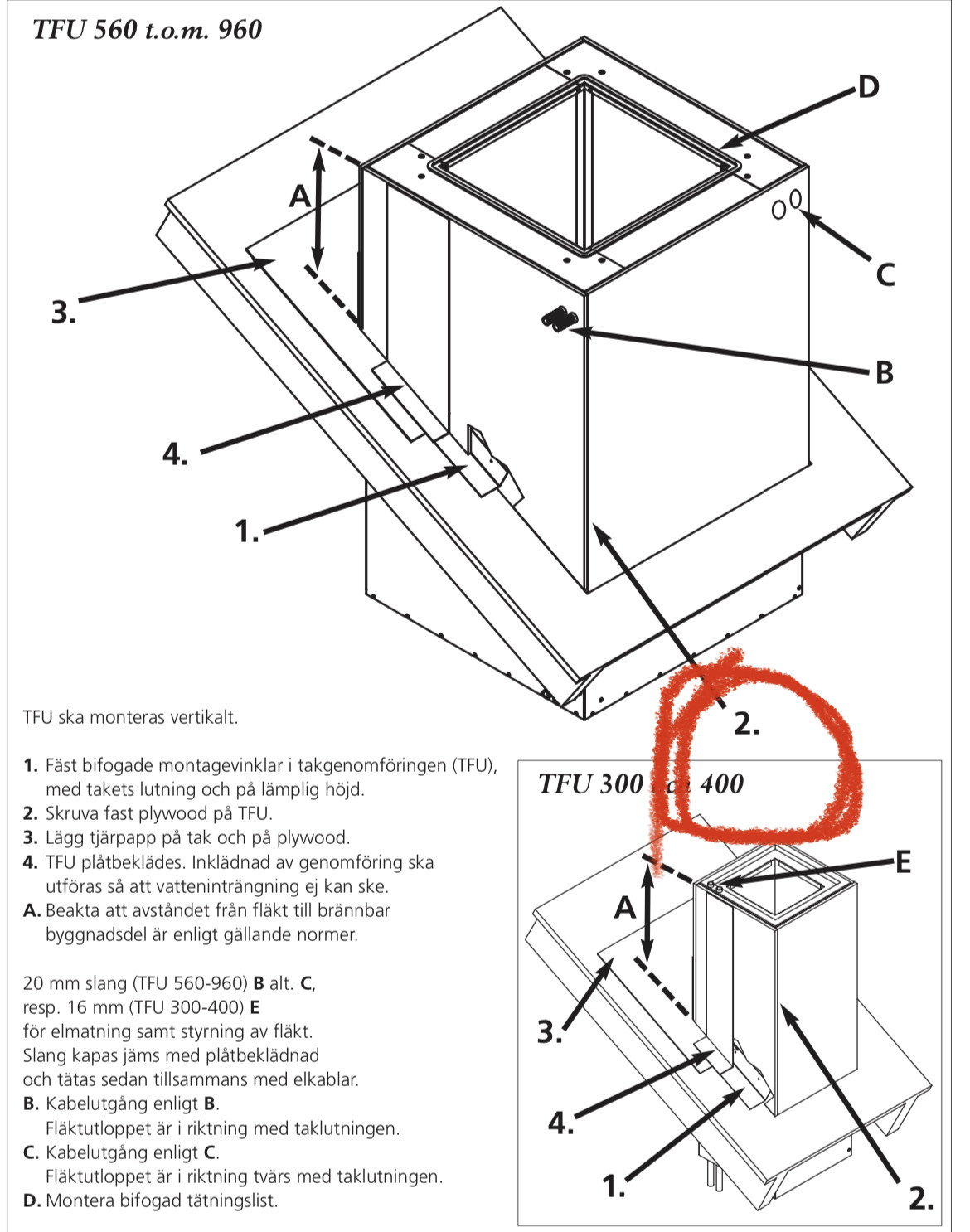
Do you know about that box TFU?
Östberg writes in their installation instructions that the box should be covered with plywood.
Fjäråskupan doesn't mention covering with plywood for the TFU they sell.
I'm unsure because the boxes look exactly the same.
I would be a bit cautious about covering with plywood as there is a risk that the fan will not cover properly from above, and I don't see any direct advantage to it either since it is fine to work with the galvanized sheet metal as long as it is not too flimsy (which I don't think it is).
Okay, but if it's 400x400 and a company is going to make the hole and do the roof work, it’s enough for you to make a hole in the interior ceiling and remove the insulation. Then, as someone mentioned, use a plumb line to mark the center and drill a small screw/bit through to mark the hole, then use a roofing screw from outside in that hole. That way it's sealed if it takes a day or so until the roofing guys come and do the rest.
Regarding plywood on the pipe collar, it's so the roofers have something to attach the roofing material to. Check with the company if they want plywood or not.
Yes, that's how it can be. But as I said, check with those who are going to lay the roofing felt so they lay felt on metal. At the jobs I've been on with stacks that need to be covered with felt, we've had to cover them with plywood first because otherwise the roofers wouldn't have applied the felt. Maybe they've been picky or something else, but it's worth checking beforehand anyway, I think.
Plyfa is a bit of a standard answer when you don't need to be responsible for the tightness from above, and it should go as quickly as possible. It's perfectly fine to weld/glue against the sheet metal and you can also screw into it, so I don't see any direct point.
Plyfa is a bit of a standard answer when you don't need to be responsible for the tightness from above, and it should go as quickly as possible. It's fine to weld/glue to the sheet metal and you can also screw into it, so I don't see any direct point.
Out of pure curiosity, what do you mean by not being responsible for the tightness from above? If a company is papering on sheet metal or plywood it doesn't matter, it's still them who are responsible for ensuring it is tight, right? And if it should go as quickly as possible, wouldn't it be faster to skip the plywood than to lay it?
Talk to Plåtis... who is going to fix the roof, and he explained how it's done, which is the answer to my question.
You use a cross laser that shines upwards. First, you get a marking on the inner ceiling, then when you've made the hole and removed the insulation, the same cross lands on the roof sheathing.
Brilliant because you have to buy another tool you didn't know you needed. If you want to get it done quickly and easily, then @MathiasS's method is probably just as brilliant.

Rickard. said:
Feels like you're exaggerating the precision a bit, the placement of the fan is what's important, but neither the duct nor the box will care if they're not completely perfect. If it had been my job, I would have let the customer mount the hood inside and give an approximate measurement outside. Then I would have opened a maximum of 30x30, put a tube in the "socket," and checked with a level; when it's straight, it's just a matter of measuring the box's placement and finishing the cut.