
3,107 views ·
14 replies
3k views
14 replies
Does regular medium filler work?
Hello,
After the electrician removed old wiring in our house, there are a lot of holes in the basement wall that need to be patched up. See the picture for an example.
Unfortunately, I don't know what material the wall is made of, but perhaps someone can tell?
My question is if regular medium putty from Beckers will work or if it needs to be something specific since it's basement walls?
The laundry room is a few rooms away but doesn't get super humid now that we've switched to a new dryer. Before that, there used to be condensation on the walls throughout the basement during drying.
Thanks a lot!
After the electrician removed old wiring in our house, there are a lot of holes in the basement wall that need to be patched up. See the picture for an example.
Unfortunately, I don't know what material the wall is made of, but perhaps someone can tell?
My question is if regular medium putty from Beckers will work or if it needs to be something specific since it's basement walls?
The laundry room is a few rooms away but doesn't get super humid now that we've switched to a new dryer. Before that, there used to be condensation on the walls throughout the basement during drying.
Thanks a lot!
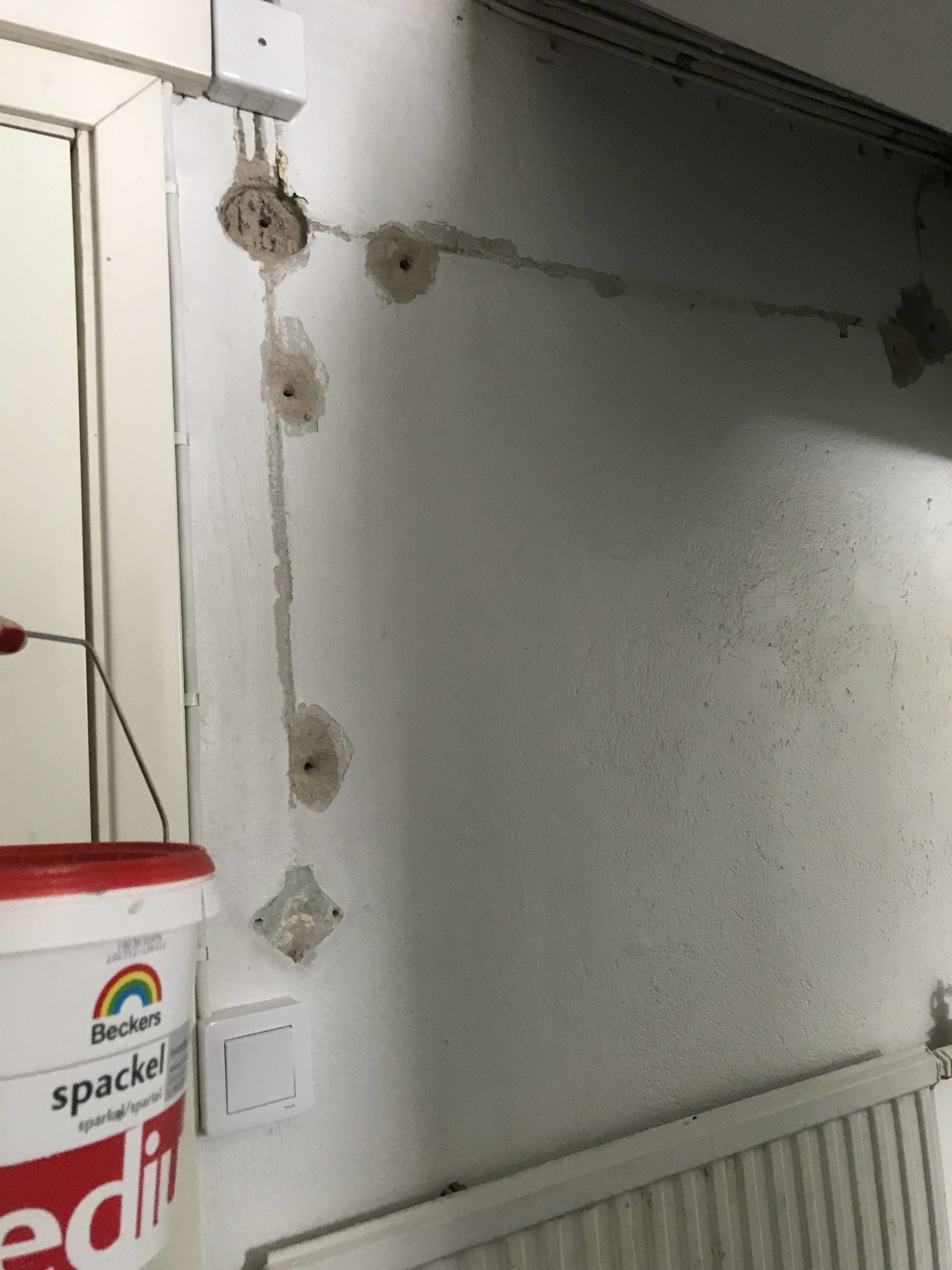

It seems to be plastered walls. Regular lightweight filler would probably work, but I would have used a cement-based product, like husfix or something similar. If nothing else, it doesn't shrink, so you don't have to apply multiple layers...


And by "lightly dampen," it is not meant that there should be just a tiny bit of moisture, but rather that there shouldn't be so much water that it runs.
In other words, do not hesitate to dampen; the important thing is that the surface being patched/plastered should not be so dry that it absorbs all the moisture from the material being applied.
If a cement or gypsum-based fill is used, it is "vital" because the water in the mix is needed for the chemical reaction.
Even with water-based sand filler (surface filler for gypsum boards and such), it is not a bad idea to lightly dampen absorbent surfaces.
In other words, do not hesitate to dampen; the important thing is that the surface being patched/plastered should not be so dry that it absorbs all the moisture from the material being applied.
If a cement or gypsum-based fill is used, it is "vital" because the water in the mix is needed for the chemical reaction.
Even with water-based sand filler (surface filler for gypsum boards and such), it is not a bad idea to lightly dampen absorbent surfaces.
Thanks so much for the reply! I'll go get husfix right away!useless said:

Great info! Thank you so much! Now house fix is purchased, and I just need to gather the energy to start plasteringMikael_L said:
And by lightly dampening is not meant that it should just be slightly damp, but that there shouldn't be so much water that it runs.
In other words, don't hesitate to dampen, the important thing is that what you are filling/plastering against isn't so dry that it absorbs all the moisture from the material you apply.
If cement or gypsum-based filler is used, it is "vital" since it is the water in the material that is needed for the chemical reaction.
Even with water-based joint compound (seam filler for gypsum boards and such), it's not a bad idea to dampen absorbent surfaces a little.
My experience with husfix is that it cures quite slowly.
That's not a problem, except that you have to wait to proceed with the next step. In other words, don't start drilling or working until the next day. And with painting, you naturally need to wait even longer, as it has to be completely dry first.
If things are urgent, plaster mortar/plaster is better, especially if you mix it with relatively little water so it can even be painted over relatively soon.
But if you, OP, have the time, I think husfix is a better choice for you. It results in a material more similar to the existing one.
That's not a problem, except that you have to wait to proceed with the next step. In other words, don't start drilling or working until the next day. And with painting, you naturally need to wait even longer, as it has to be completely dry first.
If things are urgent, plaster mortar/plaster is better, especially if you mix it with relatively little water so it can even be painted over relatively soon.
But if you, OP, have the time, I think husfix is a better choice for you. It results in a material more similar to the existing one.
Last edited:
If you moisten too much so that it is "soaking wet," I think the husfix absorbs this and becomes looser. It's not a huge problem other than that it takes longer to dry. But better that than nothing at all .
.I'm not in a hurry, so husfix will be great! Thank you!My experience with husfix is that it cures quite slowly.
That's not a problem, except that you have to wait before continuing with the next step. That is, don't start drilling or processing until the next day. And painting, of course, requires an even longer wait, it should be completely dry first.
If you're in a hurry with things, plaster or plaster putty is better, especially if you mix it with relatively little water so that it can even be painted over relatively soon.
But if you, TS, have the time, I think husfix is a better choice for you. It results in a more comparable material to the existing one.
Click here to reply