
7,218 views ·
24 replies
7k views
24 replies
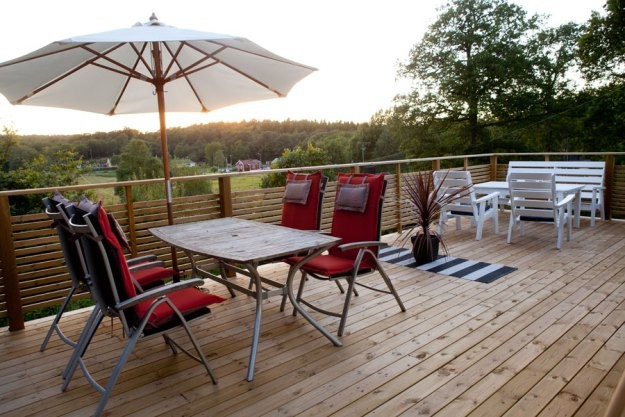
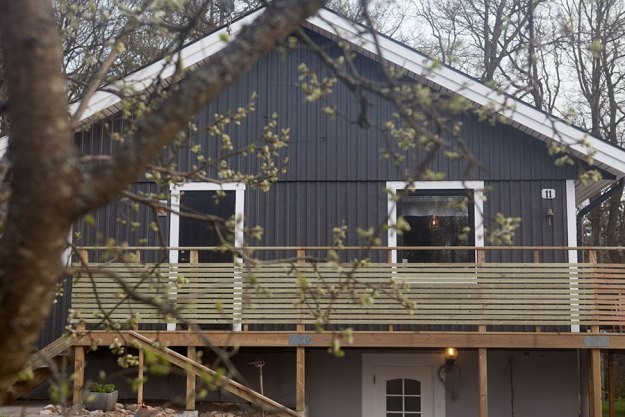
Dimension a deck above ground
Hi Locke, I'm not sure if you're thinking the same as I am regarding the posts? I assembled a Willabgarden sunroom and there were cutouts in the corner posts for the rafters which should direct the weight more directly into the posts. Is it advisable on a pressure-treated post, e.g., 95x95? On the old deck, almost all of those posts have cracked...Locke said:
I have a mix of soil, stone & clay. It looks like a handy solution, but when I've drilled down, can I scratch out space to cast a base plate for the footing then? Afraid of shortcuts, one of the old posts has sunken into the ground, maybe because there were too few footings, maybe due to the condition of the ground, hard to know really.Pannlampa said:

Hello!
Your entire column-beam system is at risk of failing if you encounter an angular error in the system. The posts will no longer bear the load in their longitudinal direction (height) and will soon be on the ground. You need to make the system moment-stable. Either use diagonal braces or joints that can handle moments—and regular joist hangers won't suffice.
The easiest solution for you is probably to brace it, but this often comes at some aesthetic cost. Ideally, the moments would be taken at the joints or by using discrete tension rods—it doesn't require much tension to brace it. Hidden galvanized flat bars at a 45-degree angle to the columns, for example. Consider the corrosion class of the fasteners you use. On a high deck, there's no room for rusted fasteners—it's a safety hazard! C2, C3?
Your entire column-beam system is at risk of failing if you encounter an angular error in the system. The posts will no longer bear the load in their longitudinal direction (height) and will soon be on the ground. You need to make the system moment-stable. Either use diagonal braces or joints that can handle moments—and regular joist hangers won't suffice.
The easiest solution for you is probably to brace it, but this often comes at some aesthetic cost. Ideally, the moments would be taken at the joints or by using discrete tension rods—it doesn't require much tension to brace it. Hidden galvanized flat bars at a 45-degree angle to the columns, for example. Consider the corrosion class of the fasteners you use. On a high deck, there's no room for rusted fasteners—it's a safety hazard! C2, C3?
Thanks for this, I hadn't thought of it at all.Locke said:Hello!
Your entire column-beam system risks failing if you have an angle error in the system. Then the posts will no longer take the load along their length (height) and will soon be on the ground. You need to make the system moment-stable. Either diagonal braces or joints that can take moment - and regular joist hangers won't do.
The easiest for you is probably to brace it, but that often requires some aesthetic compromises. Ideally, you should take the moment at the joints or set discrete tie rods - it doesn't take much tensile force to brace it. Concealed galvanized flat bars at a 45-degree angle to the columns, for example. Consider the corrosion class of the fasteners you use. On a high deck, there's no room for rusted fasteners - life-threatening! C2, C3?
But the 12 posts create 5 "boxes" under the deck, I was planning to create simple cold storage under 2-3 of them and that's where the braces can be used in the walls.
Instead of joist hangers, can I use a 45x45 along the bearer and make notches in the floor joists?
Time to update the drawing again

Last edited:
On a few occasions, I have made the columns out of 45x95 glued between two 45x170. Then you let the innermost 45x170 form a support for the main beam and the other two continue up to form a railing.
You should calculate the difference in money between 95x95 glulam pillars plus joist hangers (because that’s what you’ve drawn in now?) and the version with homemade pillars.
Notching and fiddling around can be done but... Nah...
You should calculate the difference in money between 95x95 glulam pillars plus joist hangers (because that’s what you’ve drawn in now?) and the version with homemade pillars.
Notching and fiddling around can be done but... Nah...
I have only planned joist hangers to attach the floor joists to two of the beams and let the one in the middle lie underneath. So far, I have only placed the beams on the outside of the post (attached from the side in pressure-treated 95x95 that I was considering notching).Locke said:On a few occasions, I have made the columns from 45x95 glued between two 45x170. Then you let the innermost 45x170 form support for the beam, and the other two continue up and form a railing.
You have to calculate the price difference between 95x95 laminated wood columns plus joist hangers (because that's what you've drawn now?) and the version with homemade columns.
This thing about notching and fiddling can be done, but... Nah...
It is quite nice if you can get the pillars to continue up and take the railing as well. The railing must be able to handle quite a large moment - think of a bunch of drunk guys all standing and leaning out. The construction must be "idiot-proof."




Know-It-All
· Västra Götalands
· 850 posts
Hi, in which program did you make the drawing?
Click here to reply