
Hello hello
I have started demolishing in my laundry room, removed some drywall and insulation, and saw that there is (what I believe) plastic on the wrong side, about 30 cm, that is folded up from the slab. The house was built in 1978, slab on grade. See the picture (there's a small red arrow), where you can see (from inside out) vapor barrier - insulation - asfaboard - insulation - brick (according to the building papers). What I'm wondering about is the piece of plastic that sticks up against the asfaboard at the bottom. Doesn't it trap a bit of moisture that ends up in the insulation?
Best regards,
Jonas
I have started demolishing in my laundry room, removed some drywall and insulation, and saw that there is (what I believe) plastic on the wrong side, about 30 cm, that is folded up from the slab. The house was built in 1978, slab on grade. See the picture (there's a small red arrow), where you can see (from inside out) vapor barrier - insulation - asfaboard - insulation - brick (according to the building papers). What I'm wondering about is the piece of plastic that sticks up against the asfaboard at the bottom. Doesn't it trap a bit of moisture that ends up in the insulation?
Best regards,
Jonas
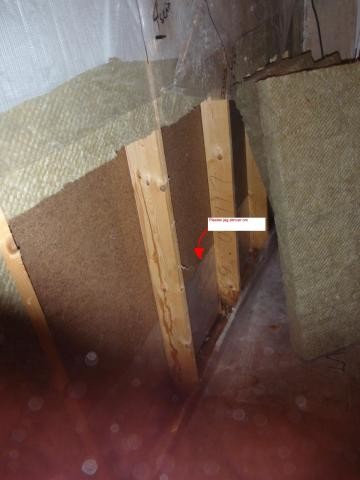
Considering it only goes 30 cm up, I don't think it's a problem. They've probably placed plastic under your studs to prevent direct contact with the concrete slab and then folded it up to also protect the studs from moisture from outside.
I don't think it will give you any problems, how do the studs look? Do you have any signs of moisture damage there? If you don't, then it has worked for 30 years without issues.
I don't think it will give you any problems, how do the studs look? Do you have any signs of moisture damage there? If you don't, then it has worked for 30 years without issues.
Yes, there is a tendency for some moisture, the insulation was wet at the bottom, and the stud is black, but it's only superficial, because if you dig down into the wood it's fine beneath the surface. That's why I was wondering about the plastic.

But surely the differential seal was comprehensive against the inside?
And on the outside of the wall, plastic 3 dm up?
It shouldn't mean any particular problems at all, as humid indoor air can't get into the wall and condense there...
You probably have some other issue causing moisture inside your wall.
And on the outside of the wall, plastic 3 dm up?
It shouldn't mean any particular problems at all, as humid indoor air can't get into the wall and condense there...
You probably have some other issue causing moisture inside your wall.

It's probably the syllplast, a reinforced plastic they used to have at that time. Then they stapled it up instead of cutting it.
Of course, if the sill gets too moist, it lies in a "plastic basin" as it is now.
I think the problem is a too damp slab, how does it look on the outside of the laundry room against the slab?
Of course, if the sill gets too moist, it lies in a "plastic basin" as it is now.
I think the problem is a too damp slab, how does it look on the outside of the laundry room against the slab?
Mikael_L: Yep, Diifspärr the entire inside, behind the plasterboard,
Ericc: I haven't thought about what it looks like there, will shovel away some snow and check,
was considering the "plastic tub", if the slightest moisture has come in, it's very difficult for it to get out,
Slab-on-ground construction from the 70s is not the best construction, from what you can read...
Ericc: I haven't thought about what it looks like there, will shovel away some snow and check,
was considering the "plastic tub", if the slightest moisture has come in, it's very difficult for it to get out,
Slab-on-ground construction from the 70s is not the best construction, from what you can read...
Yes I almost forgot about this thread.
Yes, I don't think the plastic turning up a few decimeters towards the "outside" should matter.
On the inside, it should be plastic, tight and neat, to prevent warm air with a lot of moisture (in the form of water vapor) from getting into the wall, condensing into water, and making everything wet.
Towards the outside, it should not be vapor-tight, so that the little moisture that gets in, no matter how careful you are, can "evaporate" that way. But having vapor-tight plastic on 10% of the wall surface should not matter; you don't have such a small margin with that construction.
So I think you have some other problem. For example, it might be coming from below via poor (or nonexistent) sill sealing, from the inside due to the absence of a vapor-tight layer and perhaps encouraged by misadjusted ventilation causing overpressure in the house. Or you might have a leaking pipe in the wall, or it's coming from outside through some leak in the facade, roof, or at the top plate.
But it should not be humid inside the wall; the studs should not get black stains.
Yes, I don't think the plastic turning up a few decimeters towards the "outside" should matter.
On the inside, it should be plastic, tight and neat, to prevent warm air with a lot of moisture (in the form of water vapor) from getting into the wall, condensing into water, and making everything wet.
Towards the outside, it should not be vapor-tight, so that the little moisture that gets in, no matter how careful you are, can "evaporate" that way. But having vapor-tight plastic on 10% of the wall surface should not matter; you don't have such a small margin with that construction.
So I think you have some other problem. For example, it might be coming from below via poor (or nonexistent) sill sealing, from the inside due to the absence of a vapor-tight layer and perhaps encouraged by misadjusted ventilation causing overpressure in the house. Or you might have a leaking pipe in the wall, or it's coming from outside through some leak in the facade, roof, or at the top plate.
But it should not be humid inside the wall; the studs should not get black stains.
Click here to reply