
4,227 views ·
28 replies
4k views
28 replies
Design question

45x95 will probably not break, but it will look very odd at the front edge. As I have written before, it is the deflection at the outer edge that is crucial. 45x170 C24 is the smallest conceivable dimension.
I am interested in what lies behind that statement. The allowable deflection must vary between applications. A canopy should not be the most delicate application. We are talking about a 90 cm overhang. How can there be a troubling deflection on that before the beam breaks?
The acceptable deflection in this context is entirely a matter of judgment. Normally, roof structures are dimensioned with consideration of the risk of fracture, but since the leading edge of the roof is completely unsupported and also the most visible part of the roof, I believe that deflection must also be taken into account. The calculation of the risk of fracture versus deflection is based on different material constants, bending resistance, and moment of inertia. In the calculation of the latter, the beam's height plays a much larger role. It can also be expressed as needing much more material to limit deflection than to prevent fracture.
One aspect that results in unusually large dimensions here is the short roof section between the glulam beam and the house. It might seem that dimensions should be smaller with shorter distance, but if the overhang is larger than the rest of the roof, it becomes "front-heavy" and tends to tip over, which can result in lift forces against the house. This means there will be a leverage/moment arm, somewhat like on a pair of pliers.
I discovered that if I don’t notch it out, the glulam beam plus the roof's slope will extend over 50cm below the house's joists, which will cause the front door to hit... I either need to notch it out or raise everything so that the attachment to the house is slightly higher than the joists. I suppose it's possible to bolt the house’s support beam 5cm higher without issue, but any more than that might not be stable.
I discovered that if I don’t notch it out, the glulam beam plus the roof's slope will extend over 50cm below the house's joists, which will cause the front door to hit... I either need to notch it out or raise everything so that the attachment to the house is slightly higher than the joists. I suppose it's possible to bolt the house’s support beam 5cm higher without issue, but any more than that might not be stable.
As it appears on the drawing, the support is in the middle of the joist. This results in the same load on the joist as if it were supported at both ends. What you should consider, however, is that you can get additional load at this location during thawing weather. Snow and meltwater slide or run down from the roof above and accumulate on the overhang due to the lower angle.
Justusanderson. You write that deflection is the determining factor and that the smallest conceivable dimension is 45 x 170. Then you state that what deflection is acceptable is entirely a matter of judgment. What deflection have you accepted when you came to the conclusion that 170 is the smallest conceivable?
Justusanderson. You write that deflection is the determining factor and that the smallest conceivable dimension is 45 x 170. Then you state that what deflection is acceptable is entirely a matter of judgment. What deflection have you accepted when you came to the conclusion that 170 is the smallest conceivable?
A bit unclear in later posts maybe, but in my first post, I have the measurements. The roof will be 180cm, and I've considered having the support 80-90cm from the wall, meaning the overhang will be heavier than the rest of the roof, and thus the leverage effect, plus, as you say, heavy snow can remain there when it has melted further up on the roof. However, I will install snow guards on the house roof above to prevent heavy wet snow from falling from the house onto the overhang.
If you have the roof at 180 cm and the support at 90 cm, it will be perfectly balanced. If you place the support 80 cm from the wall, you will get a slight upward force on the wall that you need to consider. Normally, you only have downward forces on the roof. In the case where the support is positioned 80 cm from the wall, you will have a 1 m overhang. It creates the same bending moment on the beam at the support as it would if a 2 m long beam were loaded in the middle and supported at both ends. The lever effect can increase the pressure on the beams at the support point, but it does not increase the bending moment.
The dimensions you mention sound so overwhelmingly oversized to me that I'm convinced it will hold. But don't fool yourself into thinking that a beam that is notched where the load is greatest will hold better than if the entire beam were as thick as at the notch.
The dimensions you mention sound so overwhelmingly oversized to me that I'm convinced it will hold. But don't fool yourself into thinking that a beam that is notched where the load is greatest will hold better than if the entire beam were as thick as at the notch.
By "matter of judgment," I mean that there are no rules in this case. I think I calculated with 1/300 of the span, i.e. 3 mm, but unfortunately, I don't have my scratch paper anymore. The glued laminated timber beam is significantly over-dimensioned. 90x180 would have been sufficient. However, the cantilever construction for the roof beams is a bit tricky. Any dimension from 45x95 and upwards will hold. My own experience with similar constructions is that one should be generous when it comes to dimensions (and wood quality). Otherwise, it tends to look a bit unsightly.A Avemo said:
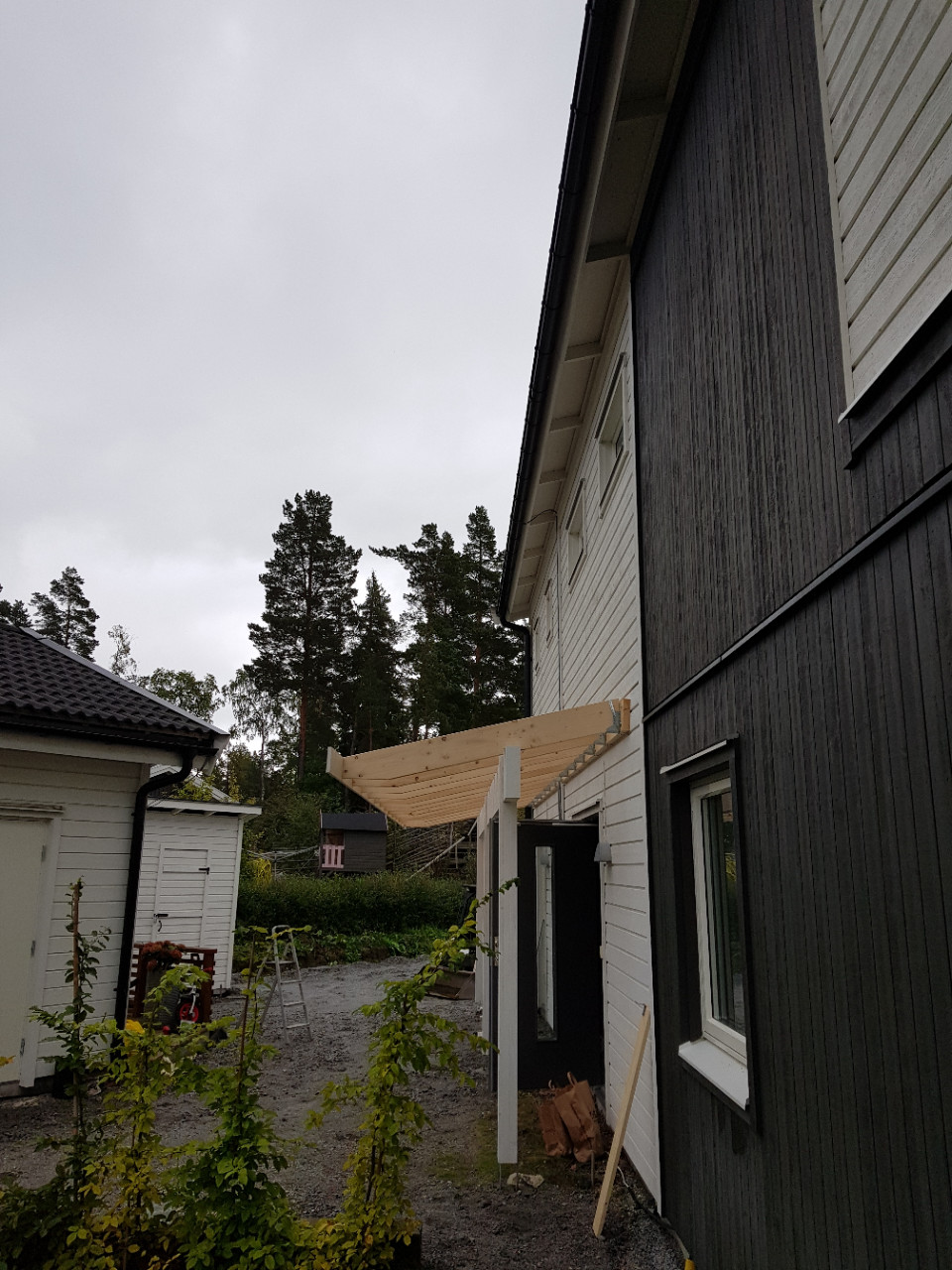
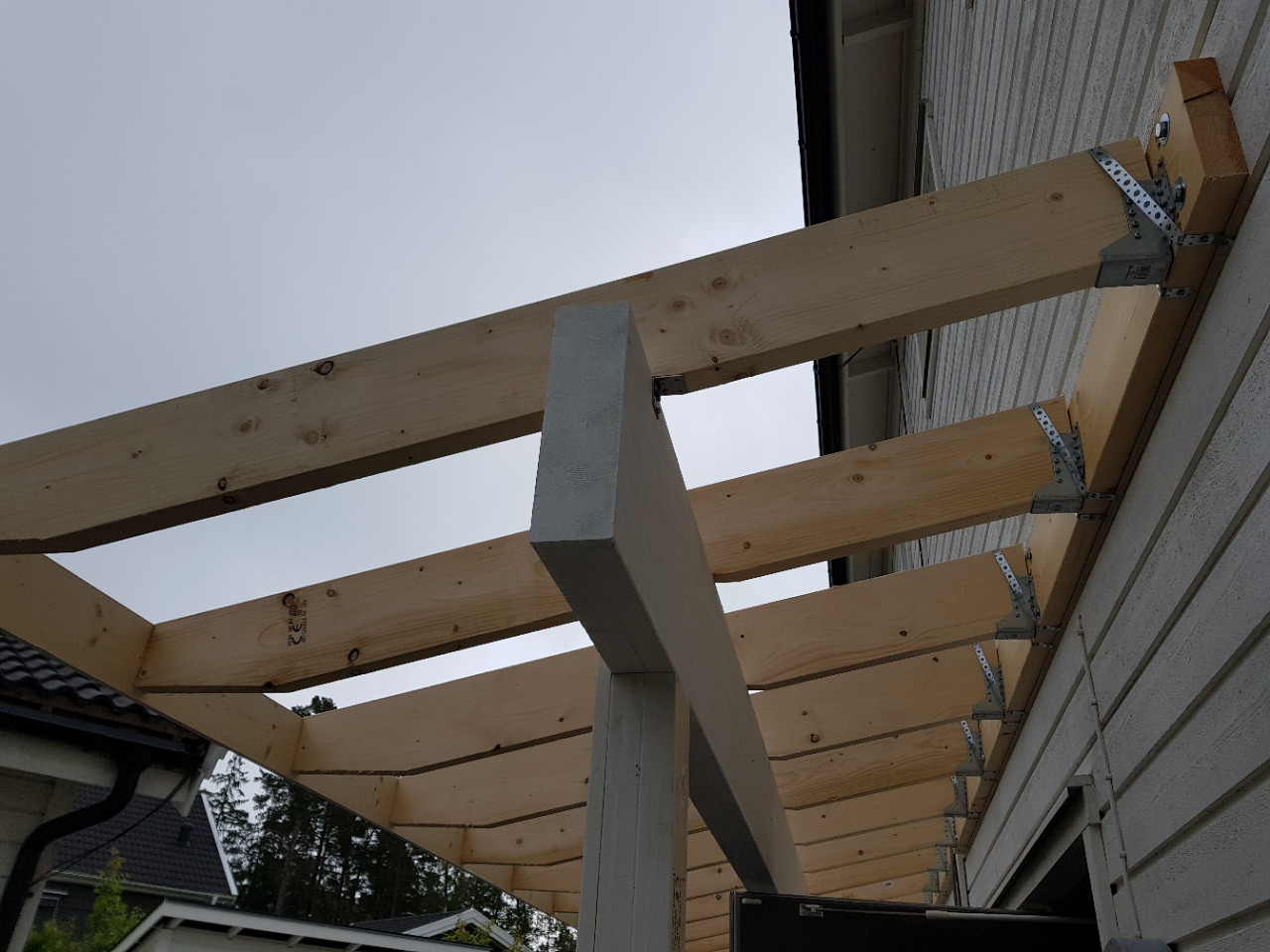
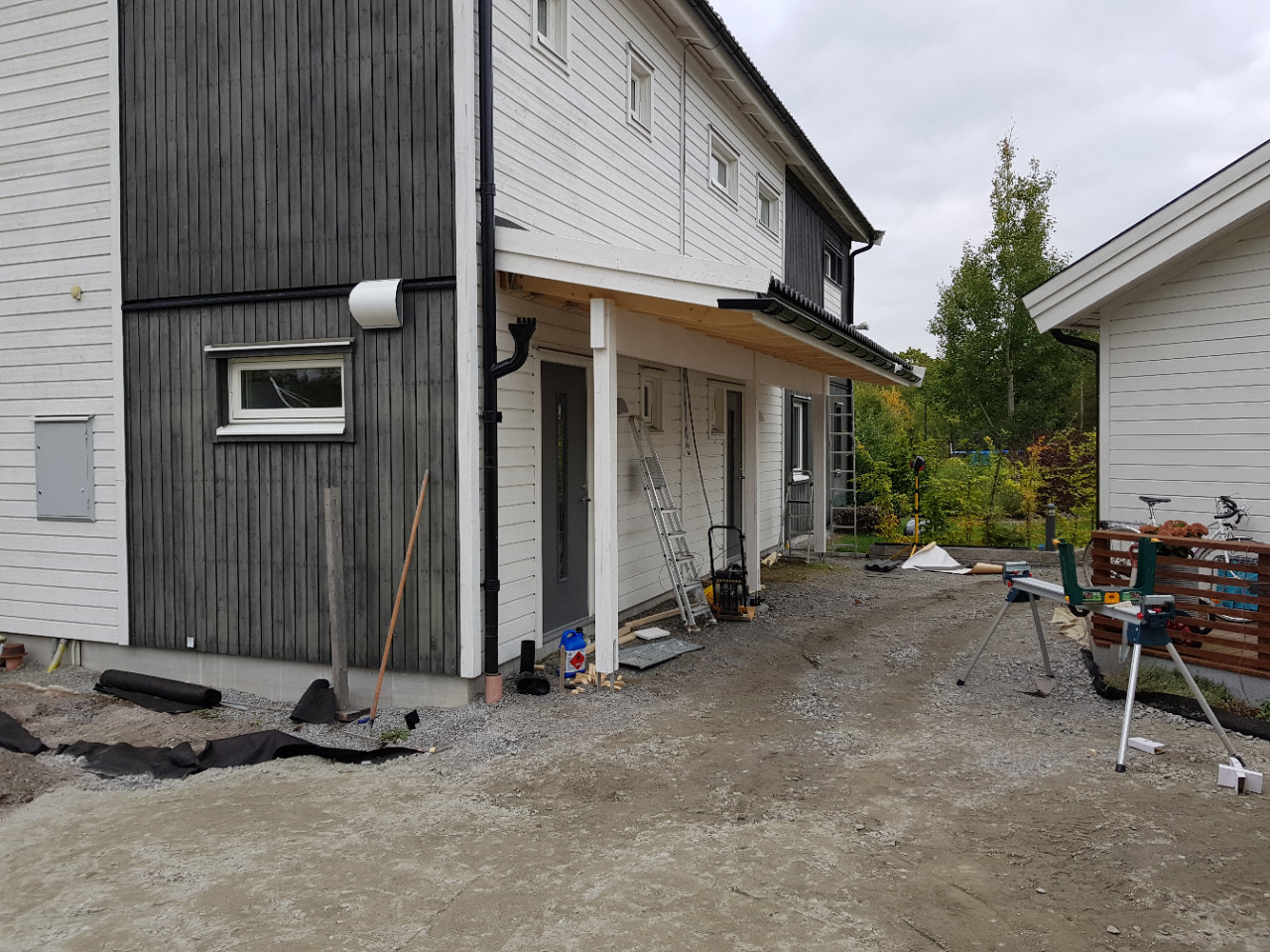
To achieve the correct slope (14 degrees) and the right height against the house so the rafters meet the house's intermediate floor, I need to notch about 3cm, not much really. However, the glulam beam ended up 64-73cm (90mm thickness) from the wall. The overhang is thus 107cm measured from the outer edge of the glulam beam.
That a 100cm overhang would be equivalent to 200cm supported at the ends doesn't feel right. You get compressive and tensile forces on the beam's center that keep it horizontal if it's supported at both ends. This should make it harder to bend. If it's fixed at one end, the tip of the overhang will tilt downward since it doesn't have a "mirror image" other half pulling it up. But maybe we're talking about different types of end supports.
That a 100cm overhang would be equivalent to 200cm supported at the ends doesn't feel right. You get compressive and tensile forces on the beam's center that keep it horizontal if it's supported at both ends. This should make it harder to bend. If it's fixed at one end, the tip of the overhang will tilt downward since it doesn't have a "mirror image" other half pulling it up. But maybe we're talking about different types of end supports.
You're absolutely right. A beam supported at both ends does not experience the same deflection as one that is supported at only one end. Since you have 45x195 beams, it still works with a 107 cm overhang, but it was probably fortunate that you chose that dimension. Another thing I forgot to mention, but which in my experience is quite important: Install a fascia board that connects the free ends of the beams. Otherwise, they might start to spread in different amounts. It doesn't look nice at all!
Why not go to a workshop and have a steel structure welded together in, for example, a 100x100 mm square tube.
It should be possible to make a much neater construction, right?
Or am I completely off?
It should be possible to make a much neater construction, right?
Or am I completely off?
I guess it's a blacksmith you should go to...KnockOnWood said:
Yes, you would get a structure that is a notch more stable than 45x195 with the latest information about span, etc. Instead, some other problems arise, such as steppen7 already having purchased the timber. But for the sake of discussion, it's important to have alternative solutions.

Click here to reply