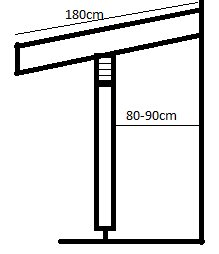
I have a house and garage a few meters apart. I am now planning to build an entrance roof on the house and want to position the posts close to the house to allow for trailers and such to pass between the garage and the house.
*Snow zone 2
*14-degree roof pitch
*Tongue-and-groove and concrete tiles
The question is, what dimension should I have for the glulam beam that supports the roof joists? And what dimension for the roof joists, and how much can I notch them at the glulam beam to gain height under the roof?
I am considering setting the roof joists at cc 600 instead of the standard 1200 to reduce the dimension so it looks lighter and gains height. I am also contemplating the effect of having the post 80cm from the wall, which provides extra room when passing by, but it creates a longer lever arm requiring a stronger glulam beam.
It would possibly be horizontal then. I don't want one that slopes downward for both aesthetic and practical reasons.
Can anyone calculate the beams?
I tried using the calculator that I think "träindustrierna" made, which is found on several sites, but it can't handle such short distances. If you choose a side-built carport with a 240cm width and 120cm eaves, you get 90x315 glulam and 45x195 cc600 joists, but smaller should suffice for my roof.
Went and bought the framework last night, so I had to make a decision, and since you can't take chances, I went with 45x195 C24 and 90x315 glulam. The span is 3.8-4m (two beams/three columns)
A question that remains open, however, is how much you can notch. I would like to notch so that the bottom edge of the glulam beam is at the same height as the eaves, allowing the option to add paneling on the underside if desired. In that case, you would need to notch 6cm, or more if you bevel the corners of the rafters at the eaves.
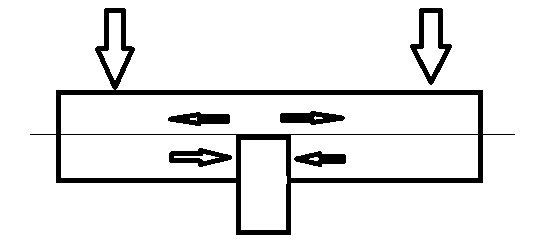
In general, I feel that you should be able to notch up to half the thickness of a beam without problems if you do it so that the notch sits tightly over another piece of wood. Since the lower half is subjected to compressive forces and the upper half to tensile forces, the beam will only want to squeeze the glulam beams together in this case.
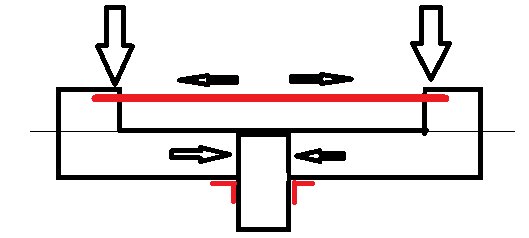
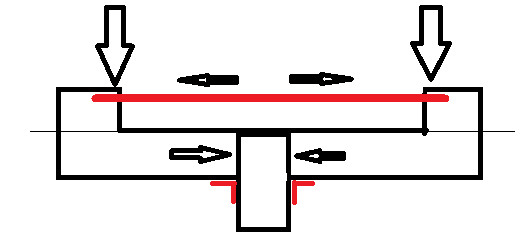
The greatest load on the roof joists is in the middle. Therefore, it is not a problem to notch them at the supports at the ends. In your drawing, you have the support in the middle. I would say that with that construction you should not notch at all. In that case, it is better to have the entire joist narrower so that you do not get as much of a fracture indication where the load is greatest.
One might imagine attaching a steel strap high up on the beams as well to better accommodate the tensile loads there, but the question is whether it is really necessary.
In theory, the example below with two "loose" beams should provide the same load-bearing capacity, where red is steel strap and angle iron:
No. Not even in theory would it work. When loaded, the joists tilt downwards and the hole strap comes closer to the center, thus reducing the bending resistance with increased load.
To return to the original question, the wood is not as stiff across the fibers as along them. If we make the (unreasonable) assumption that you achieve a perfect fit of the notched joist on the glulam beam, the glulam beam will deform more than the un-notched joist would have. And since the notch in the joist will not fit perfectly, there will be bending of the joist before it even starts to load the glulam beam. It may still hold, but you don't gain much from the thicker joist when it is weakened at the point of greatest load.
What is the issue with placing the glulam beam lower? Does it come down so low that you hit your head on it, or is it a matter of appearance?
It is well known that the greatest stress during bending of a beam occurs furthest from the center of the beam. One can imagine constructing an I-beam on site where the lower part passes uninterrupted through a hole in the center of the glulam beam. The upper part rests on top of the glulam beam, and the web of the I-beam is broken at the passage of the glulam beam. In this way, both the rafters and the glulam beam will be drilled through in the center but unbroken along the outer edge. It is important that the parts of the I-beam are properly assembled with both glue and screws. I can think of several practical difficulties in achieving this, but it might be possible to solve.
I disagree that my last example wouldn't work. What you're saying, that it would angle downwards and the metal strap would come closer to the center with a larger load, is only true if the metal strap gives way from the start and then reaches an elasticity limit so that it continues to bend downwards and then breaks.
However, it is definitely weakened by being notched out.
The reason for notching out is probably mostly aesthetic, but maybe also practical if I decide that I want to panel the underside of the roof and put spotlights there to make it look nice.
On a freely supported beam with supports at each end, the moment is greatest in the middle. In this case, the greatest moment occurs over the support. Therefore, notching there is generally not recommended. At the same time, the deflection at the outer end is what determines the dimensioning, so there is likely a small allowance for notching at the underside, especially since you have oversized the roof joists. All notches in wood are crack initiators and should be avoided.
I disagree that my last example wouldn't work. What you're saying, that it would angle down and the perforated band would come closer to the center with greater load as a result, is only true if the perforated band gives way from the beginning and then reaches some elastic limit so that it continues to bend down and then break.
Nothing is absolutely rigid. I'm not sure exactly what you mean by "hålband," but when the perforated band, the studs, the laminated beam, and the screw joints at the perforated band's attachment deform under the load, the studs bend down. As long as it's an elastic deformation, it will revert when the load is removed. But regardless of this, the bending resistance will decrease with increased load.
In many sheds, 45x95 studs function as roof rafters. This is true even for longer spans than 1.8 m. Without being able to point to any standard, I confidently claim that 45x195 is greatly over-dimensioned. I am convinced that it will hold even if you notch them to half the thickness. My point is that it becomes cheaper, simpler, more aesthetically pleasing, and just as strong to use 45x95 without notches as it is to use 45x195 notched to half in the middle.
Vi vill skicka notiser för ämnen du bevakar och händelser som berör dig.