The fundamental problem is that you are not heating the house with oil, as it was designed for. Moreover, you intend to use the basement for purposes other than storage and laundry, for which it was not designed either. There is a risk that the "platta" consists of a thin layer of concrete on an uneven substrate of moist clay, sand, and stone. The advantage in such a case is that it's easy to break up. Consider draining in the winter if you plan to hire out the job, as many companies experience a slow period then.
My advice is to drain around the house first. Then wait and see how it goes with the moisture.
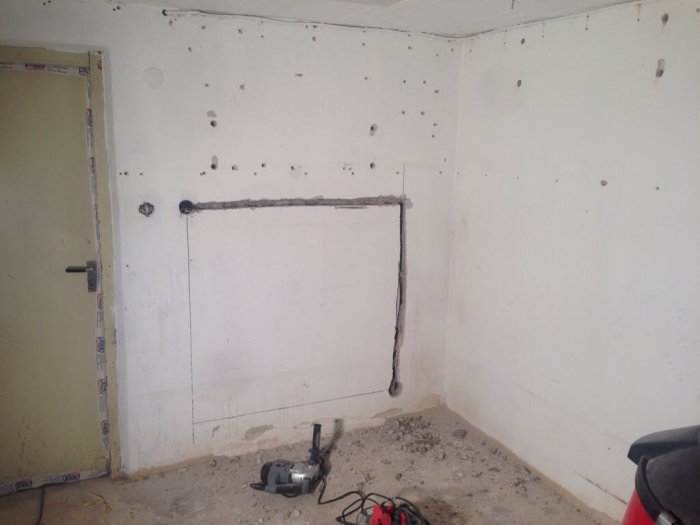
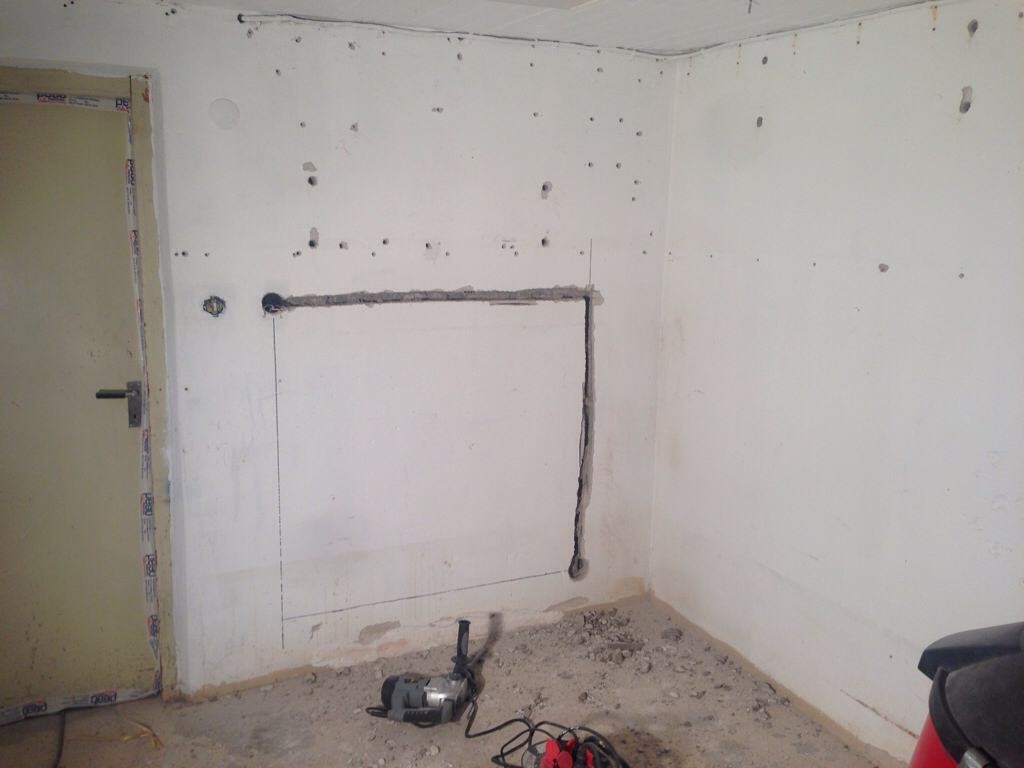
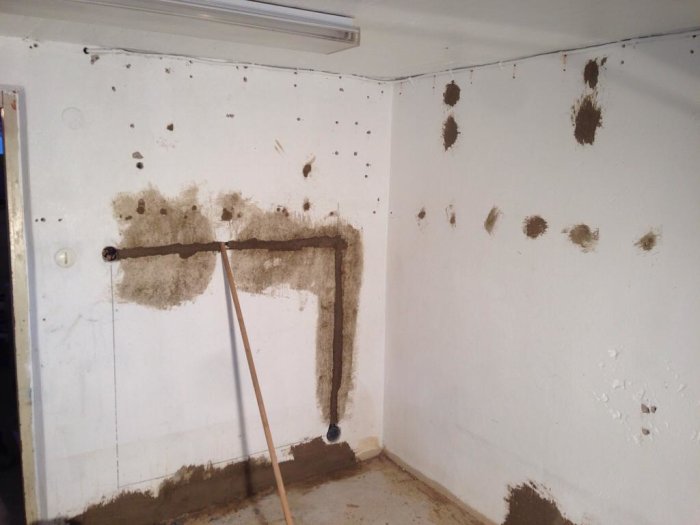
In this room, not much is loose. But it might be unnecessary to go at it with a pressure washer, so I'll skip that. I've bought a bag of plaster C that I plan to use to repair the damages, fill in old holes, and hide vp-pipes in this groove with.
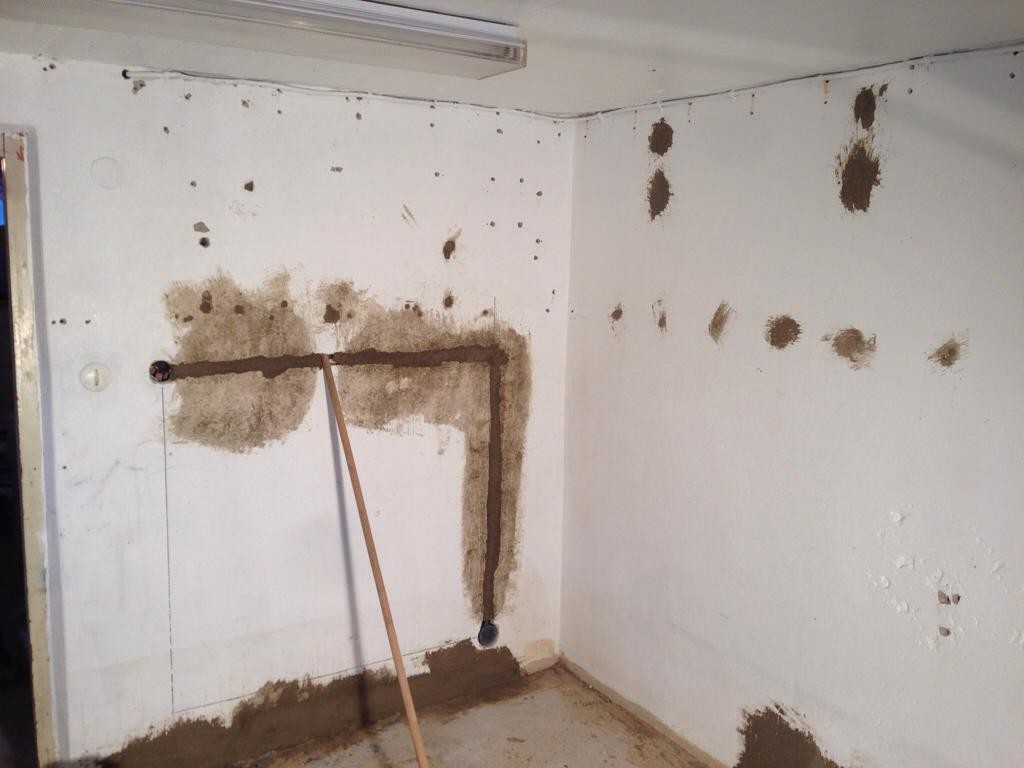
Now we have used up roughly one bag of mortar C. It's decent but not so nice in the transition between the new and old plaster. Should one sand down the joints or fill with something?
When I've plastered, I've tried to make a slightly thinner mix that I use on the transition (the seams). Then it doesn't become so sharp.
In other words, I plaster and scratch off the surface as usual. Then, when it's dried a bit, I apply a thinner mixture over as large an area as needed to hide the transition.
I'm not sure if this is the best way? But it's how I do it anyway.
The most aesthetically pleasing way is of course to knock down all the old stuff and then apply new, but that requires a bit more work.
Okay, I'll try that next time. Right now I'm waiting for it to dry properly (cold basement = seems to take a long time) then I thought I'd try sanding by hand with that kind of concrete sander.
I used a concrete grinder (a type of heavy-duty angle grinder) with a diamond wheel (the kind with "blocks") to grind away paint and loose plaster. Warning, it creates an infernal amount of dust, even though I rented a machine connected to a shop vacuum.
Then I replastered the walls with plaster mix C and painted with silicate paint. It still looks good so far, although it's only been just under 2 years so I can't comment on how it will look in 20 years.
Did you do any re-drainage or how did you tackle the moisture in the basement walls?
We drained 3/4 of the house 2 years ago and are now working on the last wall. The lower part of the walls continues to crumble, and it's worse in certain parts of the basement.
we drained 3/4 of the house 2 years ago and now we're working on the last wall. The lower part of the walls continues to deteriorate and it's worse in certain parts of the basement.
Have you noticed any significant difference since you re-drained, so you can see that it has led to anything? I live in a terraced house where every other house has a basement and every other one is on a slab at ground level. Unluckily, the worst affected wall is under the neighbor's house, so I can’t possibly re-drain (unless I buy and demolish the neighbor's house, but that’s obviously not possible...!).
Oh no, that was built differently. How is it working for your other neighbors who also have basements?
we haven't noticed any difference since the redrainage
My house seems to have the most problems, but I haven't been in my neighbors' basements, so I can't know for sure. What I'm wondering is whether it COULD be the drainage, but also if it could be a cracked/leaking pipe from the stormwater.
Click here to reply
Vi vill skicka notiser för ämnen du bevakar och händelser som berör dig.



fulingbusen said: