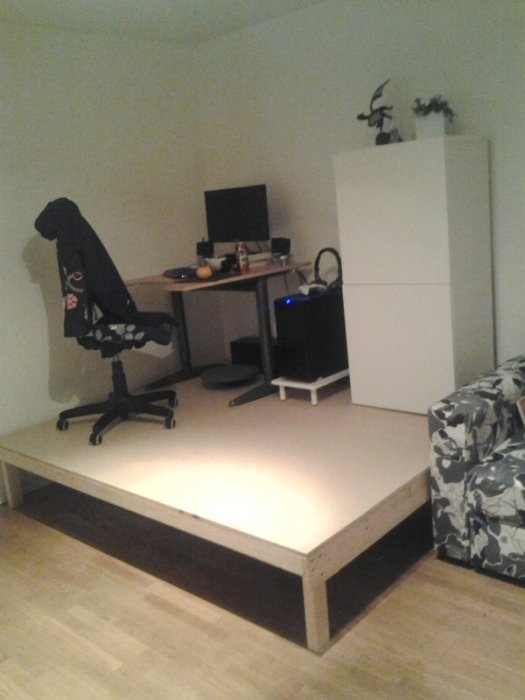
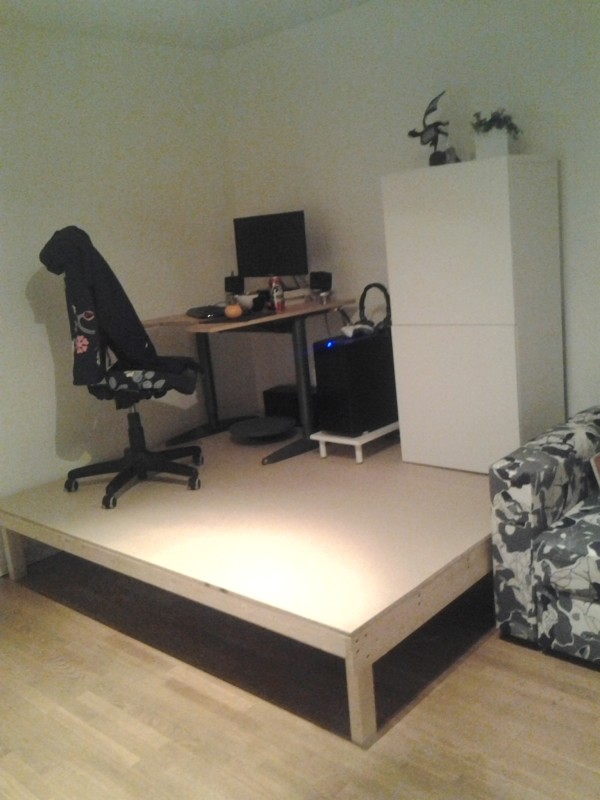
In order to make use of the small space I have in the apartment and after too much surfing on the internet, I decided to build a low loft floor, where I could have the bed underneath during the day and easily pull it out at night, as well as have a computer and chair on top.
Said and done, I quickly put something together to see if it worked visually/practically in the apartment, and sure enough. With a little imagination, it works perfectly. If I get the stability issues sorted out, I'll add some kind of flooring and paint it white.
But: it's so wobbly it's ridiculous; it won’t do for my poor computer to get seasick every time you move up there.
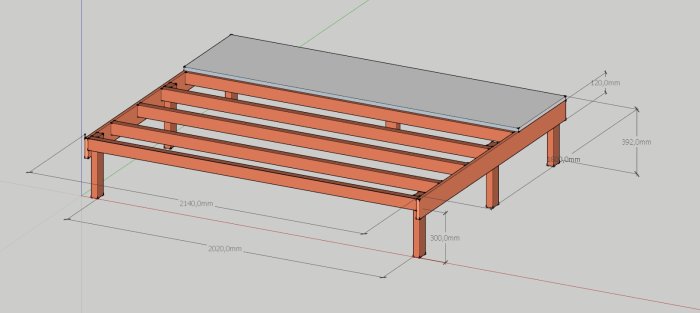
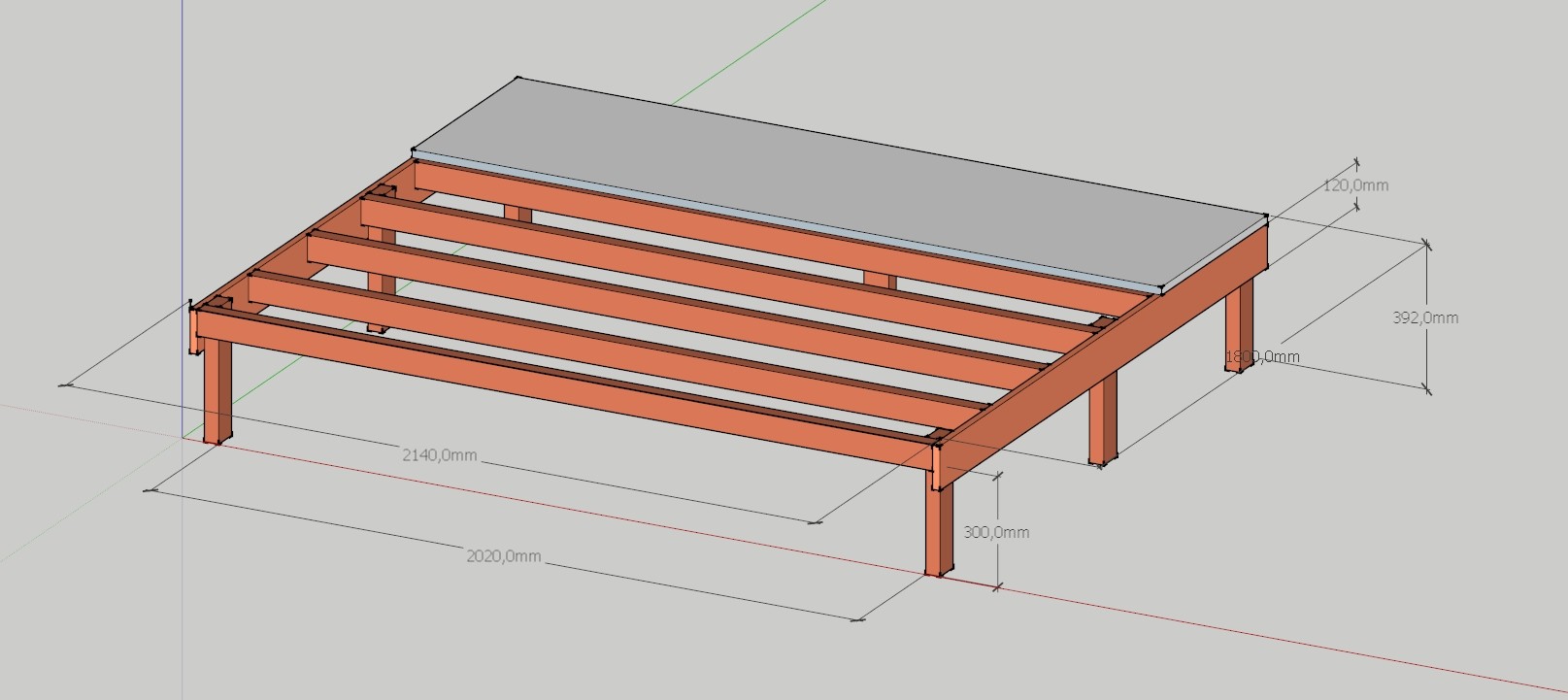
The quick construction is based on 70x40 beams cc 300 with a chipboard screwed on top.
Clumsy sketchup made afterwards of the construction
From what I read about beams and flooring, the beams should be 160 high or something, but that's not possible. The limiting dimensions in height are:
Clearance: 300 mm to fit a bed underneath
Max total height: ~400 mm so it doesn't get too ridiculously high (a few mm more might go...)
What I've tried to get a little stability in it:
Screw L-profiles, 35x35x2000x1, along the bottom of the three middle beams.
Made virtually no difference at all, as suspected, but it was a cheap and easy attempt...
What I've considered as solutions are:
Replace longitudinal beams with steel, kkr 60x40
Build some form of torsion box
Screw L-profiles 70x40x2000x? along the bottom of the three middle beams
Have the whole thing constructed in steel (though the quotes I've received are a bit too expensive for it to be fun...)
Or my most engineering-like solution, simply cutting the "floor" into two parts. A narrow part where the computer and cabinet stand and a part where you naturally move. Then the parts can stand with a 1mm gap and everything will be great!(? )
Additionally, I have no access to a garage/workshop etc., so all the building makes the kitchen bear the brunt, hence the torsion box idea is challenging.
Does anyone else have a genius way to solve the whole thing?
Run a board underneath as well, then it will be a sandwich construction that is much stronger. The joints on the boards must be glued and screwed properly onto the studs.
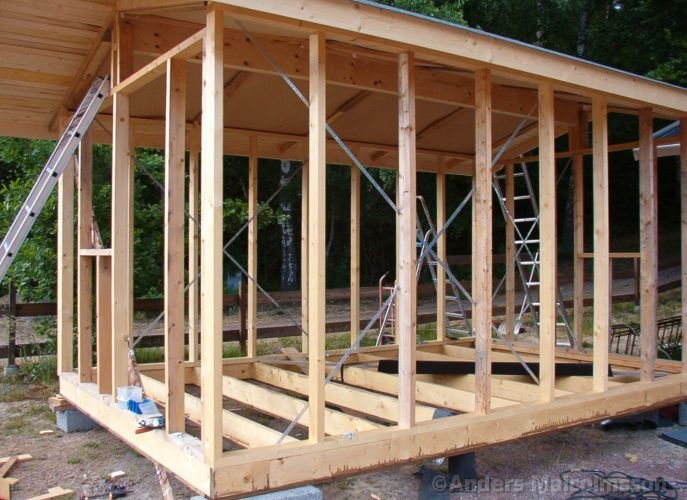
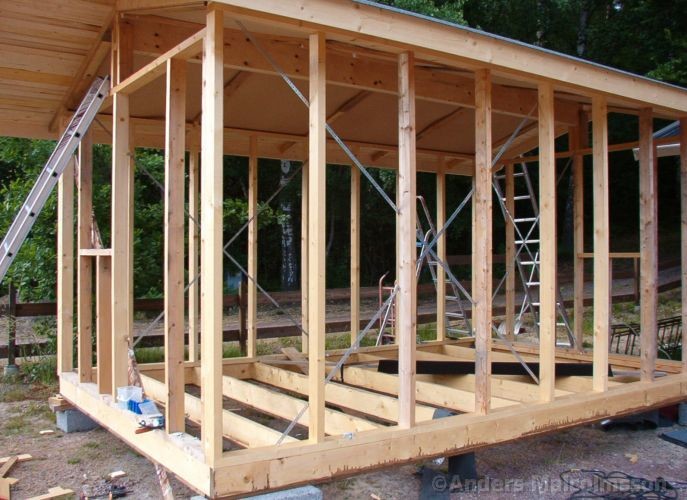
The only problem is that there is no lateral stabilization... Cut a plywood/OSB/Chipboard and screw it onto the long side facing the wall, and similarly on the short side facing the wall, so it becomes stable laterally. It's also a good idea to glue it, making it homogeneous and strong. Even simpler is to place steel bands in a cross, following the principle in the picture:
Place a board underneath as well, creating a sandwich construction that is much stronger
Check! I think dad would also notice the difference...but he was the one who thought 70x40 would work perfectly fine too
The joints on the boards must be glued and screwed properly to the studs.
Sounds wise, there's not a drop of glue in the construction right now
The problem is just that there is no lateral stabilization / standing boards on three of the sides down to the floor
Well, this is embarrassingly well thought out. I don't really know why I didn't build it like that from the beginning...
But with boards along the sides, I can also attach the entire "floor" to the two adjacent walls.
And it might be suitable to put some kind of stop behind the chair
Haha, maybe, but, gaming on the edge
Thanks so much for all the feedback!
I have some chipboards left in the basement, so step one will probably be to use them!
Click here to reply
Vi vill skicka notiser för ämnen du bevakar och händelser som berör dig.