
7,430 views ·
71 replies
7k views
71 replies
Construction abroad

Very robust air gaps for Swedish conditions, but that's probably not a disadvantage.
3mm plywood, what is that? Are you thinking of masonite?K Killerbee said:No, to keep the insulation in place. I was thinking of something equally good on the inside but cheaper than plywood inside. Right now, the wall plans look like this from the outside in:
Vertical paneling
40mm battens for air circulation
3mm plywood
150mm rockwool insulation
3mm plywood
50mm battens for air circulation
50mm rockwool insulation
12mm construction board similar to OSB
12mm gypsum/wood paneling
Then, 40mm battens are not enough, you also need ströläst to have approved ventilation.
You can have staggered "releases" in the horizontal battens, otherwise there will be no ventilation.
Yes, I know, but they are too few.J justusandersson said:
The solution you mention is essentially equal to zero ventilation.
There are tons of studies and research on this area; we read a lot about this when I studied.
You must have double to get adequate ventilation, as all tests showed.
Most manufacturers recommend it now.
You're probably right, but it also depends on what you are ventilating against. In Sweden today, it's a lot about compensating for the problems with diffusion-tight paints and using wood that is not dry. I imagine that the conditions in Morocco are a bit different. But I do not know that for sure. I think KillerBee should check out their neighbors' building methods.
Hehe my "neighbors'" construction style is brick houses with fake planks and have no insulation whatsoever. Either for warmth or the cold days.
What's wrong with my construction method?
Once upon a time, neither air space inside nor outside was used. Now 45mm x 70mm is recommended while many companies in Sweden use 45mm x 35mm.
That's how I was thinking about the paneling. The right image
What's wrong with my construction method?
Once upon a time, neither air space inside nor outside was used. Now 45mm x 70mm is recommended while many companies in Sweden use 45mm x 35mm.
That's how I was thinking about the paneling. The right image
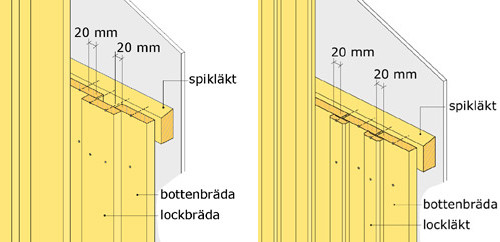
you get none or minimal ventilation which is the whole point.K Killerbee said:Hehe my "neighbors'" building method is brick houses with fake planks and have no insulation whatsoever. Neither for heat nor the cold days.
What's wrong with my construction method?
Once upon a time, neither air gap inside nor outside was used. Now, 45mm x 70mm is recommended while many companies in Sweden use 45mm x 35mm.
That's how I had planned the paneling. The right picture
especially if you have vertical paneling, you must have both nail and counter battens
No, until the 70s, air gaps were not commonly used in connection with wooden facades at all. It is diffusion-tight paints and the presence of wood that is not carpenter dry that have driven this development. It is always good to ventilate the facade, but if you know which paint to use and that the wood is dry, it is not so important.
That sounds good. Just make sure there are no other unpleasant things, such as small rodents, that we don't have in Sweden.
The remaining timber for the paneling is well-packaged with the original packaging and weather-protected under an awning on a moisture-insulated elevated platform. These too I have imported from Sweden.
During this time of year, there aren't many insects or rodents, and all open packages are inspected and repositioned.
During this time of year, there aren't many insects or rodents, and all open packages are inspected and repositioned.
That sounds like an exciting project. What kind of connection do you have to Morocco?