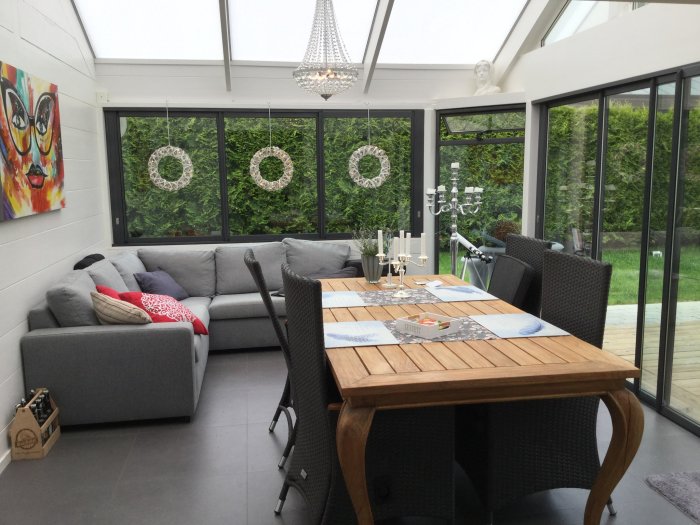
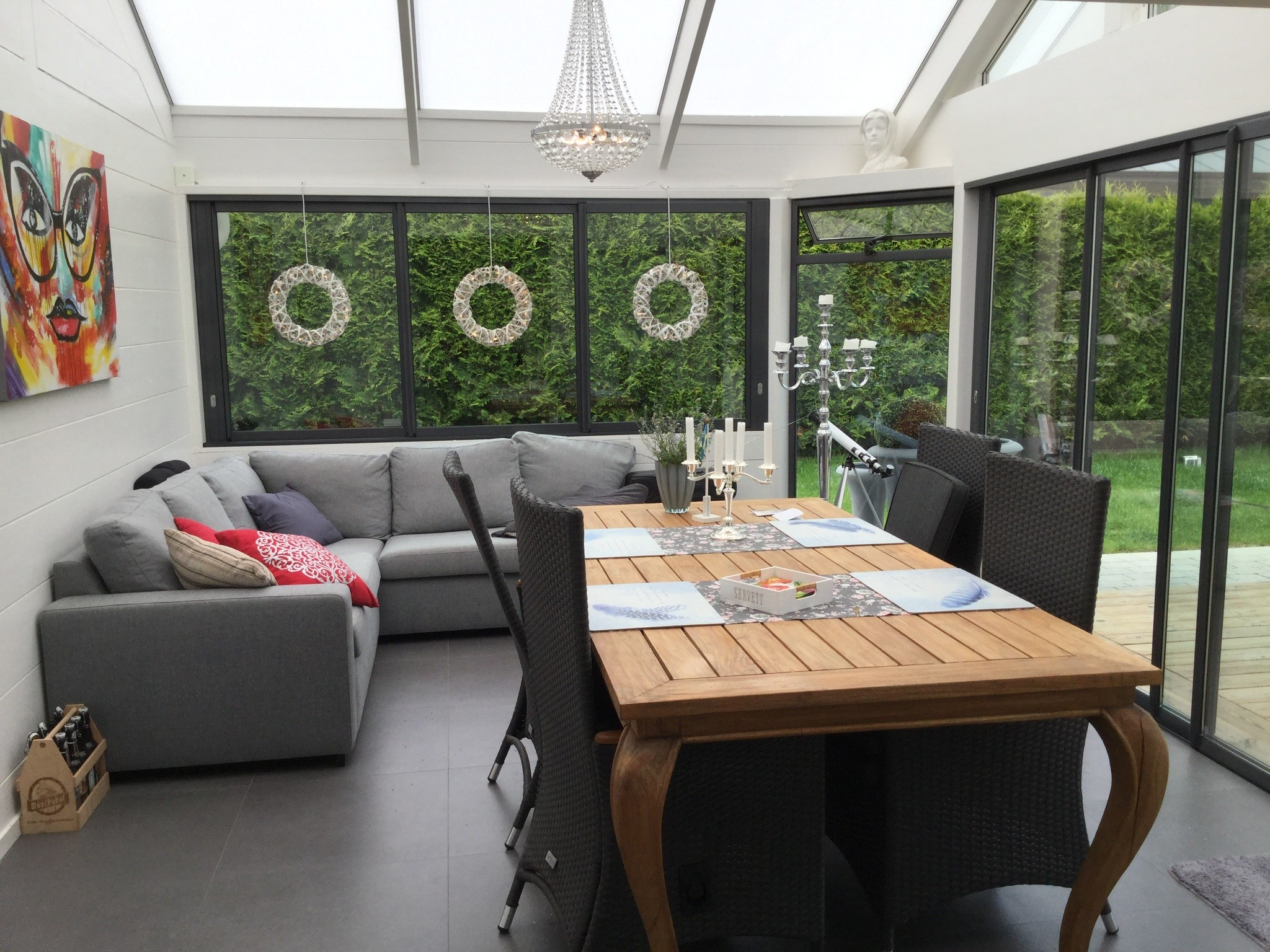
We are in the process of planning the construction of our conservatory, a room measuring 4.5x5m (4.5 m wide from the house wall outwards) and I am now considering pouring a slab for the room instead of an insulated wooden floor structure. The groundwork is already done with geotextile fabric, gravel, etc., 60 cm deep in connection with the house construction. The current idea is to build a conservatory for spring-summer-autumn but to prepare for possibly enclosing it to become an additional room in the future.
Is it overkill to pour a slab for this purpose?
My second question is, we will be using glulam columns at the outer edges to support the roof structure, which consists of a tile roof. Is a normal 300 mm concrete slab sufficient, or do we need to add extra reinforcement in the corners where the columns will be placed? The glulam columns are sized according to 190x190 mm.
And my third and final question is, should we make a 400 mm slab since it might become a fully-fledged room in the future, or is 300 mm sufficient?
My thought otherwise is to make the concrete slab myself with the help of L-elements.
Assuming that the ground conditions are right, a slab is probably the best solution, although not the cheapest. However, I become a bit hesitant about the dimensions you mention. What does 300 mm stand for? The edge of the slab should be dimensioned for the loads that will occur, which should preferably be clarified first. How did you come up with 190x190 mm glulam pillars? Such a pillar with normal height can take a load of about 50 tons. It feels a bit overkill.
The measurements 300 vs 400 mm refer to the height of the edge beam I am talking about.
Regarding the columns, I have received help from a structural engineer from the company that manufactures the glulam I will be using (a bit biased perhaps)... The dimension is determined by the transfer beam we will use, which is 190x360 since we will only have columns at each end of the beam. Admittedly, it might also be possible to use 140x140, I haven't checked the requirements regarding the support length for the beam.
The construction for the roof is thus a ridge beam of 115x405 mm, 6 m long, with attachment to the existing house roof at one end and a column down into the slab at the outer end, this column is 115x180 mm. The transfers are 190x360 mm and an unknown dimension (perhaps 115x180 there as well?) for the columns so far, but these will be placed at the corners of the slab.
Then I understand better. Where in the country is the house located? The difference between Upper Norrland and Skåne is quite significant,
It is often practical to use the same column width as beam width even if it involves substantial over-dimensioning. 190x360 corresponds to 90x450 but means a height reduction that may be necessary, so I understand that too. If the ambition is for the slab to be able to serve as a permanent part of the house, it argues for a 400 mm edge beam with room for 300 mm cellplast.
Lovely The house is located in the southern parts of Dalarna, snow zone 3.
Yes, it will be attached to the house at an angle, making it a permanent extension of the existing house. Do I need to add any extra reinforcement where the pillars will stand, or is the footprint from them enough to distribute the weight so the point load does not become unreasonably high?
Just as you said, height is our limitation, hence that dimension for the load-bearing beam.
Where the load-bearing pillars are supposed to stand, the foam insulation was removed in the L-support so it forms a reinforced concrete foundation there.
I am very satisfied with the build and use it almost year-round; if it's above 0˚ C, there are no issues maintaining 21˚.
It is quite simple to check that the edge beam can withstand the current column pressure. Calculate with a total roof load of about 90 kN, of which 1/4 falls on the column that supports one end of the ridge beam. That is probably the critical point. 22.5 kN on 115x180 mm becomes approximately 1 MPa if I calculate correctly.
Just a clarification: With the column loads that seem to be relevant, some form of plinth/beam construction is required to distribute the load over a larger area. One should not count on more ground pressure than 100-200 kPa depending on the subsoil.
Thank you so much!! Do you have any suggestions on what an alternative solution might look like? Glulam as a transfer beam there as well, but then the corner posts would also have to bear a larger portion of the load?


 The house is located in the southern parts of Dalarna, snow zone 3.