It's important to remember that concrete is not resistant to tension, ONE reinforcing bar doesn't help because when under load, the concrete above the bar will be subjected to tensile forces.
I think a better option is a plaster mesh or similar about 5 mm from each surface (i.e. at the outer edges of the concrete).
It's a bit like the principle of drywall (where it's the paper on the outside of the boards that prevents them from breaking).
Under loading, it's the concrete below the reinforcement that's subjected to tensile forces, which is why all constructions subjected to overhead loads are reinforced at the bottom. Mesh, etc., on the top or in the middle is solely to prevent cracking and has little impact on the construction's strength.
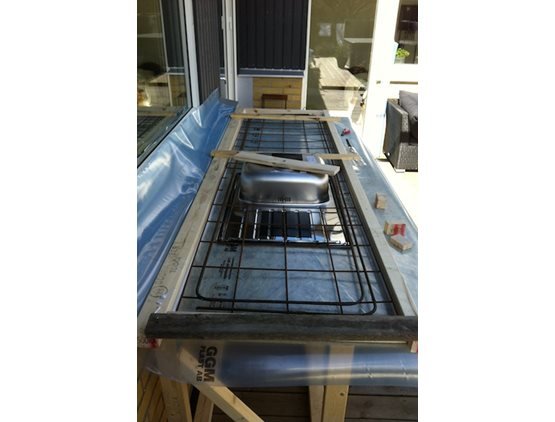
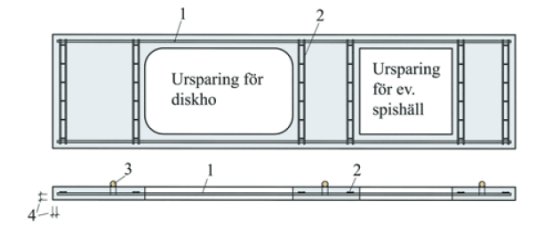
The only thing that limits the thickness of the slab is that it becomes heavy, but I'm aiming for 40 mm thickness. I have seen a few different examples of reinforcement, but don't know which one to choose.
Under load, it's the concrete beneath the reinforcement that is subjected to tensile force, which is why all constructions loaded from above are reinforced at the bottom. Mesh, etc., at the top or in the middle is solely to prevent cracking and has little effect on the structural strength.
Which is lucky, otherwise we'd be in trouble since all our upper reinforcement bars in the floor slab are rusted and exposed
Under load, it's the concrete below the reinforcement that's subjected to tensile force, therefore you reinforce all structures that are loaded from above at the bottom. Mesh, etc., at the top or in the middle is only to prevent cracking and has little impact on the structural strength.
It depends on how you load it. If the slab only has support at the ends, then sure, all the load (both the slab's own weight and any additional load on it) will pull at the bottom and compress at the top. Then reinforcement only at the bottom works. But if you also have a support point in the middle, there's a risk that the slab is loaded in reverse (support in the middle and load at the ends). This can happen, for example, if you try to lift the slab, or if you try to place the slab upside down to glue a basin underneath.
One way to keep the weight of the slab down is to embed cellplast in the middle, but perhaps that weakens it too much?
Yes, I have considered casting in place. But that requires a fair amount of surface finishing for it to turn out well, right? Similarly, the form requires a bit more thought On the other hand, it ends up in the right spot immediately...
I have zero experience in this, so all input is appreciated
I would not hesitate to cast in place. I would use expanding concrete. Lightly vibrated and you will get a nice surface without too much finishing work. The formwork should not have to be too difficult, place a board on the bench that can remain there.
If you cast on site, the countertop surface becomes the exposed surface of the concrete? Normally, you would make a mold with a smooth bottom because the smooth bottom ensures that the slab has an even and fine surface? The exposed surface can never be as smooth and fine, partly because larger grains will protrude above the surface and the water in the concrete has a surface tension that prevents it from becoming completely smooth?
Well, the usual method is probably to flip the slab after casting, but I have seen examples where it has been cast in place, though that of course requires quite a bit of grinding.
So the question is what becomes least complicated with good results. The finished slab will weigh close to 300 kg, and it's quite an operation to have a form that can be flipped and to manage the effort and then lift it into place. I've considered a workshop lift/engine hoist and slings, but it seems a bit unnecessary to buy just because of this, especially when you don't have a garage
How much work is it to grind the surface if you don't flip it? If you float and finish the surface, should it be less work?
How much work is it to sand the surface if you don't flip it? If you float and trowel the surface, should it be less work?
I have tried making test pieces with expansive concrete, and I have completely avoided touching the concrete with anything after casting, no floating or troweling. The surface turns out surprisingly well, but of course you need to sand it if you want it really good...
Yes, you are right about that. I'll just have to try .
But I still think I'll try to build the form so I won't have to keep the board underneath in that case. Even if it means a bit more tinkering. Well, that's the next concern.
Does it make any difference between finja bemix standard or weber exm 702?