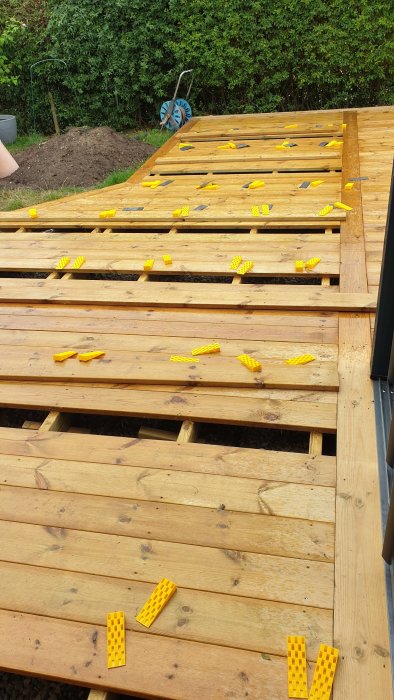
Now the carpenter has been here, and we have had an initial discussion about the situation; he seems willing to fix things until I'm satisfied. He stood by while we jumped on the deck, and it was clear he was surprised by how much it flexed. My partner told me to stop jumping so the beams wouldn't snap .
So planned solutions are as follows:
1) I'll fix the wall gaps myself as best as I can with soft caulking and inserted insulation. I found thin expanding window strips that I'll put in where possible, then the soft caulking will do the rest.
2) The gaps between the floor and wall will be solved with a combination of foam sealant, foam board pieces, and maybe some self-leveling compound to keep out the mice (thanks for the suggestion @Myrkebab!) We should be able to saw off the panel on the wall with the worst gaps so that it's one whole channel to fill instead of fiddling with foam sealant. I'll probably do this myself too.
3) The post by the sliding door section will be replaced with a larger one; it's not a major operation since it's not the load-bearing structure and was added afterward. He'll just have to deal with that. Then, having to paint it twice is a minor issue for me.
4) Deck boards will be taken up along the joists so we can put wood feet/plastic shims underneath/on the side as per @norrbottenssnickaren's suggestion; it seems like the simplest solution to stabilize it. I'll insist on oversized dimensions for both the feet and plastic shims because now I want a dance floor stable enough for elephants. He may have to put in some blocking too, just because I've become paranoid.
It's really sad when trust completely drops... now the whole project feels like a risk since he's been so fundamentally clumsy. It's very surprising since he's apparently managed +40 years in the business with no negative reviews online, and he was very difficult to schedule because he has ordered projects in queue and several "regular clients."
It sounds hopeful that many of you aren't worried about the lifespan of the decking, so perhaps the damage isn't as bad as I thought. We'll see where it ends up in the end; some monetary deduction for prolonged project time and wasted material might be appropriate. The most important thing is that it's done correctly.
Please continue to give me more tips on remedial methods, things I should consider, or ideas for appropriate deductions. I need all the help I can get.
Experience is no guarantee of either knowledge or competence. There are plenty of people who go to work only thinking about when they can go home. People who don’t reflect and are not constantly self-critical. To me, experience means very little. It only takes three to four years for an ambitious person with talent to learn what a lazy person takes in over an entire working life.
Get an inspector and withhold money, then it will be easier to get somewhere.
Yes, the idea has come up, but at the moment it feels like an unnecessary cost since the carpenter seems committed to resolving this to our satisfaction. No money has been paid to the carpenter yet; however, I have purchased all the materials myself.
So, I'm hoping for sufficiently good advice here to avoid bringing in a third party. I just want to know what is technically correct in construction and what I should demand regarding actions.
It is certainly possible to calculate that the lifespan of the decking could be shorter, but in practice, that difference is probably minimal.
The idea that you would break a bunch of joists with cc60 that have two cm of play sounds extremely unlikely.
Of course, you should have your issues addressed, but I think you need to calm down a bit regarding the fear of material defects. There is a risk of being dismissed by the craftsman if you take a laboratory-technical approach to the materials they work with every day.
It's the same with Biltema's plastic feet.
They are made specifically for decks. Of course, they are tested to last a long time outdoors. Moreover, there is no UV exposure to speak of under the floor.
Why would they be worse than plastic shims that can also weather or become attractive mouse food?
The great thing about wooden houses and wood in general is that if something goes wrong, you can just loosen and redo it.
Unfortunately, it's partly a professional hazard to assume a laboratory-technical approach regarding material selection and technique choice; that's just the way I function . It gets worse when I'm not experienced in the area and need to understand it. The original plan was to delegate the overthinking to the carpenter so that I wouldn't have to, but now we're back to me having to make decisions, and all parameters need to be considered
The dismissal is probably pretty even on both sides at the moment, it bothers me little if he thinks I'm overambitious when he himself has been so clumsy.
Plastic shims are static, a screwable plastic foot is dynamic. It's not just the plastic in the whole thing that must hold, but the detail part, the screw thread, which has a much smaller contact area, so the margin of error is higher . Then it might last anyway, I just have bad experience with Biltema in other plastic stuff.
Experience is no guarantee of either knowledge or competence. There are plenty of people who go to work and only think about when they get to go home. People who don't reflect and are constantly critical of themselves. For me, experience means very little. It takes only three to four years for an ambitious person with talent to learn what a lazy person absorbs over an entire working life.
True, the problem when outsourcing jobs is that it's impossible to know beforehand how skilled the person is. Apart from reference jobs, I wasn't thorough enough to go and look at previous work, however, I got in contact with the carpenter through a reference and everything else indicated that he was skilled. I probably wouldn't have had the knowledge to assess the jobs at that time regardless. Now I know more than I did 4 months ago
True, the problem when outsourcing work is that it's impossible to know how skilled the person is in advance. Besides reference jobs, I wasn't thorough enough to go and look at previous work, but I got in touch with the carpenter through a reference and everything else indicated that he was skilled. I probably wouldn't have had the knowledge to assess the jobs at that time anyway. Now I know more than I did 4 months ago
What you can do is make an assessment of the person. That is, is this a thinking being who is easy to reason with? Does the person seem honest?
What you can do is make an assessment of the person. That is, is this a thinking being who is easy to reason with? Does the person seem honest?
Yep, and all of that applied to this carpenter during the quote phase... Honest, experienced, good communication, punctual, clear, control-oriented/demanding (which for me is a positive indication that a person knows what they're doing... I also make demands in my professional role to be able to guarantee a result. The worst thing I know is a sycophantic "absolutely, we'll solve it" attitude, which to me is a clear indication of someone who doesn't think through the problem... I'd rather have a grumbling guy who mutters as he inspects the conditions and then lists possible solutions to a problem.) But it didn't help much this time. Except that now, when problems have arisen, good communication still remains and there are no indications that he won't take responsibility for it, and that is at least a positive thing.
Anyone have more suggestions/comments? I really need help, the discussion with the carpenter is likely to be in the next few days and I want to be able to make the right demands...
He can mill a groove between the bricks in the wood with the router and insulate
Yep, and all of that matched this carpenter in the quote phase... Honest, experienced, good communication, punctual, clear, control needs/requirements (which for me is a positive indication that a person knows what they're doing... I also set demands in my professional role to guarantee a result. The worst I know is the fawning "absolutely, we'll fix it" attitude, for me that's a clear indication of someone not thinking through the problem... I'd rather take a grumbling old guy who mutteringly inspects the conditions and then lists possible solutions to a problem.) But it helped little this time. Apart from the fact that now, when problems have arisen, good communication still remains and there are no indications that he doesn't intend to take responsibility for this, and that's at least a positive thing.
In that case, it sounds like you've done what you can. Someone else might have reacted to something that would have revealed the matter earlier, but you seem to have done what can be expected based on your circumstances.
Today the carpenter was here and adjusted the deck in 3 places, according to the method shown in the picture. A few test jumps before the downpour suggest a significantly more stable deck. Hopefully one less problem.
New problem(?): to make it easier to insert polystyrene, we cut the panel and lifted at the innermost floor chipboard piece. We then saw that the structure is supported by 3 screws that have a considerable distance to the wall, about 5cm of visible screw. Is it supposed to be like that? The draft is brutal by the wall, but I hope a combination of polystyrene pieces and foam insulation will suffice. I've outsourced any future mouse problems to the cat.
Today the carpenter was here and adjusted the deck in 3 places, according to the method in the picture. Some test jumps before the downpour came testify to a significantly more stable deck. Hopefully one problem less.
[image]
New problem(?): to make it easier to insert foam, we cut the panel and lifted at the innermost floorboard piece. Then we see that the construction is supported by 3 screws that have a considerable distance to the wall, about 5cm of visible screw. Should it be like this?
The draft is brutal by the wall but a combo of foam pieces and sealing foam I hope is enough. I have outsourced any future mouse problems to the cat.
GreenYoda said:
Today the carpenter was here and adjusted the deck in 3 places, according to the method in the picture. Some test jumps before the downpour came testify to a significantly more stable deck. Hopefully one problem less.
[image]
New problem(?): to make it easier to insert foam, we cut the panel and lifted at the innermost floorboard piece. Then we see that the construction is supported by 3 screws that have a considerable distance to the wall, about 5cm of visible screw. Should it be like this?
The draft is brutal by the wall but a combo of foam pieces and sealing foam I hope is enough. I have outsourced any future mouse problems to the cat.
No, the screw should not be hanging in the air. Is there support under the beam? Could it have happened because you cut off the caps? Floorboards are usually glued and screwed. You shouldn't be able to loosen it. But maybe lucky in this situation. In the worst case, you will get floor squeaks when walking on the floor. Are you going to lay laminate flooring or parquet or something similar on top?
Today the carpenter was here and adjusted the deck in 3 places, according to the method in the picture. A few test jumps before the downpour came indicate a significantly more stable deck. Hopefully one less problem.
[image]
New problem(?): to easier access and insert the foam insulation, we cut the panel and lifted the innermost floorboard. We see that the construction is supported by 3 screws that have a substantial distance from the wall, like 5cm of visible screw. Is it supposed to be like this?
The draft is brutal by the wall but a combination of foam pieces and caulk I hope will suffice. I've outsourced any future mouse problems to the cat.
But it looks hopeful with the deck. One less problem
No, the screw should not hang in the air. Is there support under the beam? Could it be because you cut off the caps? The floor chipboards are usually always glued and screwed. You shouldn’t be able to loosen it. But maybe lucky in this situation. In the worst case, you'll get floor creaks when you walk on the floor. Are you going to lay laminate flooring or parquet or something similar on top?
Yes, there should be support under the beam where the screws are located, as I recall, it should rest directly on the concrete slabs...so the screws might be more stabilizing than load-bearing? The caps weren't attached to the floor in any way, they fell into the cavity where I am going to spray insulating foam. So that can't have affected it. There will be a special outdoor room laminate floor laid on top, yes.
Yes, there should be support under the beam where the screws are, it should, as I recall, rest directly on the concrete slabs...so the screws might be more stabilizing than load-bearing? The covers were not attached in any way to the floor, they fell into the cavity where I will spray foam. So it can't have affected that. There will be a special conservatory laminate flooring on top, yes.
Maybe you can press down some plastic wedges next to the screws so that it tightens against them. And then don't skimp on the foam. A rug or something similar wouldn't have been good on the chipboard if they aren't glued. There's a risk they might move a little and that would maybe show through. But it doesn't help against potential creaking. Is the floor quiet now?
Maybe you can push down some plastic wedges next to the screws so it tightens against them. And then don't skimp on the foam. A mat or similar probably wouldn't be good on the floor chipboard if they're not glued. There's a risk they could move a little, and that might show through. But it doesn't help against possible creaks. Is the floor quiet now?
In what way would wedges help/have a function? How can the screws be problematic? Yes, right now the floor is silent and solid as it seems, we will jump-test it later after we move things that are there now... as previously written the sunroom stands on its own floor frame, hopefully with fewer/no wedges in the way the decking floor had.

GreenYoda said:
A general update:.
Skumpe said:
Experience is no guarantee of either knowledge or competence. There are plenty of people who go to work and only think about when they get to go home. People who don't reflect and are constantly critical of themselves. For me, experience means very little. It takes only three to four years for an ambitious person with talent to learn what a lazy person absorbs over an entire working life.