
28,710 views ·
88 replies
29k views
88 replies
Complain about construction against carpenter?

Electronics enthusiast
· 2 457 posts
several mm rather than cmT Thörre said:Never good to use block pieces to set the deck on. After a year when they've dried, they become several cm smaller with the risk that several blocks will be hanging in the air and the deck will sway. Especially if the deck is attached on one side to the house wall and is not freestanding.
Instead, I bought terrace feet from Biltema which are easy to adjust.
[link]

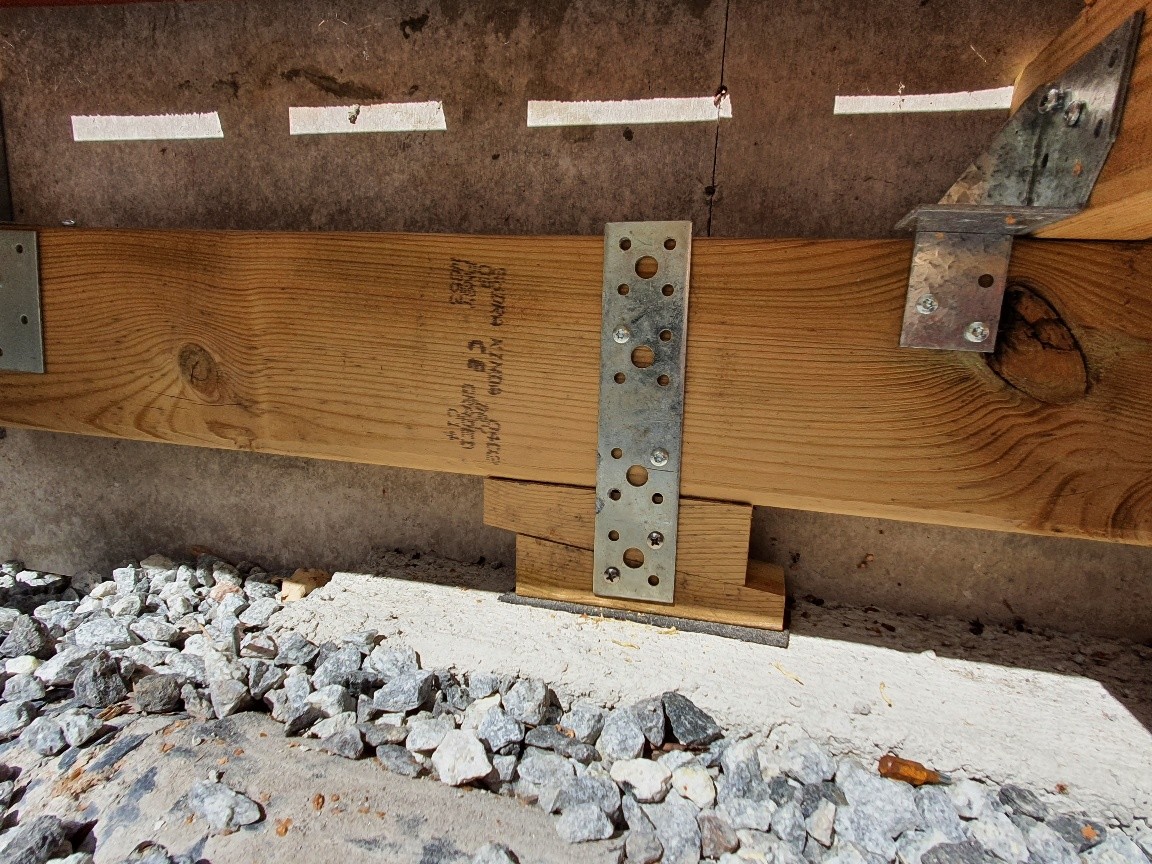
That looks fine and basically the same solution as smaller plastic wedges. There's not really room to double wedge with the current wooden wedges, so they probably need to be replaced...maybe a combination of plastic wedges and wooden feet.Cruzze said:
Peppery little solution but I do not have enough confidence in Biltema to believe that their plastic constructions will last over the years. Had it been a budget project, it would have been worth trying, but now I feel I want a little more security in the bag.T Thörre said:Never good to use rule pieces to set the deck on.
After a year when they have dried, they become several cm smaller with the risk that several blocks will be hanging in the air and the deck will sway. Especially if the deck is attached on one side to the house wall and is not freestanding.
Instead, I bought terrace feet from Biltema which are easy to adjust.
[link]
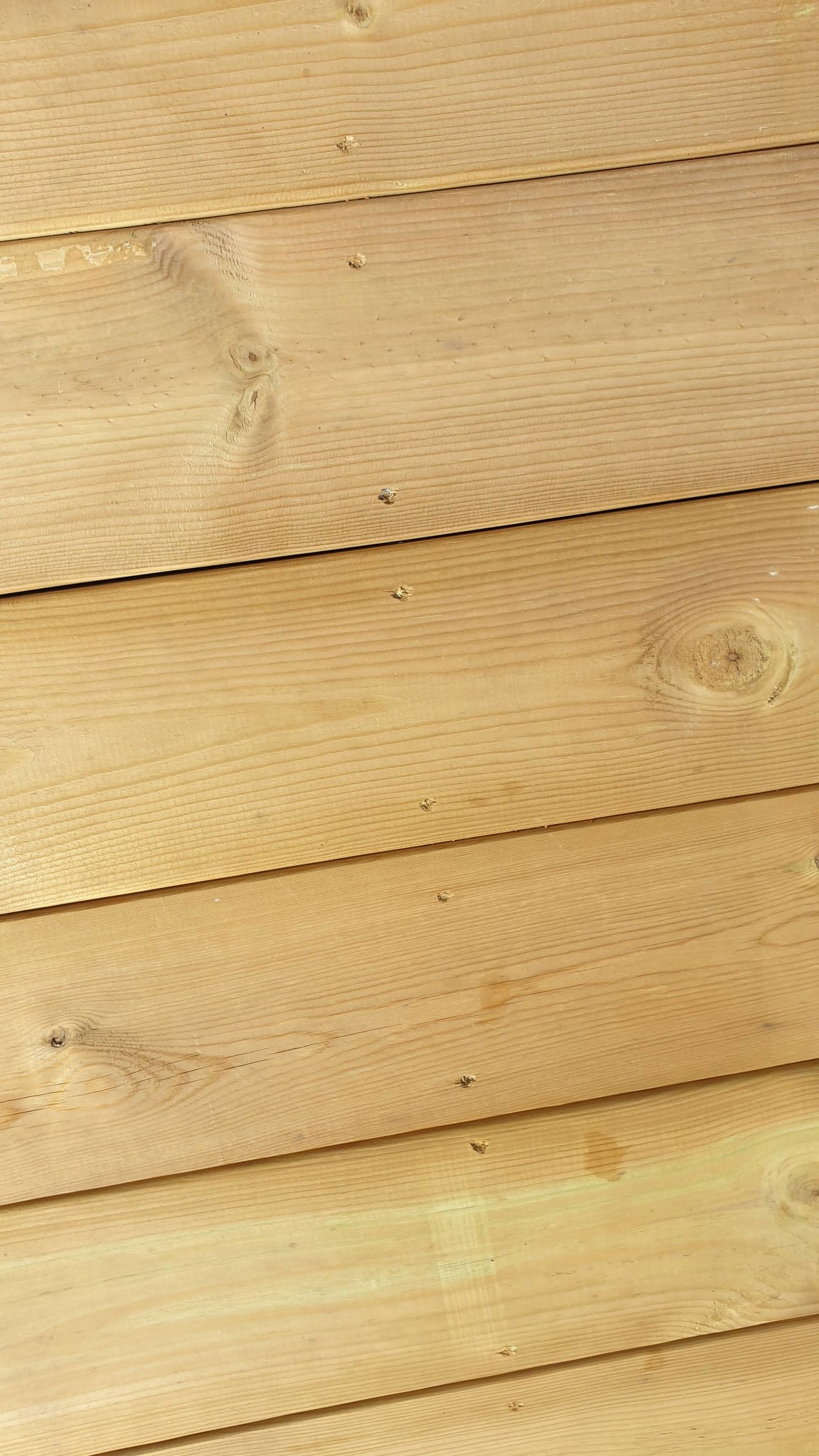
Yep, as I said, it's not a budget project, so they are A4 screws all the way through, so they should withstand being unscrewed. I perceive that the screws are generally properly tightened, but I don't know if I'm the right person to assess that...H Harald Blåtumme said:It is usually very easy to disassemble/reassemble decking even after many years if they are installed with stainless steel screws. Without any damage, but of course, they need to be properly tightened. How it might be with so-called "invisible" mounting and angled screws which are in fashion now, I have no idea about, never tried this. I will probably never do it either if I can foresee a need to lift/replace decking within the terrace's lifespan.

You only have the "foot" on one side of the joist, not both? There are lots of leftover pieces, so it would be nice to avoid buying more expensive lumber...maybe a combination of wooden feet and plastic blocks. I've gotten paranoid now that it's gone so wrong, so I'll probably want to have an excessive amount of support under the deck this time.
A general update:
The carpenter has now been here, and we've had an initial discussion about the situation. He still seems determined to make things right until I'm satisfied. He stood by as we jumped on the deck, and it was clear he was taken aback by how much it flexed. My partner told me to stop jumping so the joists wouldn't break.
Planned solutions are as follows:
1) I'll fix the wall gaps myself as best as I can with soft sealant and inserted insulation. I found thin expanding window foam which I will insert where possible, and the soft sealant will do the rest.
2) The gaps between the floor and the wall will be addressed using a combination of foam sealant, styrofoam pieces, and possibly some self-leveling compound to deter mice (thanks for the suggestion @Myrkebab!) We should be able to saw off the panel on the wall with the worst gaps so that there's a whole channel to fill instead of fiddling with foam sealant. I will probably do this myself as well.
3) The post by the sliding door section will be replaced with a larger one. This isn't too big of an operation since it's not a load-bearing structure and was added afterward. He'll handle it. The fact that I'll have to repaint is a minor issue.
4) Deck boards will be lifted along the joists so we can place wooden feet/plastic wedges underneath/alongside, following @norrbottenssnickaren's suggestion. This seems like the simplest way to stabilize it. I'll insist on an exaggerated dimensioning of both feet and plastic wedges because, after all, I want a dance floor stable enough for heffalumps. He might also need to add bridging, as I'm now quite concerned.
It's incredibly disappointing when trust completely falls... now the entire build feels like a risky project since he's been so blatantly fundamentally clumsy. It's very surprising as he's managed over 40 years in the industry without any negative reviews online. Moreover, he was very difficult to book because he has planned projects queued up and several "regular customers."
It's hopeful that many of you don't seem worried about the deck's lifespan, so the damage might not be as bad as I thought. We'll see where it ends up in the end; a certain monetary deduction for extended project time and wasted material might be in order. The most important thing is that it gets done correctly.
Please continue to give me more tips on remediation methods, things to consider, or ideas for appropriate deductions. I need all the help I can get.
The carpenter has now been here, and we've had an initial discussion about the situation. He still seems determined to make things right until I'm satisfied. He stood by as we jumped on the deck, and it was clear he was taken aback by how much it flexed. My partner told me to stop jumping so the joists wouldn't break
.Planned solutions are as follows:
1) I'll fix the wall gaps myself as best as I can with soft sealant and inserted insulation. I found thin expanding window foam which I will insert where possible, and the soft sealant will do the rest.
2) The gaps between the floor and the wall will be addressed using a combination of foam sealant, styrofoam pieces, and possibly some self-leveling compound to deter mice (thanks for the suggestion @Myrkebab!) We should be able to saw off the panel on the wall with the worst gaps so that there's a whole channel to fill instead of fiddling with foam sealant. I will probably do this myself as well.
3) The post by the sliding door section will be replaced with a larger one. This isn't too big of an operation since it's not a load-bearing structure and was added afterward. He'll handle it. The fact that I'll have to repaint is a minor issue.
4) Deck boards will be lifted along the joists so we can place wooden feet/plastic wedges underneath/alongside, following @norrbottenssnickaren's suggestion. This seems like the simplest way to stabilize it. I'll insist on an exaggerated dimensioning of both feet and plastic wedges because, after all, I want a dance floor stable enough for heffalumps. He might also need to add bridging, as I'm now quite concerned.
It's incredibly disappointing when trust completely falls... now the entire build feels like a risky project since he's been so blatantly fundamentally clumsy. It's very surprising as he's managed over 40 years in the industry without any negative reviews online. Moreover, he was very difficult to book because he has planned projects queued up and several "regular customers."
It's hopeful that many of you don't seem worried about the deck's lifespan, so the damage might not be as bad as I thought. We'll see where it ends up in the end; a certain monetary deduction for extended project time and wasted material might be in order. The most important thing is that it gets done correctly.
Please continue to give me more tips on remediation methods, things to consider, or ideas for appropriate deductions. I need all the help I can get.
I recently did as you did, applied construction joint between the brick pathway and the conservatory post. I'm wondering if it would add anything to place an L-shaped metal sheet over that transition? Have you ordered any sheet metal work in connection with the conservatory?
Yes, the carpenter also handles sheet metal work, so it will be attached over the polycarbonate roof, etc. The idea is that after the sheet metal work, we will water test the whole structure to ensure it's watertight.A Alfons3301 said:
The carpenter's suggestion for all the gaps was to place sheets over them, which I've considered. But spontaneously, I think aesthetically it becomes quite cluttered with sheets everywhere, and it only covers for wind and water, with no insulating effect. For the small gaps, I don't think it makes much difference to add sheets except aesthetically it becomes uglier. For the large gap, he had intended to place a sheet, but there he will instead replace the post so it becomes better insulated and nicer.

Düsseldorff
Building conservationist
· Bromma
· 3 181 posts
Düsseldorff
Building conservationist
- Bromma
- 3,181 posts
On the other hand, you can take the opportunity to lay the decking flush with the wall now that it has to be removed anyway.GreenYoda said:
Thanks for the backup, it really feels like a lousy construction. The floor will have to be redone, the question is to what extent. Picking up the decking and putting it back, as I understand it, will shorten the lifespan of the boards. The question is by how much. That he has to lay entirely new decking would probably be best but feels like a waste of time, money, and the environment.
But how do you mean that the lifespan of the decking would be shortened?

It is certainly possible to calculate that the lifespan of the decking might be shorter, but in practice, that difference is probably minimal.
The idea that you could break several joists with cc60 that have two cm of play sounds extremely unlikely.
Of course, your issues should be addressed, but I think you need to relax a bit regarding the paranoia about material defects. There is a risk of being regarded as foolish by the craftsman if you take a laboratory approach to the materials they work with every day.
It's the same with Biltema's plastic feet.
They are specifically made for decking. Of course, they are tested to last a long time outdoors. Moreover, there is no UV impact to speak of under the floor.
Why would they be worse than plastic shims that can also deteriorate or become interesting mouse food?
The good thing about wooden houses and wood in general is that if there is a mistake, you can just loosen it and redo it.
The idea that you could break several joists with cc60 that have two cm of play sounds extremely unlikely.
Of course, your issues should be addressed, but I think you need to relax a bit regarding the paranoia about material defects. There is a risk of being regarded as foolish by the craftsman if you take a laboratory approach to the materials they work with every day.
It's the same with Biltema's plastic feet.
They are specifically made for decking. Of course, they are tested to last a long time outdoors. Moreover, there is no UV impact to speak of under the floor.
Why would they be worse than plastic shims that can also deteriorate or become interesting mouse food?
The good thing about wooden houses and wood in general is that if there is a mistake, you can just loosen it and redo it.
Get an inspector and withhold money, then it becomes easier to get somewhere.
In the sunroom, it's only against the wall where there are gaps, and it's not decking there, so hopefully, we won't have to remove that floor. The rest of the deck is only against one wall, but I haven't noticed any problems there.
It's what I've read/heard, that because the screw hole becomes larger and "less sealed," the water impact on the wood increases. But based on the comments, it seems negligible, so I hope that's true.