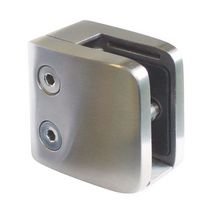
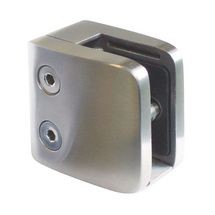
I have a staircase railing consisting of laminated glass panels in clamp fittings that were installed about 7 years ago. A glass panel by the sloped ceiling has only one fitting on one side where I assume the panel slipped out due to vibrations on a windy weekend.
I then tightened the clamp fittings really hard and they could be tightened quite a bit; I assume the rubber in the clamp fittings deforms/dries over time. Since I hadn't thought to retighten the fittings, it was pure luck that nothing happened, and I wonder now if I need to alter the construction and put something underneath or if the retightening I've done is sufficient? Currently, the panels are very secure, but the consequences if a panel were to slip out again are not something I want on my conscience
Finally, I want to ask if there's a convenient way to sand a laminated glass panel that's about 8mm thick, as it was damaged at the corner by about 1cm, which I plan to sand/round/smooth out.
Many clamps (nowadays) have a security pin to prevent this from happening. Google for "glass clamps security pin" and you'll see how they work. But it clearly becomes more complicated to mount such a clamp.
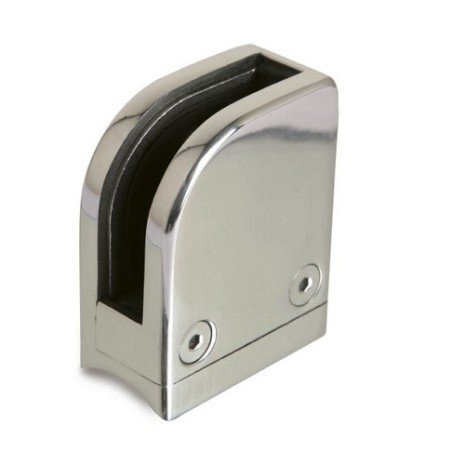
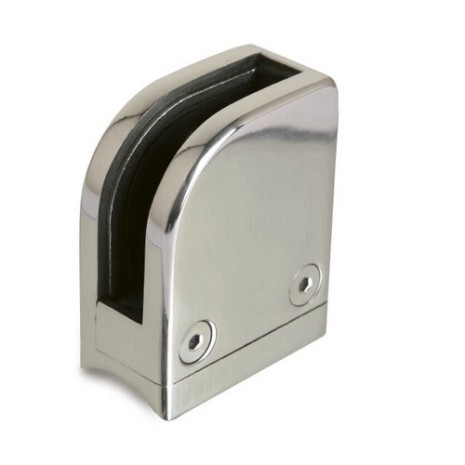
Many clamp brackets have "holders" for the pin approximately in the center of the part that holds the glass surface, as you can see here:
So, you need to drill a hole in the glass. When the glass is already in place, it's quite easy to loosen one bracket at a time and mark the correct position for the hole. Drilling the glass afterward, I assume, is a task for a glazier (it at least requires the glass to be laminated and not tempered, I think).
This is relevant when the glass is mounted "externally" so that it can fall down if it comes loose. If the railing is mounted "standing on top," the glass will only fall a few centimeters at most.
Regarding grinding, a glazier can easily handle it as long as the glass is not tempered.
The picture clearly showed, but it is still very meticulous with the measurement if you don't want too large a hole and too much play in the peg/hole. Yes, we have a railing that stands on the floor and there's no problem there, but this hangs outside the stairs and then a bit after the stairs. I thought for a while to screw small stop blocks in the same material as the "stair chassis," but it wouldn't look that nice, then I thought about a homemade solution like this peg, and it would be safe, but the question remains if it's really necessary.
New clamp fittings with pegs have been developed due to various problems, but shouldn't the biggest problem be the retightening (due to drying/deformed rubber) of the clamp fittings, and it's often not possible for builders and others to remember constructions and stairs and retighten a year later.
Shouldn't my retightening and regular checks be sufficient? I understand it's difficult for you to fully answer, but can you share your opinion with me?
Lastly, I wonder what a reasonable price would be for smoothing the damaged corner if I take the panel to the glass company?
It doesn't matter if you make a slightly larger hole in the glass than the pin, as it is hidden by the clamp mount. The pin will not hold the glass under normal circumstances; it's just there as a safety measure to catch the glass if the clamp function should fail.
I think you're right when you assume that the biggest problems with clamp mounts (or the biggest reason you want a safety pin) are in commercial properties where you don't want to have to think about checking the glass/mounts.
I don't know what your staircase looks like, but there's another type of mount that you install in the bottom corners of the glass, preventing the glass from sliding down, even without an extra pin. But installing a couple of extra mounts might look strange, and if you move the existing bottom ones, it may leave ugly holes in the posts.
As for grinding glass edges, I would guess you'll end up paying a hundred or a couple, unless the glazier has some sort of minimum charge or startup cost.
I believe the biggest risk is the panel that has already fallen down since it is only attached at the bottom edge against the roof due to the angled cut. The panel is triangular, and there I could actually replace the attachment with a corner bracket as the holes aren't very visible, or I could seal and paint. Safety is, after all, the most important.
Now I feel like I have a little understanding of this and how to proceed, thank you for the help.
Best regards, Bambi
Click here to reply
Vi vill skicka notiser för ämnen du bevakar och händelser som berör dig.