Absolutely no superfluous post. The crucial question is "provided that the underlying beams are correctly dimensioned." If the floor joists are correctly dimensioned so that deflection and stiffness are maintained without a screw-glued chipboard on top, then the grooved boards only need to handle a 600 mm span, which is not very difficult. It is not wrong to factor in the subflooring in the construction, but one should be aware of the limitations it leads to.
Not meaning to hijack the thread, but maybe the OP can benefit from the in-depth questions.
This was the question I discussed a little bit with the technician at Roth, but I didn’t feel I got a satisfactory answer.
If you need to screw-glue chipboard to your joists to achieve the required strength, can you then use their so-called self-supporting floor plates?
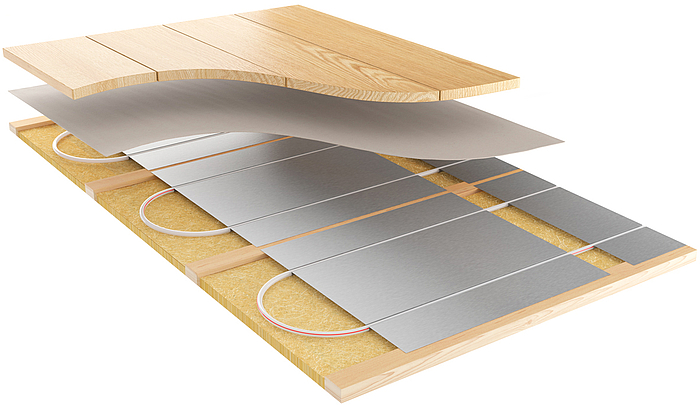
These are 590mm wide, thus leaving 10mm on a CC-60 floor to screw into, and it also results in a maximum of 10mm wide glue joint. The thickness of the plate is 0.5mm, which means you can't get a glue joint with full compression but rather a filling glue joint, even though parts of these 0.5mm are surely pressed together when you screw.
Would such a system meet the requirements for the chipboard to interact with the joists in the way it has been dimensioned in the OP's case?
In my own case, the chipboard is not glued at all, and screwed too sparsely, so we have creak issues. I am looking for a solution that guarantees creak-free results in tandem with leveling the floor, evaluating that the glue joint is critical for this.
Roth plates cannot replace a screw-glued chipboard when such is needed in terms of flexibility and strength. In that case, you first need to screw-glue a batten on top of the floor joists before you can attach the Roth plates.
So the battens would achieve the intended effect solely by increasing the total height of the stud and thereby increasing the moment of inertia?
I think that if the questionable glue joints resulting from the sheet concept prevent lateral forces from being transferred between the panels and studs, this would be the only benefit remaining with the battens.
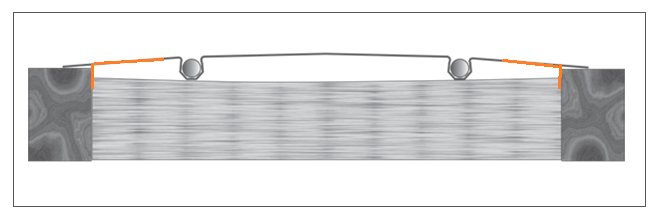
Moreover, I thought that a bend at each end of that sheet, so that it is instead attached to the side of the stud, would solve this problem. But it requires some customization, as neither the studs nor the spacing are sufficiently repeatable to produce sheets like that. Access to nail/screw them would also be an issue, but this could be solved with oval holes in the sheets that allow a bit holder to pass through.
But maybe it would be an alternative that allows you to have your cake and eat it too.
Kind of like those cassette systems I linked to earlier, which rest on strips on the side of the studs, but much cheaper.
So the battens would achieve the intended effect solely by increasing the total height of the beam, thereby increasing the moment of inertia?
Yes, but you should ideally calculate it first. With a masonite beam, the addition won't be symmetrical, so Steiner's theorem needs to be used to calculate the moment of inertia. I have no experience with metal systems, so I prefer not to say too much, but I'm a bit skeptical.
Their ability to stabilize the construction. I have never seen them in real life. I am truly not the right person to have this discussion with. Privately, I would never install waterborne underfloor heating in a wooden construction at all, and I would not use masonitbalkar in an intermediate floor and I hate particle boards...
The purpose of the plates is not at all to contribute to stabilization, but they are only for heat distribution and for fixing the tube. So I understand your skepticism if that's how you interpreted it. These ones I linked to are indeed in 0.5mm galvanized steel, but the ones I have are in aluminum and could be cut with ordinary kitchen scissors. They absolutely do not contribute to strength.
It is rather the problem that @Pumabjörnen raises that worries me.
I already have such a system today, and a LOT of squeaking in the floor. I have always thought it is because it wasn't glued, and that it was screwed too sparsely. The seller, who also built the house, pointed this out when he lamented that there was squeaking in the floor.
But I don't even want to consider using similar components after we've ripped up and relaid the floor, if the squeaking might as well come from sliding between the plate and the board. I've thought that glue here would be enough to solve the problem, but maybe not?
Maybe it's even better to use some type of filling glue with a long open time, like PL instead of wood glue, to get something more flexible that dampens micro-vibrations?
The plates' task is not at all to contribute to stabilization, but they are only for heat distribution and to fix the hose. So, I understand that you are skeptical if you have interpreted it that way. The ones I linked to are indeed 0.5mm galvanized steel plate, but the ones I have are aluminum and could be cut with regular kitchen scissors. They absolutely do not contribute to durability.
It's rather the issue that @Pumabjörnen raises that worries me.
I already have such a system today, and A LOT of creaking in the floor. I have always thought it was because it wasn't glued, and that it was screwed too sparsely. The seller, who also built the house, pointed this out when he lamented the creaking in the floor.
But I don't even want to consider using similar components after we have ripped up and relaid the floor if the creaking might as well come from sliding between the plate and the chipboard. I thought glue here would be sufficient to solve the problem, but maybe not?
Perhaps it is actually better to use some kind of gap-filling adhesive with a long open time, like PL instead of wood glue, to get something more pliable that dampens micro-vibrations?
Thoughts?
The plates (if they go up on the beam) create a height difference. (even if not higher than a few mm) this together with the fact that the plates also take up space on the beam means that the risks for poor adhesion regardless of adhesive type increase significantly imo.
What is recommended in the installation instructions (most brands (*never seen anything else*)) is regular wood glue (alt. the winter variant at <+10) But what is often missed here is imo to emphasize the quantity. 1-1.3 L
It is not about "a few millimeters," which in my world is quite a lot. The plates are 0.5mm thick, and with some sinking into the wood when tightening the boards, you can probably expect a 0.3-0.4mm gap between the stud and the board.
But even though it might seem small, you are right about the problem with wood glue. I don't think a correct joint can be achieved here with regular wood glue, as you want pressure rather than a gap.
This is precisely the phenomenon I'm pondering, along with all the other ways a system with these types of plates can create creaking noises and how to avoid them. If you don’t need to glue the boards for them to mechanically interact with the studs, then the solution with PL glue might work as it could dampen vibrations/sound and glue the boards in place. But that's just speculation, and perhaps we can't go further without starting to test it.
Again, I'm not the original poster, and the basic question in the thread concerns the strength and interaction between the studs and the sheet material, but since one of the requirements has been to minimize construction height, I have felt that these considerations are relevant enough to continue discussing them in the thread.
Click here to reply
Vi vill skicka notiser för ämnen du bevakar och händelser som berör dig.