
10,635 views ·
41 replies
11k views
41 replies
Chipboard vs sparse paneling
I am building a two-story house and am now considering what type of subfloor to lay on the joists. The joists are Masonite Beams I-beams 350 mm. This will be insulated with loose wool.
I have chosen to use underfloor heating upstairs as well and am therefore between two choices regarding the subfloor:
In both cases, I will lay the pipes in heat distribution plates. What will be on the subfloor is:
What I'm considering, need help with, and are the most important factors for the choice are:
I would prefer to go with the sparse panel since I think it must be much easier to lay than gluing and screwing chipboard. But I am mostly worried about the rigidity in the joists. Does anyone have experience with such a subfloor? What would you have done if you had the option to choose?
I have chosen to use underfloor heating upstairs as well and am therefore between two choices regarding the subfloor:
- Sparse panel of 28x120 screwed across the floor joists cc 150 so that the internal distance is 30 mm between the sparse panels
- Grooved chipboard glued and screwed across the floor joists
In both cases, I will lay the pipes in heat distribution plates. What will be on the subfloor is:
- Bjelin Floor Underlay PO Kombifoam
- 11 mm hardened wooden floor from Bjelin
What I'm considering, need help with, and are the most important factors for the choice are:
- Is there a risk that the option of sparse panel gives noticeably poorer rigidity in the joists? Or is it equivalent to glued and screwed chipboard?
- Is there any risk of a bouncy floor with a sparse panel?
- Is it okay to place a non-load-bearing interior wall directly on grooved chipboard or sparse panel? Planning to prepare with noggins in the joists under the subfloor so there is something to screw into
I would prefer to go with the sparse panel since I think it must be much easier to lay than gluing and screwing chipboard. But I am mostly worried about the rigidity in the joists. Does anyone have experience with such a subfloor? What would you have done if you had the option to choose?
I Intershade said:I am building a two-story house and am now considering what type of subfloor to lay on the joists. The joists are made of Masonite Beams lightweight beams 350 mm. This will be insulated with loose fill.
I have chosen to go with underfloor heating even on the upper floor and thus stand between two choices regarding the subfloor:
- Sparse panel of 28x120 screwed across the floor joists cc 150 so that the internal distance is 30 mm between the sparse panels
- Grooved particleboard screwed and glued across the floor joists
In both cases, I will place the hose in heat distribution plates. What will be on the subfloor is:
- Bjelin Floor Underlay PO Kombifoam
- 11 mm hardened wood flooring from Bjelin
What I am wondering about, need help with, and are the most important factors for the choice are:
- Is there a risk that the sparse panel option gives noticeably poorer rigidity in the joist system? Or is it equivalent to screwed and glued chips of wood?
- Is there any risk of a bouncing floor with the sparse panel?
- Is it okay to place a non-load-bearing interior wall directly on the grooved particleboard or sparse panel? I plan to prepare with shortlings in the joist system under the subfloor so that there is something to screw into
I prefer to go with the sparse panel as I think it must be much smoother to lay than to screw-glue particleboard. But I am mostly worried about the rigidity in the joist system. Does anyone have experience with such a subfloor? What would you have done if you had the choice?
Particleboard all day every day, the only cases I've heard of using a sparse panel have been when there is already an existing subfloor.
Particleboard vs. sparse should imo have a much greater resistance to shear in the joist system and weight distribution during furnishing, and provide a more even surface as the wood might not keep the same thickness to one hundred percent and moves more in relation to the chipboard.
Why would sparse be smoother than chipboard?
Regarding the wall, load-bearing or not: when mounting particleboard, you usually want to have the room division finished so that the floor is mounted room by room and an expansion joint against all fixed objects (walls, pillars, etc.) is obtained. However, I have seen countless examples of placing walls on top of glued and screwed chipboard floors and have so far never heard of or experienced any consequences from this myself (but it could just as well be a coincidence).

What is the span and c/c of the masonite beams? The information is needed to assess the floor deflection. A disadvantage of placing the partition walls directly on the subfloor is that the walls must be torn down to replace the subfloor.
Feels shaky with just the tracked floor chipboard on the joists. It doesn't cost much more to lay regular floor chipboard first.
I did it at home myself with regular chipboard and then tracked chipboard. I'm quite happy about it because there was a lot of tracking after my plumber had been with me. I wouldn't have managed to get blocking under the tracks. Additionally, you can move walls a little without worrying about the blocking.
It gets very thin where the tracks are, almost so that if you jump with force, you'll go straight through.
I did it at home myself with regular chipboard and then tracked chipboard. I'm quite happy about it because there was a lot of tracking after my plumber had been with me. I wouldn't have managed to get blocking under the tracks. Additionally, you can move walls a little without worrying about the blocking.
It gets very thin where the tracks are, almost so that if you jump with force, you'll go straight through.
The span of the Masonite beams is c/c 600 mm.
I am starting to consider using grooved floor particle boards.
I will wait before I make a final decision and see how "a short one, a long one" handles the sparse paneling on the floor, I saw on Instagram that Martin is going to do it that way on the upper floor.
It's much easier to lay sparse paneling.
Some advantages are that you don't have to think about support around the floor particle board.
It's much easier with turns for the floor heating pipes.
You don't have to work with boards but with much more manageable 28x120 dimensions.
It's much easier to open the subfloor in the future, thus also possible to place inner walls on the sparse paneling.
But the question, as mentioned, is how the joist will feel when it's finished, as I don't really have a proper reference for that.
Grooved floor particle boards, like LK HeatFloor or Forestia Thermogolv, can be laid directly on the floor joists perfectly fine. I've never found it to be shaky.
If I lay two layers, I'd rather use sparse paneling or strips of particle board for the pipe. But I don't want to build too much in height...
I am starting to consider using grooved floor particle boards.
I will wait before I make a final decision and see how "a short one, a long one" handles the sparse paneling on the floor, I saw on Instagram that Martin is going to do it that way on the upper floor.
It's much easier to lay sparse paneling.
Some advantages are that you don't have to think about support around the floor particle board.
It's much easier with turns for the floor heating pipes.
You don't have to work with boards but with much more manageable 28x120 dimensions.
It's much easier to open the subfloor in the future, thus also possible to place inner walls on the sparse paneling.
But the question, as mentioned, is how the joist will feel when it's finished, as I don't really have a proper reference for that.
Grooved floor particle boards, like LK HeatFloor or Forestia Thermogolv, can be laid directly on the floor joists perfectly fine. I've never found it to be shaky.
If I lay two layers, I'd rather use sparse paneling or strips of particle board for the pipe. But I don't want to build too much in height...
How long are the masonite beams?
I have ordered a pdf with strength data from Masonite Beams. While waiting for it, I made a simple estimation and concluded that 4948 mm is at the longest limit regarding deflection performance. If this is correct, you will need a layer of screwed-glued floor particleboards (or plywood) underneath. I will get back to you when I know more.
It is Byggma/Masonite Beams that have developed the construction, and it states that their data regarding maximum spans to meet the criteria assume that a 22 mm screw-glued chipboard is used. I will check with them if they have any data on the equivalent with sparse paneling.J justusandersson said:I have ordered a PDF with strength data from Masonite Beams. While waiting for it, I made a simple estimation and concluded that 4948 mm is on the longer side concerning deflection performance. If this is correct, you need a layer of screw-glued floor chipboard (or similar plywood) underneath. I will get back to you when I know more.
I can answer that. Under those conditions, a sparse panel in the way you have in mind won't suffice. I understand, chipboard is not a fun material to work with. Flooring plywood is nicer and also stiffer, but also more expensive.
But it should work with slotted floor chipboard LK HeatFloor or Forestia Thermogolv directly on the floor joists?J justusandersson said:
The slotted boards are a bit more expensive, 120 SEK/board for regular 22 mm floor chipboard compared to 185 SEK/board for Forestia Thermogolv, according to a quote I got from AB Karl Hedin.
One idea is to screw and glue "regular" floor chipboard over the joists and then screw a thinner sparse panel on top of that, something like 21x120, to lay floor heating plates and pipes? Which is preferable?
Alt. 1:
- Walls mounted directly on floor joists or on noggings of horizontal 45x95 c/c 600 mm if the walls are along the joists
- Slotted floor chipboard directly on the joists screwed and glued room by room
Alt. 2:
- Noggings of horizontal 45x95 c/c 600 screwed between floor joists where there will be a wall above
- Floor chipboard screwed and glued over the entire joist structure
- Walls mounted directly on top of the floor chipboard, supported by noggings or joists under the wall
- Sparse panel 21x120 c/c 150 mm with sound proofing strip underneath screwed room by room
Additionally, I also use a sound proofing strip under the bottom plate of the interior walls and seal the joints with sealant.
There are more steps in alternative 2, but I still think it will be easier to execute considering that I will mostly be building this alone.
It will be considerably easier to frame the walls if there is a finished chipboard floor.
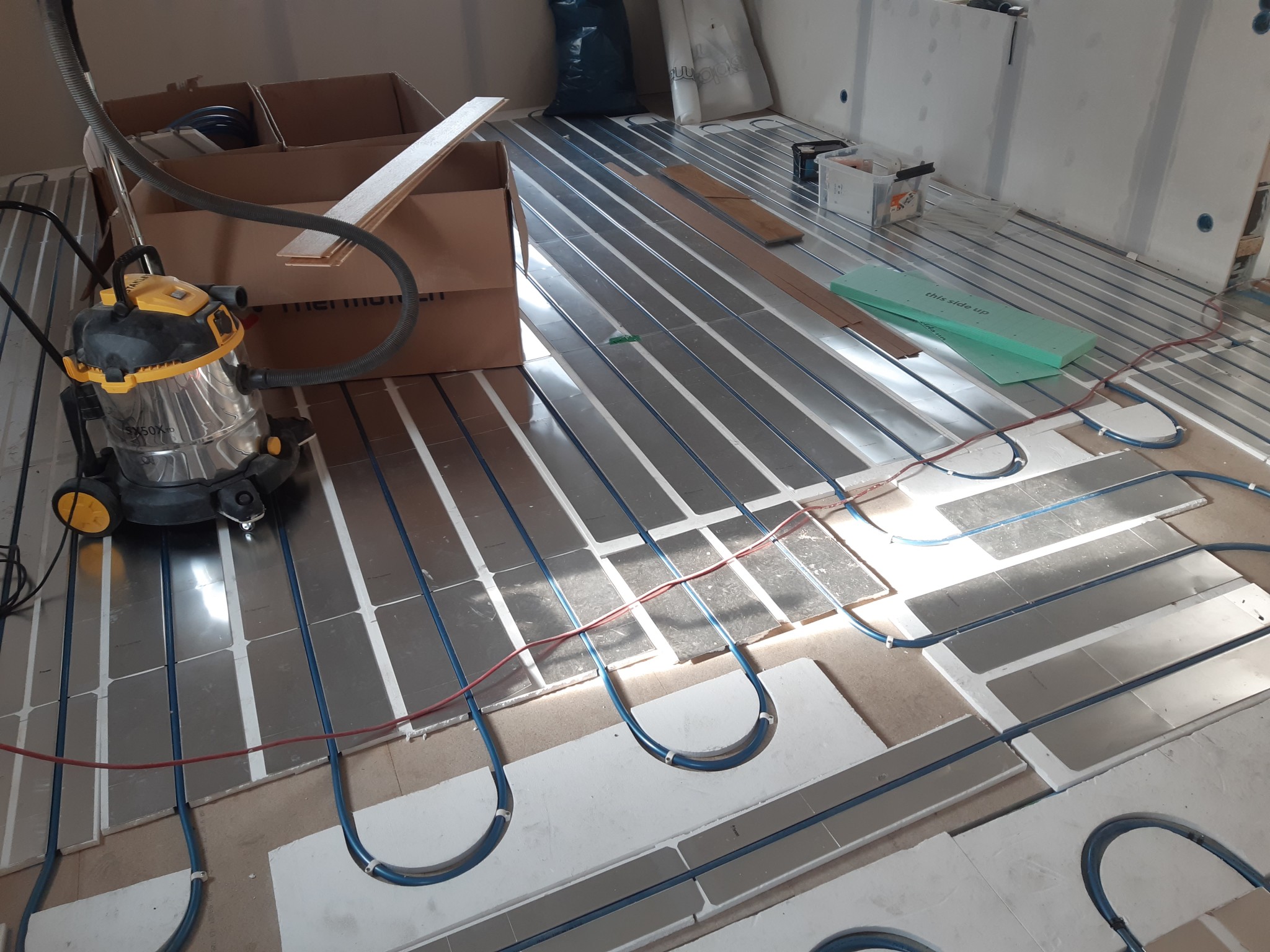
If you are considering laying a layer of chipboard and then sparse, I can otherwise recommend that thermotech has a system with 17mm foam boards where the convection plate is glued to the foam. Very easy to lay.
I screw-glued a 22 mm moisture-resistant v313 chipboard to the joists before.
I chose to place the walls on top of the chipboard, partly perhaps against better judgment and because, as you wrote, I thought it became incredibly complicated to frame the walls beforehand and did not have their placement 100% clear (let's hope I never need to tear up the subfloor! )
)
I screw-glued a 22 mm moisture-resistant v313 chipboard to the joists before.
I chose to place the walls on top of the chipboard, partly perhaps against better judgment and because, as you wrote, I thought it became incredibly complicated to frame the walls beforehand and did not have their placement 100% clear (let's hope I never need to tear up the subfloor!
)
Last edited:
Do you then lay the surface floor directly on this?
I think there are quite large areas without cellplast, or maybe it is fitted in after the picture was taken?
I think there are quite large areas without cellplast, or maybe it is fitted in after the picture was taken?
Exactly, first the boards with the plates were installed according to the drawing and then "filler boards" were placed in the empty spaces that arose here and there due to how the loops were drawn.D David_Berglund said:
The picture was probably taken during the work with the latter.
Are you satisfied with the final result?
I currently have underfloor heating where the plates are placed on the beams under the regular chipboard, and unfortunately, this results in a somewhat insufficient contact between the plate and the chipboard, and we cannot glue with this solution.
We are now going to lift and level the floor, but we want the smallest possible height change due to a staircase, and therefore we're looking for good alternatives. This might be something if it only builds 17mm.
I currently have underfloor heating where the plates are placed on the beams under the regular chipboard, and unfortunately, this results in a somewhat insufficient contact between the plate and the chipboard, and we cannot glue with this solution.
We are now going to lift and level the floor, but we want the smallest possible height change due to a staircase, and therefore we're looking for good alternatives. This might be something if it only builds 17mm.