It was an interesting option. Found that LK also has a 16 mm sheet.
Feels like it's now between:
1. Grooved floor chipboards
2. Floor chipboard + 16 mm EPS grooved board
Do you experience any problems with flank transmissions since you have placed the walls on the chipboard floor?
But it should work with tracked floor chipboards LK HeatFloor or Forestia Thermogolv directly on the floor joists?
No, not with those conditions. It could have been avoided if you had increased the dimensions of the I-beams, but it's too late now. If you use floor plywood instead, you can reduce the thickness somewhat compared to chipboard. On top of the chipboard, you can add sparse paneling if you want. I think you should install the floor room by room so you can take it up without having to tear down walls. Interior walls need support in the floor with noggings or extra joists where I-beams are absent.
No, not with those conditions. It could have been avoided if you had increased the size of the masonite beams, but it's too late for that now. If you use floor plywood instead, you can reduce the thickness somewhat compared to particle board. On top of the particle board, you can lay a sparse panel if you want. I think you should lay the floor room by room so you can remove it without needing to tear down walls. Interior walls need support in the floor with noggins or extra beams where masonite beams are absent.
I have received approval for 22 mm grooved floor particle board on the joists from them.
What do you mean by saying that screwed and glued 22 mm grooved floor particle board isn't enough? So I can refer to something and ask why they said OK for it.
Regarding laying room by room or not, I'm very indecisive. It's very easy to have a subfloor to work on when I build the walls on the second floor.
But I could also lay a temporary floor during the construction period.
The task of the chipboard is, among other things, to help distribute a point load directly across a beam to the adjacent beams. A grooved chipboard has significantly poorer properties in this respect. It's your floor. Masonite Beams will not fix it if you are dissatisfied. I think it’s fair that you ask them why a grooved chipboard is suddenly sufficient when they previously said they had planned on a standard board. Had you increased the height by 2 cm, you wouldn’t have needed any floor chipboard at all. They should have informed you about that. I would opt for a full-height board first. Nothing compares to the feel of a solid floor.
A temporary floor during construction has many advantages.
The chipboard's task is, among other things, to help distribute a point load directly over a beam to the adjacent beams. A grooved chipboard has significantly poorer properties in that respect. It is your floor. Masonite Beams will not fix it if you are dissatisfied. I think you can rightfully ask them why suddenly a grooved chipboard is sufficient when they previously said they had calculated with a normal board. If you had increased the height by 2 cm, you wouldn't have needed any floor chipboard at all. They should have informed you about that. I would opt for a full-height board first. Nothing compares to the feel of a solid floor.
Temporary flooring during construction has many advantages.
I must have misunderstood that a grooved 22 mm was approved.
I will have to rethink the subfloor construction.
Then I'll go with a regular 22 mm screwed and glued chipboard. And on top of that 16 mm EPS board with pre-glued metal or sparse. Will calculate which is cheapest.
PPumabjörnen said:
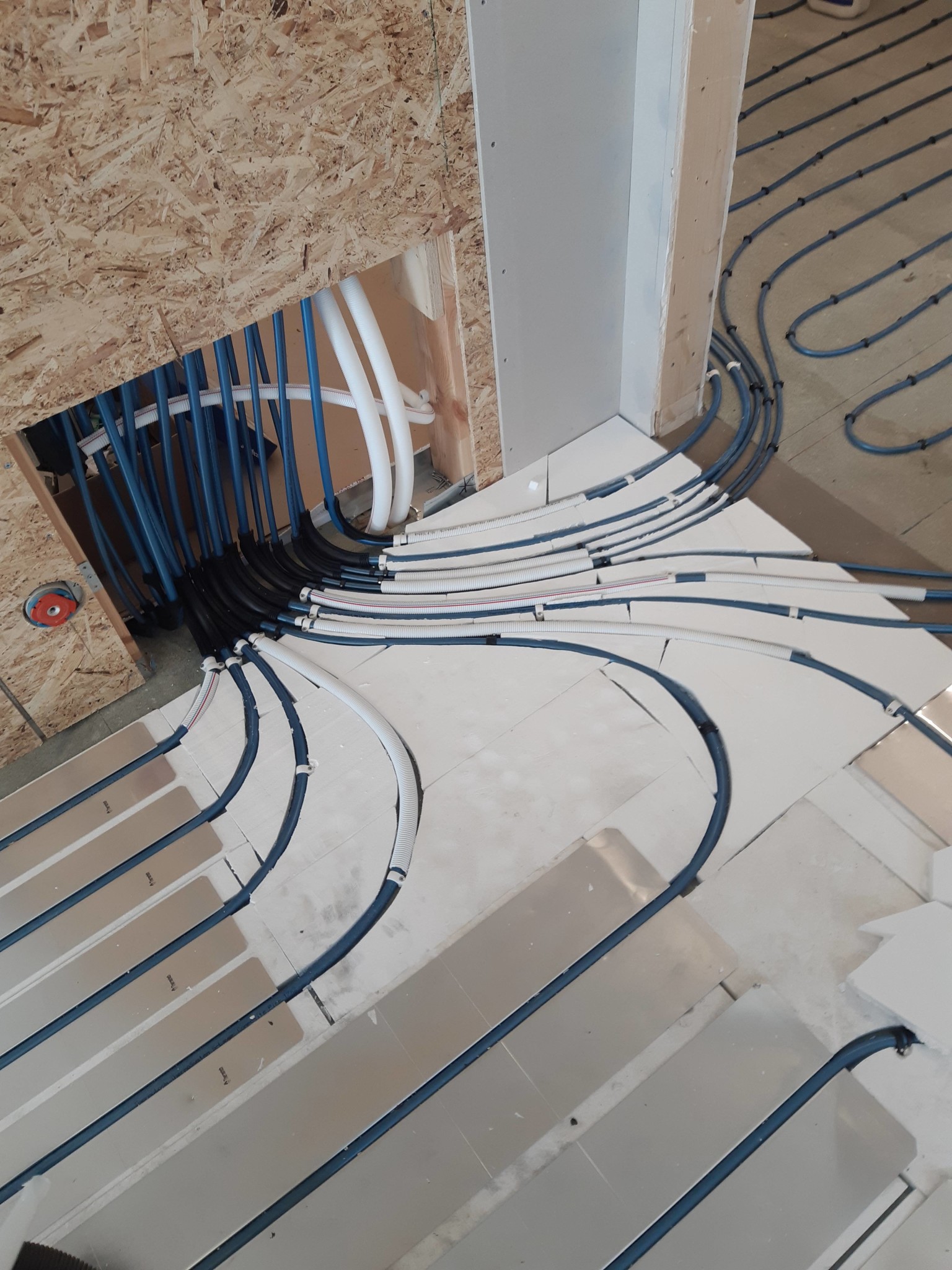
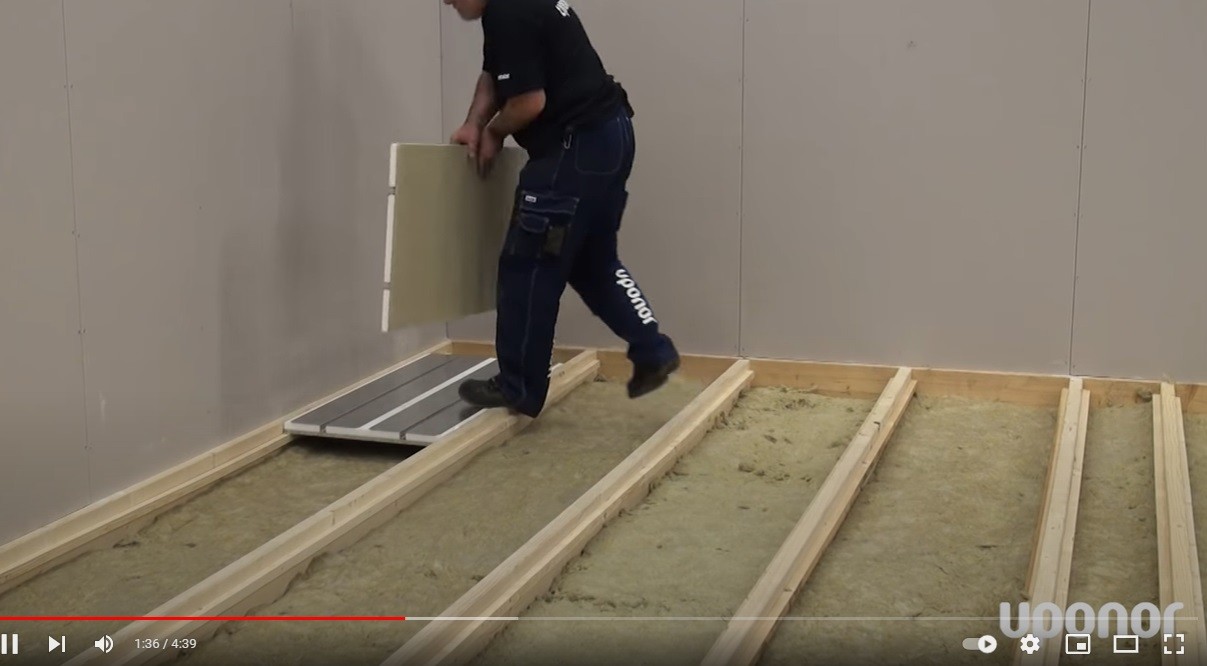
Exactly, first the boards themselves were installed with the metal according to the drawing, and then "filler boards" were placed in the gaps that appeared here and there due to how the loops were drawn.
The picture is probably taken during the work with the latter.
I'm also curious about how you experienced that solution for underfloor heating?
I must have misunderstood that tracked 22 mm was approved.
Then I have to rethink the construction of the subfloor.
I'll go with regular 22 mm screw-glued particle board. And on that 16 mm EPS board with pre-glued metal or sparse. I'll calculate what is cheapest.
I'm also curious about how you experienced that solution for underfloor heating?
I am very satisfied, I find it very comfortable/sturdy to walk on. The only place where I am a little dissatisfied is the square meter where all the loops go into the underfloor heating center where due to the heat you need to put protective pipes around the hose, and I think the choice fell on the protective pipes for 20 pex so there I tried to level the height difference on the protective pipe which was slightly higher than the polystyrene with a harder floor foam without great results as there is some flex. I can also say that I didn't have it completely easy to fit the polystyrene around the pipes. I would have liked to be there and help the plumber the day they put everything together so maybe one could have spaced the loops more where they are densest, but well..
I have found another option. It is to place LK sheets directly on the Masonite beams and lay the pipes there.
Then glue-screw 22 mm floor chipboard on top of this.
Two questions arise then:
Does it work to glue on the sheets?
Might the subfloor become too thick from a thermal conductivity perspective with 22 mm floor chipboard, 2 mm foam, and 11 mm hardened wood flooring? I have also sent the questions to LK.
Found another option. It is to put LK floor profile sheet directly on the Masonite beams and place the pipes there. Then screw-glue 22 mm chipboard on top of this.
Two questions arise then:
Does it work to glue on the sheets?
The subfloor might become too thick from a heat conduction standpoint with 22 mm chipboard, 2 mm foam, and 11 mm hardened wood floor? I have also sent the questions to LK.
I wouldn't say it sounds very good to glue on the sheets, it sounds like you will experience the same problem that David wrote a bit earlier in the thread.
DDavid_Berglund said:
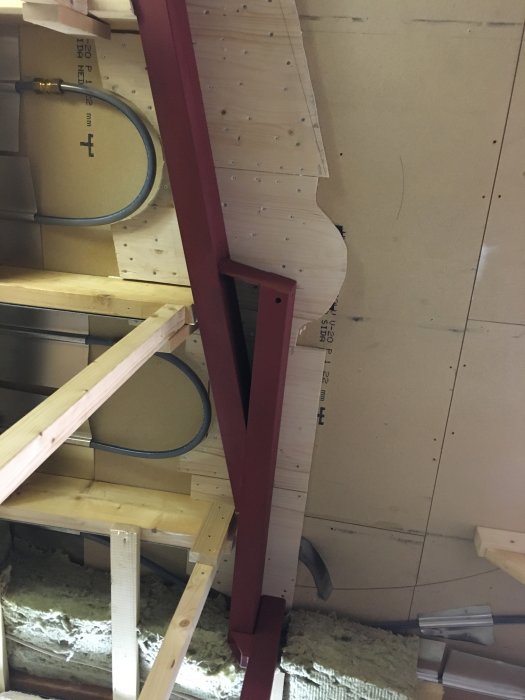
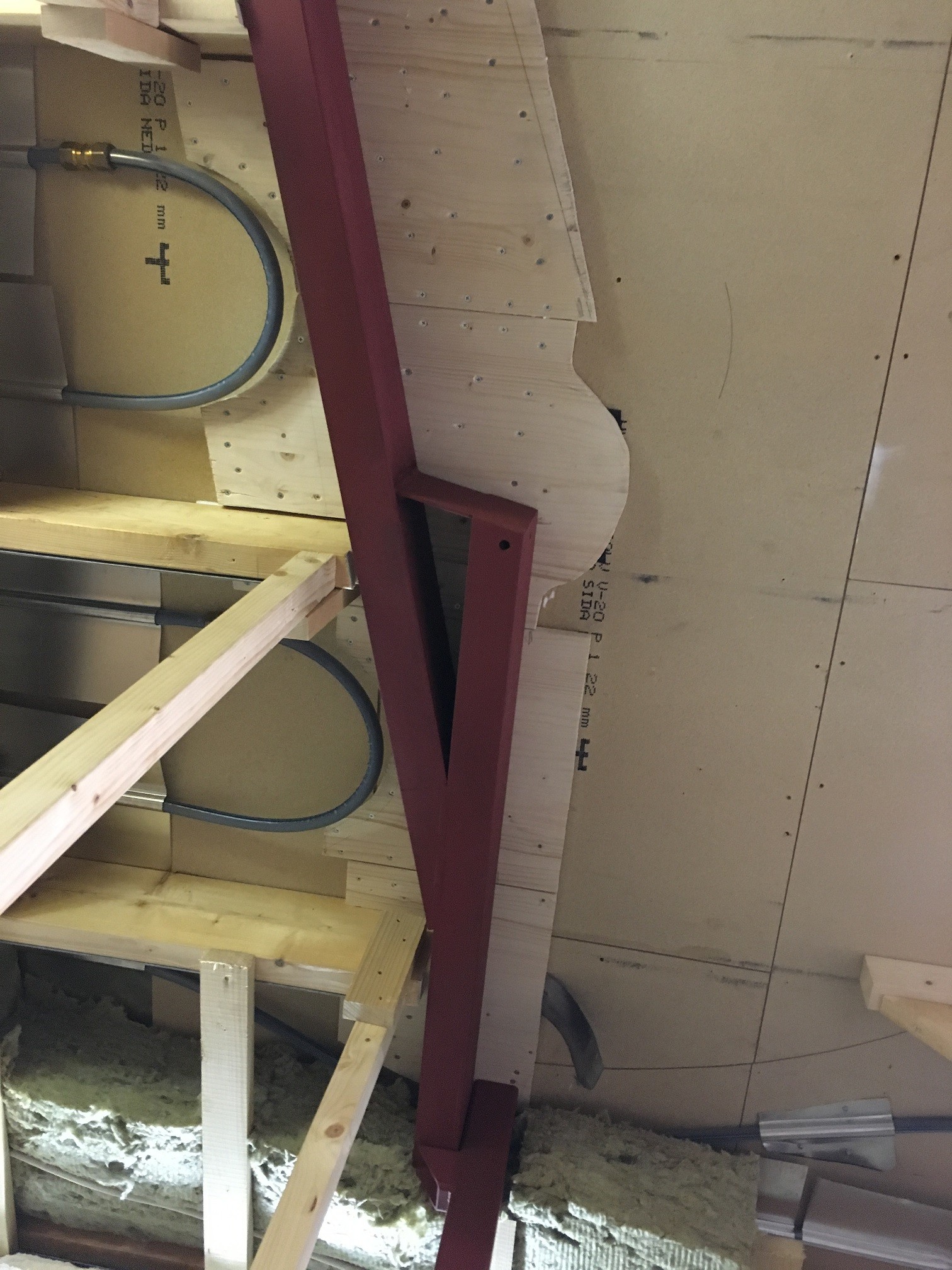
I have a heated floor today, where the sheets are placed on the beams under the regular chipboard, and unfortunately, this provides somewhat inadequate contact between sheet and chipboard, and you cannot glue with this solution.
And yes, you would probably lose some effect in terms of heat conduction, how much I do not know.
Wouldn't say it sounds any better to glue the plates, sounds like you would then experience the same problem as David wrote a little further back in the thread
And yes, you would probably lose some efficiency in terms of heat conduction, how much I don't know.
Suspect it won't be good either, but perhaps there is a solution to it. We'll see what LK says.
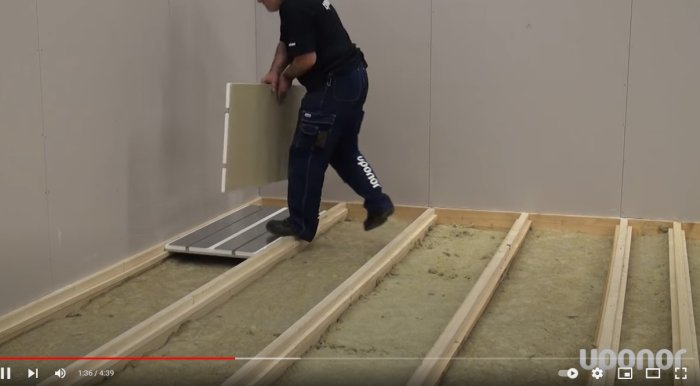
Otherwise, placing foam plastic with pre-glued sheet on floorboards seems to be the best option for me. At least in terms of building height.
What was the per square meter price for you with such boards?
Looks like my post disappeared, so I'm posting it again.
That's the kind of solution I have, which I thought was a makeshift job from the previous owner.
Here's an underneath picture when I switched over for a basement staircase a few years ago. It's not exactly the same sheet metal, but roughly the same function. The one you linked to earlier has a good chance of providing better contact than mine, as mine also has a joint in the middle and is primarily pressed up by insulation. Something that is obviously a bit questionable, even though I've never experienced any issues with the heat. But I could probably have a slightly lower supply temperature with a different system.
But... Now that I see it's established to do it that way, and in my case I care about every millimeter to not have differing step heights on the staircase, I will probably run with the same concept again, just replacing the hose while I'm at it, as it's almost 30 years old.
I had very similar conditions when I built my house. I used tracked chipboard on light beams and interior walls on top of that. However, no load-bearing ones. Simple and became solid and good.
I had very similar conditions when I built my house. I used grooved chipboard on I-beams and interior walls on that. However, none were load-bearing. Simple and it became sturdy and good.
What spans did you have? Beam height? 1 or several rows of bracing?
I spoke today with a technician at Roth, who manufactures underfloor heating systems.
They mentioned that their grooved panels can be placed on CC60 floor joists and provide adequate strength without additional construction elements, provided that the underlying joists are correctly dimensioned. I have always thought you needed a subfloor before these groove panels.
They had also recently received approval to install it in wet rooms with CC-600, which surprised me even more.
If I managed, I attached a PDF file about this.
EDIT: Perhaps this is obvious to everyone except me, and in that case, you can disregard this redundant post.