Well, it's time to write my first post in this forum. We are planning a villa construction project, and for a layman, it's quite overwhelming with all the details that need attention.
Now I've encountered a problem with how to resolve the ceiling on the upper floor. The roof structure will consist of two 45x220 beams joined at height with a slope of 7 degrees. Under this, I need to somehow run ventilation pipes with a minimum diameter of 100mm.
Ideally, I want as simple a construction as possible with a flat plasterboard ceiling at an interior ceiling height of 2700mm to be able to use standard plasterboard. An advantage of suspending this with some kind of metal framing system like Norgips Flex, apart from facilitating the interior wall construction, is that I get a natural zone for installations like ventilation, etc. A disadvantage is that these systems are not exactly cheap, either in materials or labor costs.
One alternative I'm considering is placing an extra beam of 45x120 or similar under the rafters, beneath the plastic, to create an installation zone since I can drill substantial holes in it to run ventilation, etc., and then mount the sparse panel and plasterboard to the extra beam. However, I’ll get an internal ceiling height difference of almost a meter between the long sides. The advantage is that we get a lot of pleasant ceiling height, but it feels like I'll have a significantly more complicated journey with the interior walls.
So, what on earth do you choose? Is there a good solution I've missed? We want a construction that is as cost-effective as possible and not too complicated to achieve. The total ceiling area is in the order of 120m2.
It sounds reasonable to use 45x120 as you’re planning. Then you don't need to drill holes; you can make cutouts in the material where the vents should go.
It is a monopitch roof with a 7-degree slope. The distance between the outer edges of the exterior walls is 8m. Ideally, I would have liked the trusses to be flat on the underside, but the frame producer (who also manufactures trusses) says that it would make for very complicated trusses and therefore thinks that this solution with straight beams is better. But the question is, of course, where I get the most value for my money. Additional work ends up somewhere. Either I put it into getting trusses that are flat on the underside, hanging down the ceiling, or building higher and slanted interior walls. All options involve problems, but the question is which path is best to go? It can be added that the extra ceiling height ends up in the bathroom and large walk-in closet with small windows. So the usefulness of it can be discussed.
A slope of 7 degrees is not an optimal roof pitch. It limits possible roofing materials to felt and sheet metal (standing seam or flat seam and possibly a click system). This also affects the detailed design of the roof concerning insulation, ventilation gap, etc. Double 45x220 on height (constructed together for interaction) is borderline in terms of structural strength. I would choose glulam.
In general, I think that if you are going to have a sloped ceiling, it should add something, such as the possibility for high-positioned windows. As it doesn't do that now, I definitely think you should build an even inner ceiling.
The reason we're going with a 7-degree pitch instead of something flatter is that the architect thought we should leave the option open to use metal roofing in the future. As it stands, we're thinking of using felt.
Ideally, I'd prefer to have a ceiling with waves, but if it ends up costing me more than having high ceilings, I have a hard time understanding why? Does anyone have any ideas on how I can get a wavy ceiling without it being very expensive? The ceiling systems I've looked at seem to require that I still need to extend the interior walls to the ceiling beams for stability and then hang ceiling panels in each room. That sounds both expensive and like double the work.
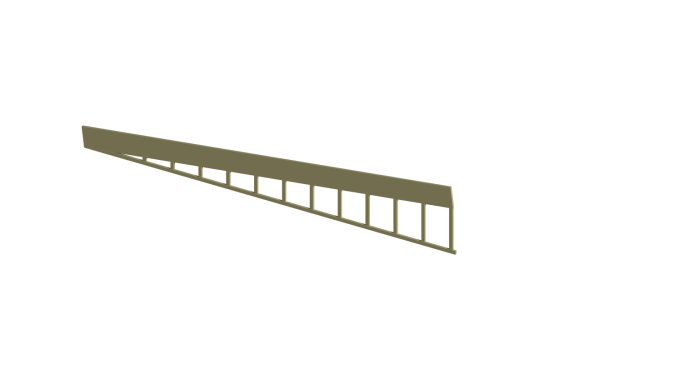
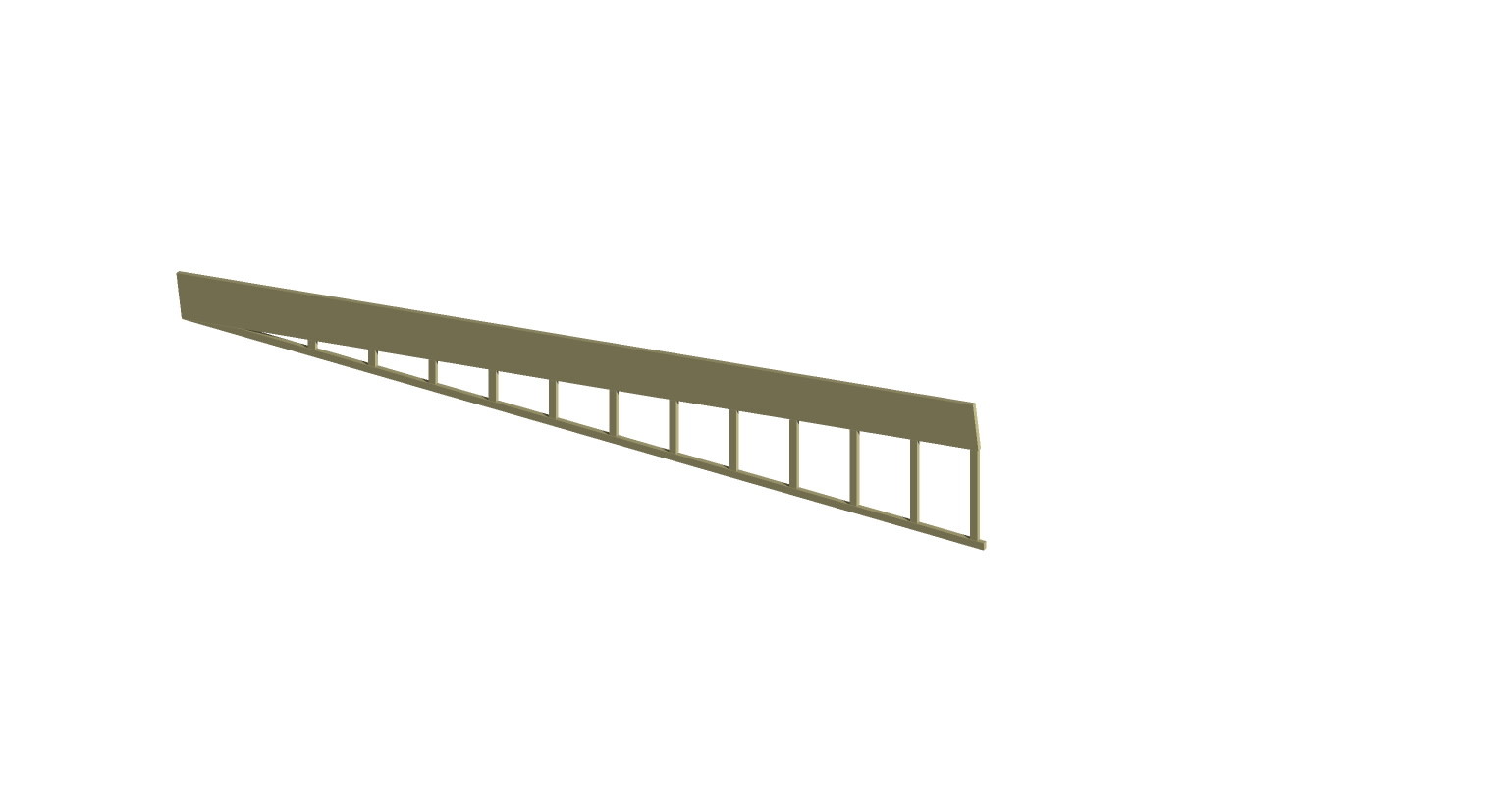
What involves the most work partly depends on the choice of material for the inner walls' surface. If many boards need to be cut at an angle, it might be worthwhile. Generally, it doesn't have to be very expensive material-wise to make a frame for a wave-shaped ceiling. But it will be quite a bit of work. A simple framework similar to the attached image, plus various stabilizing diagonals/boards. The c/c distance between the ceiling beams matters. I don't think commercial suspended ceiling systems are suitable. They are mainly intended to conceal installations, etc.
That actually looks superb. Now I'm almost annoyed I didn't come up with it myself How dense would those need to be to support a spaced panel capable of holding up a plasterboard ceiling? Our architect wants the trusses at cc100, and then every other truss with one of those would become cc200. Is that too far apart?
Sparse paneling should probably be mounted at c/c 600 mm. Lowered sections like in my illustration can be complemented with smaller beams perpendicular. You'll need to calculate a bit to see what's optimal. A completely different option is shed beams (sloping on the top but horizontal on the bottom) in glulam. Google it.
Ok, now we're talking about the spacing between the sparse panels? I started with cc30? What I was wondering was whether the trusses (with your extra beams underneath) need to be closer than cc200 in order to mount the sparse panels on the trusses?
The distance between each sparse panel board should be 30 cm. The boards should be attached to studs with 60 cm spacing. If you use trusses with 200 cm spacing, you should place studs perpendicular to these at c/c 60 cm. I can calculate the dimension of these studs if I find out what the ceiling will consist of. The other construction I made with 45x70 mm timber.
Hmm that's interesting. Basically, the designer has envisioned cc120 between the roof trusses. So is that too long a distance to install the slat paneling? The idea is that the interior ceiling should be standard 12-13mm gypsum.
Spontaneously, I would say that 120 cm c/c is too far for sparse paneling, but it also depends on the dimensions of the latter. I'll do some calculations on it.
It is primarily an aesthetic issue. But it is not attractive when the ceiling sags in waves due to excessive deflection. It is also a matter of long-term loads that become more noticeable over time. If you can use 25x120 mm lumber as sparse paneling, it works with c/c 120 cm. Otherwise, you need to increase the thickness, for example, 35x45 mm.
Click here to reply
Vi vill skicka notiser för ämnen du bevakar och händelser som berör dig.



 How dense would those need to be to support a spaced panel capable of holding up a plasterboard ceiling? Our architect wants the trusses at cc100, and then every other truss with one of those would become cc200. Is that too far apart?