
5,759 views ·
11 replies
6k views
11 replies
Can I chisel out the entire base plate, or will I damage the house? House from 1930.
Can I tear out the entire slab in my house? The house is from 1930 and has about an 80cm thick foundation wall made of stone. The foundation wall is at least 2.5m high, of which about 40cm is above ground. The slab is cast inside the foundation wall and is about 5cm thick. No reinforcement. The basement is about 50 sqm. Under the slab, there is soil and fractured stone. There seems to be a higher content of fractured stone towards the exterior walls.
We have torn up almost the entire floor but left a 20cm wide strip along the central wall and exterior walls. I want to remove this strip to then dig out about 20-25cm and be able to lay tiles without getting a lower ceiling height than before. Attached is a picture from the test demolition before we removed the entire middle part.
Are there any risks with this? Can this small strip we've left really be what's preventing subsidence?
We have torn up almost the entire floor but left a 20cm wide strip along the central wall and exterior walls. I want to remove this strip to then dig out about 20-25cm and be able to lay tiles without getting a lower ceiling height than before. Attached is a picture from the test demolition before we removed the entire middle part.
Are there any risks with this? Can this small strip we've left really be what's preventing subsidence?
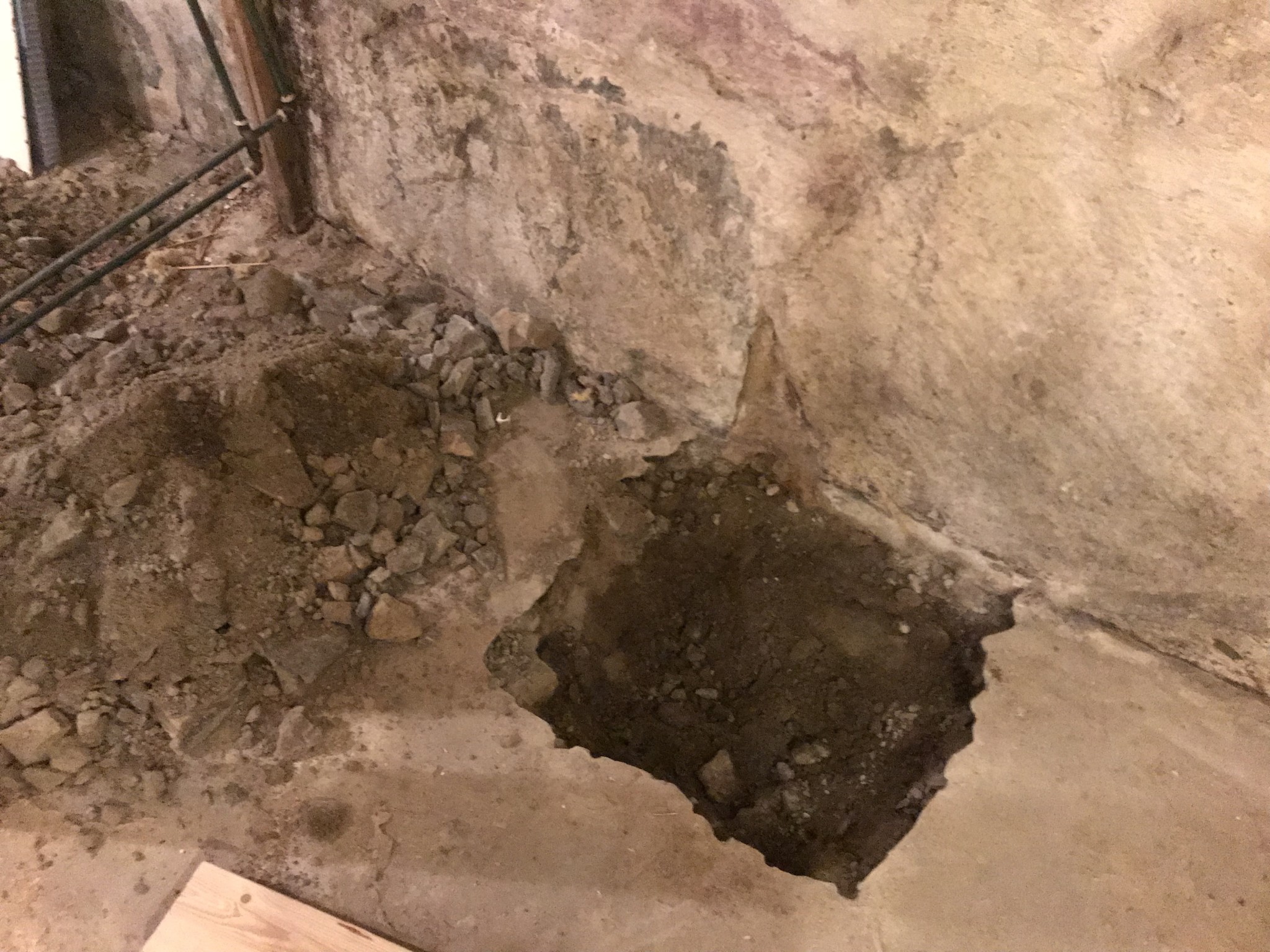

The normal way to lay foundations for houses with basements in the past (circa 1920-70) was to cast spread footings (usually reinforced) as foundations for exterior walls and load-bearing interior walls. Once these basement walls were erected, unreinforced and fairly thin slabs were cast between the walls as basement floors. In your case, it seems there is no concrete under the stone walls, but they must then reasonably rest on some other material that can bear the load. What can be said with certainty is that the concrete you have partially chipped away does not belong to the foundation. If the basement walls have shown no settlement since 1930, they are likely to hold for a long while. Is the stone hewn granite?
I don't know what kind of stone it is, unfortunately.
Even if the slab is not part of the foundation, it is likely to support the foundation wall somewhat; the question is whether the support is needed. I was thinking of digging a bit more here by the foundation wall to see if I can find some kind of footing under the wall.
Even if the slab is not part of the foundation, it is likely to support the foundation wall somewhat; the question is whether the support is needed. I was thinking of digging a bit more here by the foundation wall to see if I can find some kind of footing under the wall.
We have the same construction as you, but our walls are cast, not built with bricks. I guess it's fine. We drained a few years ago, and had the entire wall exposed on the outside. There were no problems. We didn't have a foundation, it turned out. Under the wall, there's sand, gravel, and stone in our case (gravel ridge).
Edit: built in 1933
Edit: built in 1933
It is usually a wider foundation that stands on well-packed material. Old houses, as mentioned, stand on the walls, and there is nothing wrong with that construction if it is well-made. It is still used today if you want to quickly get a roof over your head and pour the floor later. How much you dare to dig out at the outer walls/inner wall without compromising stability, I'll let an expert on the forum comment on. It's a great idea to take a short section and do a test dig to see how deep and stable the foundation is 
But in your case, was the earth pressure non-existent since the wall was completely exposed, right? Did you break up the entire slab?B bakterie said:
The plates have no supportive function as they were added later. However, it is unusual to have stone basement walls in houses built as late as 1930. (On the other hand, foundation-less walls are common) Cast walls were probably the most common. For a more nuanced discussion, it is important to clarify the overall construction of the walls. In walls made of hewn granite, blocks were generally locked laterally with dowels (which are not visible). You can probably assume there is some form of such locking in your case, otherwise, the wall would not withstand the earth pressure. Important information is also what the ground (=subsoil) consists of.
Exactly, so the comparison is not entirely fair. No, we've only chipped up a part next to the central wall. But I think if there were issues with soil pressure, it would have already been noticeable. The 5cm at the bottom where the slab might help, I guess, are negligible in this context.L lallaren said:
Earth pressure is calculated to have different directions and magnitudes depending on soil type and the presence of external loads on the ground surface, but is generally lowest at the foundation level. It is absolutely negligible with regard to the floor slabs in this context. The floor structure between the basement and the ground floor is of great importance for the stabilization of the basement outer walls against earth pressure.
Thanks for all the input.
I decided to almost completely remove the strip (with a sledgehammer). I only saved a piece on one side of the hearth wall, which I plan to remove when the room on the other side of the hearth wall has been cast. So far, nothing has moved as far as I've seen, but I assume movements can sneak up as well. I'll come back later with pictures and updates on how things are progressing.
The next project is to do something about all the large boulders that stick up when you've dug a little bit into the soil under the slab...
I decided to almost completely remove the strip (with a sledgehammer). I only saved a piece on one side of the hearth wall, which I plan to remove when the room on the other side of the hearth wall has been cast. So far, nothing has moved as far as I've seen, but I assume movements can sneak up as well. I'll come back later with pictures and updates on how things are progressing.
The next project is to do something about all the large boulders that stick up when you've dug a little bit into the soil under the slab...
You can try snigeldynamit. Effective in the long run, but patience-testing. Good luck!
There was no snail dynamite. I used a rotary hammer, cracking wedges, and sledgehammer instead. I can really recommend cracking wedges - you still need to drill, but then it quickly splits the stone. However, I should have bought larger than 18mm as the larger wedges are more effective.J justusandersson said:
Click here to reply