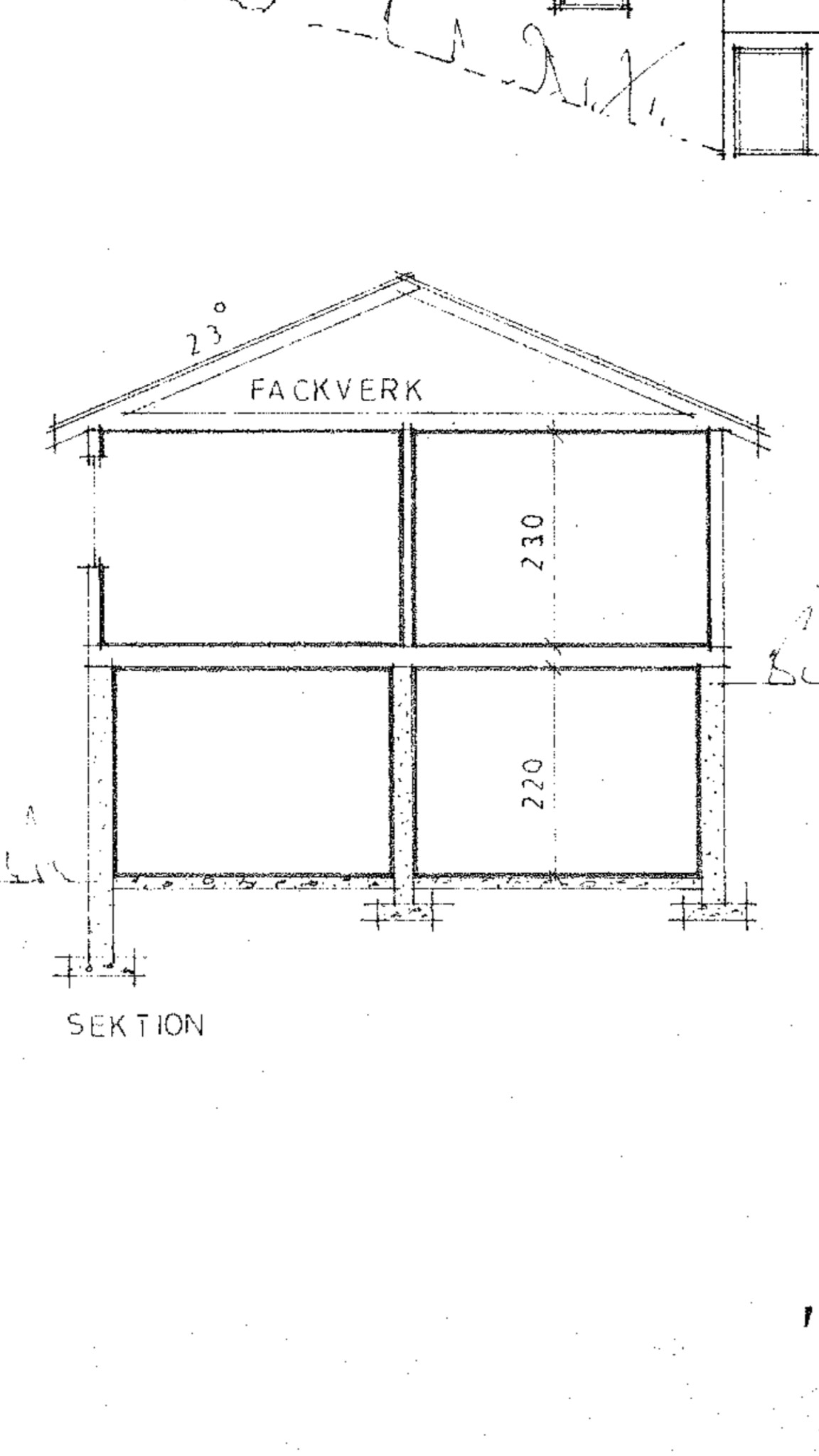
It seems like there are many skilled in construction on the forum now.
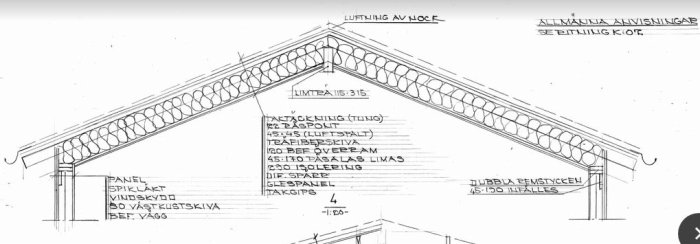
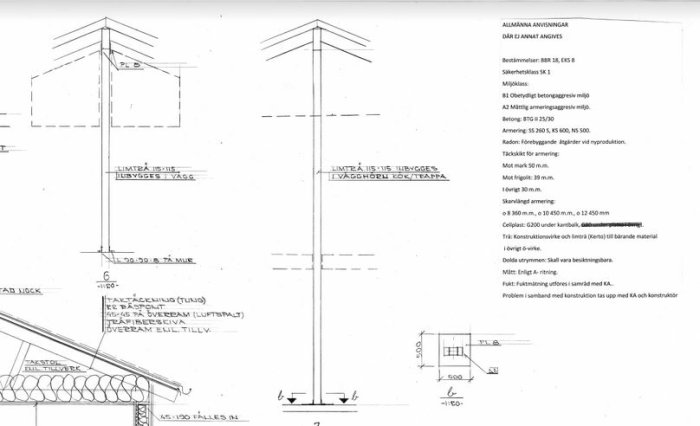
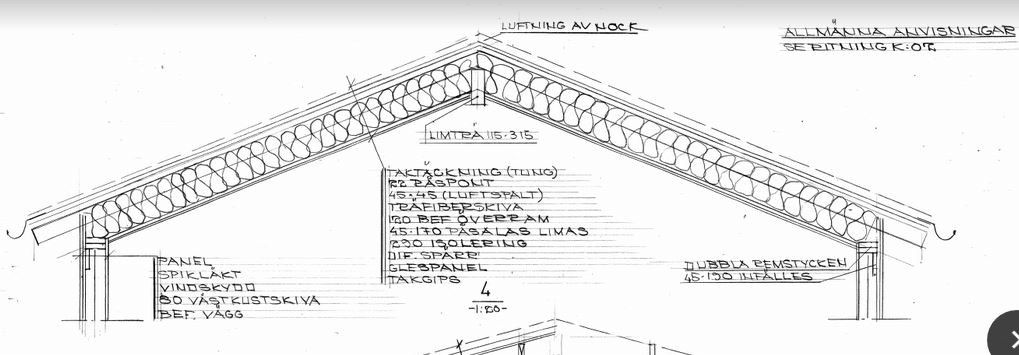
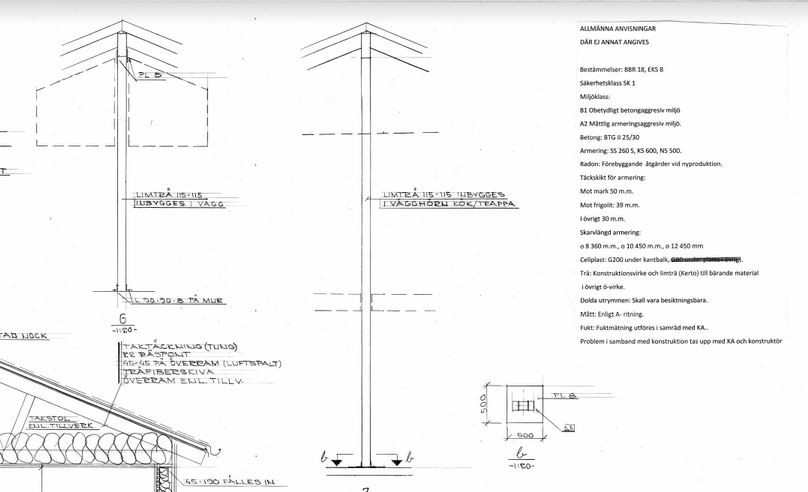
We are planning to open up to the ridge in the living room and had a consultation with a structural engineer. However, we now see that it doesn't quite work according to the drawing. This is because the glulam beam does not end up in the corner as we thought but about 10 cm into the wall where there is also a staircase. Thus, the glulam post doesn't fit and will protrude too much from the wall. Therefore, we are considering switching to steel. We contacted an engineer who couldn't take on the task but said after looking at the drawing that we could switch our 115x115 glulam to square steel. He recommended a VKR 80x80x8 (wall thickness) due to the buckling length.
He seemed to know his stuff, but since we don't have anything in writing, I just wanted to check here if you agree.
The ceiling will be about 3 m at the highest point.
Then a few bonus questions:
If someone wants to interpret what is meant by cross-section "b" as well, that would be good. We are a bit unsure of what is intended by that.
Also, the double rafters to be embedded in the facade, what is their function?
He recommended a VKR 80x80x8 (material thickness) due to the buckling length.
If you can find the balance point, you can place an SJ - Lok of 80 tons on the post without any problem.
We usually use 100x100 but only with 5 mm material, and I have it because there is over 100 tons at 4m height. So 80x80x8 is completely fine. It weighs 17.5 kg/m.
From what I can see, that profile with an 8mm thickness does not exist, the thickest is 7.1mm. http://www.e-magin.se/paper/ndrj52ff/paper/1 The capacity of this profile is 325kN in pure buckling, which I guess is fully sufficient considering it only seems to support the roof? The only thing you should ensure is that the bearing surface against the beam is at least as large as before. How long ago was the drawing made and have you filed a building notification?
Perfect, just noticed that the standard references are not current, if you were to search today
How were you thinking of fireproofing, gypsum?
Does the pillar go from the ridge all the way down to the basement?
yes, it supports the modified trusses, that is, just the roof. No, it rests on a steel beam that I believe is called an H-beam (looks like a horizontal H). This rests on a basement wall. What purpose does such a large sheet serve there? It will be suspended in the air.
we asked for the smallest possible diameter because it needs to go into the wall (45 studs and single gypsum) as much as possible, so 8 cm is better than 10
Ok, then the attached drawing is not entirely current? There it looks like the pillar goes down to the basement slab,
yes, I see that now. How strange because we don't have a basement slab but 4 cm cast floors on crushed siporex in all the rooms. The walls are continuous and stand on footing, so they are stable.
Maybe I need a new drawing anyway? How strange, we never talked about that, crossing the horizontal H-beam feels very unnecessary...
do you think one could reduce the dimension if the post becomes shorter? Otherwise, one could probably still build as the basement wall is likely just as stable as a continuous glulam beam.
Plaster builds up more than paint, so paint might be preferable. However, fireproof paint is less fine in texture and relatively sensitive to mechanical impact.
You might want to double-check with the konstruktör to avoid any misunderstandings. Isn't it 3m between the ridge and the joist or what did you mean with the question about smaller dimensions?
Vi vill skicka notiser för ämnen du bevakar och händelser som berör dig.