
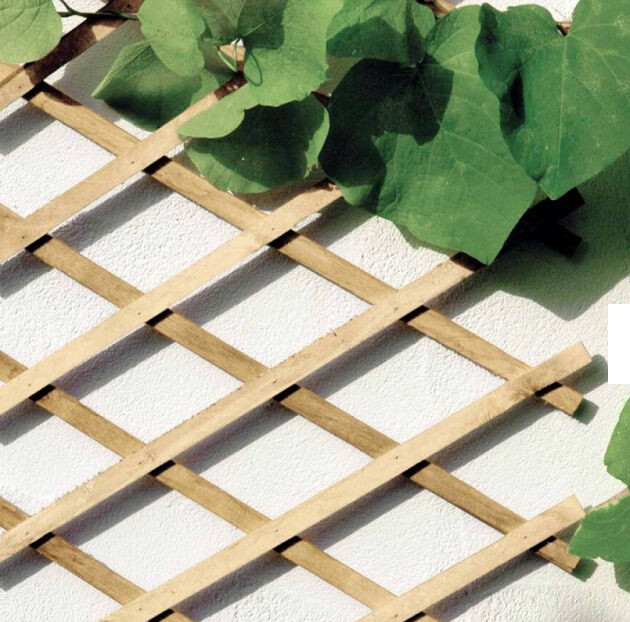
These often have a nail in each cross and are sold "folded" to take up less space in handling, so I guess you can make them with squares and then pull it to the angle you want.
I would probably take a board of some kind and set in a number of nails/screws in rows and place the first layer of slats there. Then place the next layer of slats and use a reference block to get the exact distance between the slats that are nailed on, and drive a nail through the middle of the meeting.
I would probably choose a nail that goes through both slats but doesn't go through them into the board at first, and when the whole trellis is done, lift each joint and drive the nail through to bend it slightly from the backside (turn the whole trellis), and tap the point with a hammer and "turn down the point" again.
Then the nails won't be pulled out again.
I would probably take a board of some kind and set in a number of nails/screws in rows and place the first layer of slats there. Then place the next layer of slats and use a reference block to get the exact distance between the slats that are nailed on, and drive a nail through the middle of the meeting.
I would probably choose a nail that goes through both slats but doesn't go through them into the board at first, and when the whole trellis is done, lift each joint and drive the nail through to bend it slightly from the backside (turn the whole trellis), and tap the point with a hammer and "turn down the point" again.
Then the nails won't be pulled out again.

Is the trellis intended to be mounted up and down every year? If so, it's practical to have it foldable, otherwise, it doesn't matter, just nail it where you want it in the configuration you prefer.
If a panel is unmanageable, it also works to make a couple of "katter" (spacers) to keep the same distance all the time. Cut diagonals from 45mm timber, and both directions are aligned at the same time.
Personally, I don't think it's important to achieve everything with micrometer precision. It just looks dead and lifeless, but it shouldn't be too crooked either. I would probably just start by nailing together a cross from two battens and then twist them until a decent configuration/angle/size of the trellis presents itself, and then nail on another slat parallel (by sight) to one of the others, and so on.
If a panel is unmanageable, it also works to make a couple of "katter" (spacers) to keep the same distance all the time. Cut diagonals from 45mm timber, and both directions are aligned at the same time.
Personally, I don't think it's important to achieve everything with micrometer precision. It just looks dead and lifeless, but it shouldn't be too crooked either.
I would probably just start by nailing together a cross from two battens and then twist them until a decent configuration/angle/size of the trellis presents itself, and then nail on another slat parallel (by sight) to one of the others, and so on.
Click here to reply