I made a similar thread a while ago, unfortunately, it became more about the spotlights than the building technique. Therefore, I'm making a new attempt.
I want spotlights in my ceiling, but I don't want to have to tear down the existing ceiling. Therefore, I plan to build a recessed frame, similar to this one:
The spotlights I plan to use are Malmbergs MD-350 or equivalent.
My idea is to screw up 45x45 battens in the ceiling and then cover them with plasterboard. Just like in the picture, I thought the frame should be a bit wider than deep. Maybe 20 cm wide and about 5 cm deep (45 batten + plasterboard).
What I'm wondering is if it will be difficult to attach 5 cm thin plaster strips on the side and secure them without breaking?
How would you handle the seam between the plasterboards? To make the seam as invisible as possible, I plan to place it under the frame, like this:
Would you put a paper strip underneath, or have it overlap the edge?
Or would you skip the paper strip and just fill it?
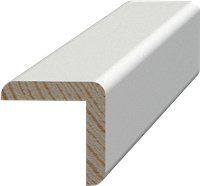
Or would you use a corner bead, like this one:
Or do you have other suggestions on how to build such a frame?
I've thought and thought but can't figure out which solution is best, so I would appreciate some help.
I have the same construction in my basement. No problems with the plasterboard if you don't cut such long strips. Insert a corner strip like the ones used in bathrooms when making corners and then spackle it before you paint.
I made something similar in my previous residence, although it wasn't a frame but an elongated kitchen and dining area where I separated the kitchen part from the dining area by changing the level (58mm) of the ceiling (I had spotlights in the lower kitchen section and planned to install a type of LED strip to indirectly illuminate the dining area, but we sold before I got the strip up).
I never tried it with plasterboard, so maybe it would have worked perfectly, but to avoid any risks, I used MDF instead.
To avoid dealing with the seam, I let the MDF have rounded edges (very small radius, just slightly rounded) and let the rounding drop below the plasterboard and applied a soft sealant in the tiny gap that remained. A picture will come in the next post (writing on the computer and taking photos with the phone), here I've exaggerated the drop a bit, it was only 1 or max 2 mm, thought it looked good, almost nicer than having a smooth edge.
If you still want it smooth, I would use metal corner protectors to have something to plaster against.
I have the same construction in my basement.. No problems with the plasterboard if you don't cut strips that are too long. Put in a corner bead like the ones used in bathrooms when making corners and then apply joint compound over it before painting.
Thickness? Well, 10 or 12 mm I would guess. I don't really remember if I cut it from a sheet or if I had a fitting piece I could cut it from (I do know I routed at least one edge, so maybe it was a regular sheet). You could check if there are suitable salningsbitar (like separate window and door frames) that can be used if you don't want to cut strips of MDF.
But as I said, I have no reason to doubt lapower's statement that it works well with plasterboard, so if you feel more comfortable with that solution, you can go for it.
now I don't know if I and lapower are thinking of the same thing but personally I would go with a "regular" corner guard, the kind you have on outer corners of walls. Like this one:
now I don't know if I and lapower are thinking of the same thing, but personally, I would use a "regular" corner protector, like the kind you have on outer corners of walls. Something like this:
[link]
/U
Ah ok, I understand. Is it difficult to plaster over something like that? Does it also prevent the edge between the plasterboards from cracking?
There are metal-reinforced paper strips that are perfect for your corners! They should be available at most hardware/paint stores.
As for the question, I don't think it's necessary; they are mostly meant to protect the corners in exposed areas of a house.
I would go with drywall all over and then just use a paper strip at the joint, placing it on the underside as comfortably as in your first example!
Click here to reply
Vi vill skicka notiser för ämnen du bevakar och händelser som berör dig.